
Chapter 9
Approaches and Landings
The rate at which the round out is executed depends on the airplane’s height above the ground, the rate of descent, and the pitch attitude. A round out started excessively high needs to be executed more slowly than one started from a lower height. The round out rate should also be proportional to the rate of closure with the ground. When the airplane appears to be descending very slowly, the increase in pitch attitude should be made at a correspondingly slow rate.
The pitch attitude of the airplane in a full-flap approach is considerably lower than in a no-flap approach. To attain the proper landing attitude before touching down, the nose needs to travel through a greater pitch change when flaps are fully extended. Since the round out is usually started at approximately the same height above the ground regardless of the degree of flaps used, the pitch attitude should be increased at a faster rate when full flaps are used. However, the round out should still be executed at a rate that takes the airplane’s downward motion into account.
Once the actual process of rounding out is started, the pilot should not push the elevator control forward. If too much back-elevator pressure was exerted, this pressure is either slightly relaxed or held constant, depending on the degree of the error. In some cases, it may be necessary to advance the throttle slightly to prevent an excessive rate of sink or a stall, either of which results in a hard, drop-in type landing.
It is recommended that a pilot form the habit of keeping one hand on the throttle throughout the approach and landing should a sudden and unexpected hazardous situation require an immediate application of power.
Touchdown
The touchdown is the gentle settling of the airplane onto the landing surface. The round out and touchdown are normally made with the engine idling. During the round out, the airspeed decays such that the airplane touches down on the main gear at or just above the approximate stalling speed. As the airplane settles, proper landing attitude is attained by application of whatever back-elevator pressure is necessary.
Some pilots try to force or fly the airplane onto the ground without establishing proper landing attitude. The airplane should never be flown onto the runway with excessive speed. A common technique to making a smooth touchdown is to actually focus on holding the wheels of the aircraft a few inches off the ground as long as possible using the elevators while the power is smoothly reduced to idle. In most cases, when the wheels are within 2 or 3 feet of the ground, the airplane is still settling too fast for a gentle touchdown. Therefore, this descent is retarded by increasing back-elevator pressure. Since the airplane is already close to its stalling speed and is settling, this added back-elevator pressure only slows the settling instead of stopping it. At the same time, it results in the airplane touching the ground in the proper landing attitude and the main wheels touching down first so that little or no weight is on the nose-wheel. [Figure 9-11]
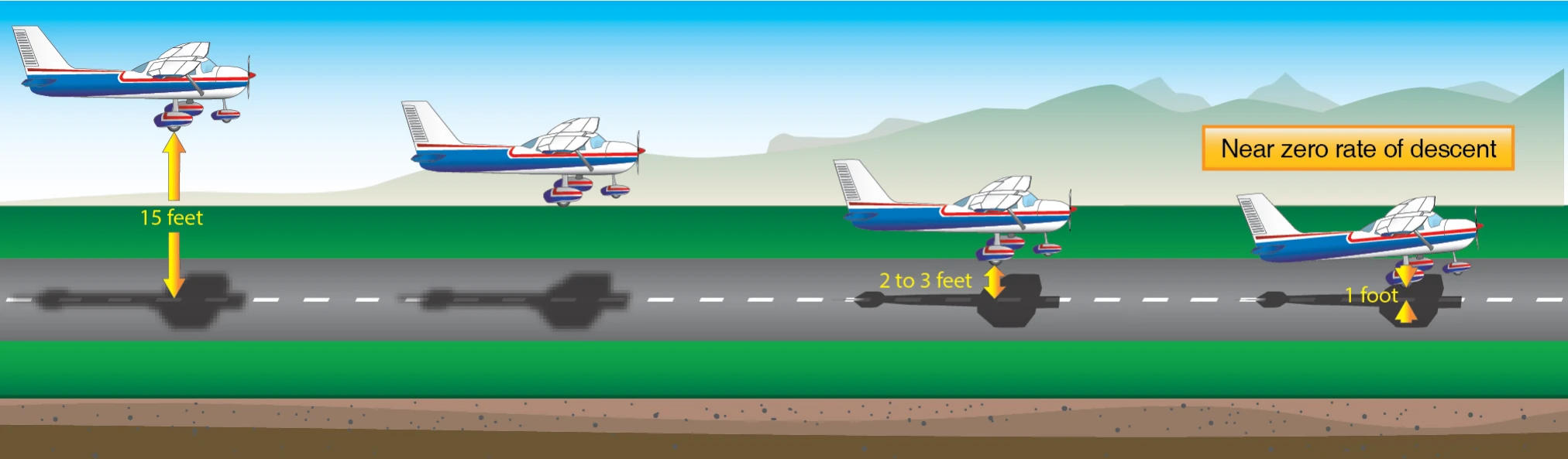
After the main wheels make initial contact with the ground, back-elevator pressure is held to maintain a positive AOA for aerodynamic braking and to hold the nose-wheel off the ground as the airplane decelerates. The pilot should be certain not to inadvertently have brake pressure engaged as touchdown occurs. Early use of brakes can result in a sudden drop in the nose and a loss of aerodynamic braking. As the airplane’s momentum decreases, back-elevator pressure is gradually relaxed to allow the nose-wheel to gently settle onto the runway. This permits steering if the airplane has a steerable nose-wheel. At the same time, it decreases the AOA and reduces lift on the wings to prevent floating or skipping and allows the full weight of the airplane to rest on the wheels for better mechanical braking action. As the airplane slows, the mechanical braking becomes more effective.
It is extremely important that the touchdown occur with the airplane’s longitudinal axis exactly parallel to the direction in which the airplane is moving along the runway. Failure to accomplish this imposes severe side loads on the landing gear. To avoid these side stresses, the pilot should not allow the airplane to touch down while turned into the wind or drifting.
After-Landing Roll
The landing process should never be considered complete until the airplane decelerates to the normal taxi speed during the landing roll or has been brought to a complete stop when clear of the landing area. Accidents may occur as a result of pilots abandoning their vigilance and failing to maintain positive control after getting the airplane on the ground.
A pilot should be alert for directional control difficulties immediately upon and after touchdown due to the ground friction on the wheels. Loss of directional control may lead to an aggravated, uncontrolled, tight turn on the ground, or a ground loop. The combination of centrifugal force acting on the center of gravity (CG) and ground friction of the main wheels resisting it during the ground loop may cause the airplane to tip or lean enough for the outside wingtip to contact the ground. This imposes a sideward force that could collapse the landing gear.
The rudder serves the same purpose on the ground as it does in the air—it controls the yawing of the airplane. The effectiveness of the rudder is dependent on the airflow, which depends on the speed of the airplane. As the speed decreases and the nose-wheel has been lowered to the ground, the steerable nose provides more positive directional control.
The brakes of an airplane serve the same primary purpose as the brakes of an automobile—to reduce speed on the ground. In airplanes, they are also used as an aid in directional control when more positive control is required than could be obtained with rudder or nose-wheel steering alone.
To use brakes, on an airplane equipped with toe brakes, the pilot slides the toes or feet up from the rudder pedals to the brake pedals. If rudder pressure is being held at the time braking action is needed, the pilot should not release that pressure as the feet or toes are being slid up to the brake pedals because control may be lost before brakes can be applied.
Putting maximum weight on the wheels after touchdown is an important factor in obtaining optimum braking performance. During the early part of rollout, some lift continues to be generated by the wing. After touchdown, the nose-wheel is lowered to the runway to maintain directional control. During deceleration, applying brakes may cause the nose to pitch down and some weight to transfer to the nose-wheel from the main wheels. This does not aid in braking action, so back pressure is applied to the controls without lifting the nose-wheel off the runway. This enables directional control while keeping weight on the main wheels.
Careful application of the brakes is initiated after the nose-wheel is on the ground and directional control is established. Maximum brake effectiveness is just short of the point where skidding occurs. If the brakes are applied so hard that skidding takes place, braking becomes ineffective. Skidding is stopped by releasing the brake pressure. Braking effectiveness is not enhanced by alternately applying, releasing, and reapplying brake pressure. The brakes are applied firmly and smoothly as necessary.
During the ground roll, the airplane’s direction of movement can be changed by carefully applying pressure on one brake or uneven pressures on each brake in the desired direction. Caution must be exercised when applying brakes to avoid over-controlling.
The ailerons serve the same purpose on the ground as they do in the air—they change the lift and drag components of the wings. During the after-landing roll, they are used to keep the wings level in much the same way they are used in flight. If a wing starts to rise, aileron control is applied toward that wing to lower it. The amount required depends on speed because as the forward speed of the airplane decreases, the ailerons become less effective. Procedures for using ailerons in crosswind conditions are explained in the “Crosswind Approach and Landing” section of this chapter.