
Chapter 1
Risk Management and Single-Pilot Resource Management
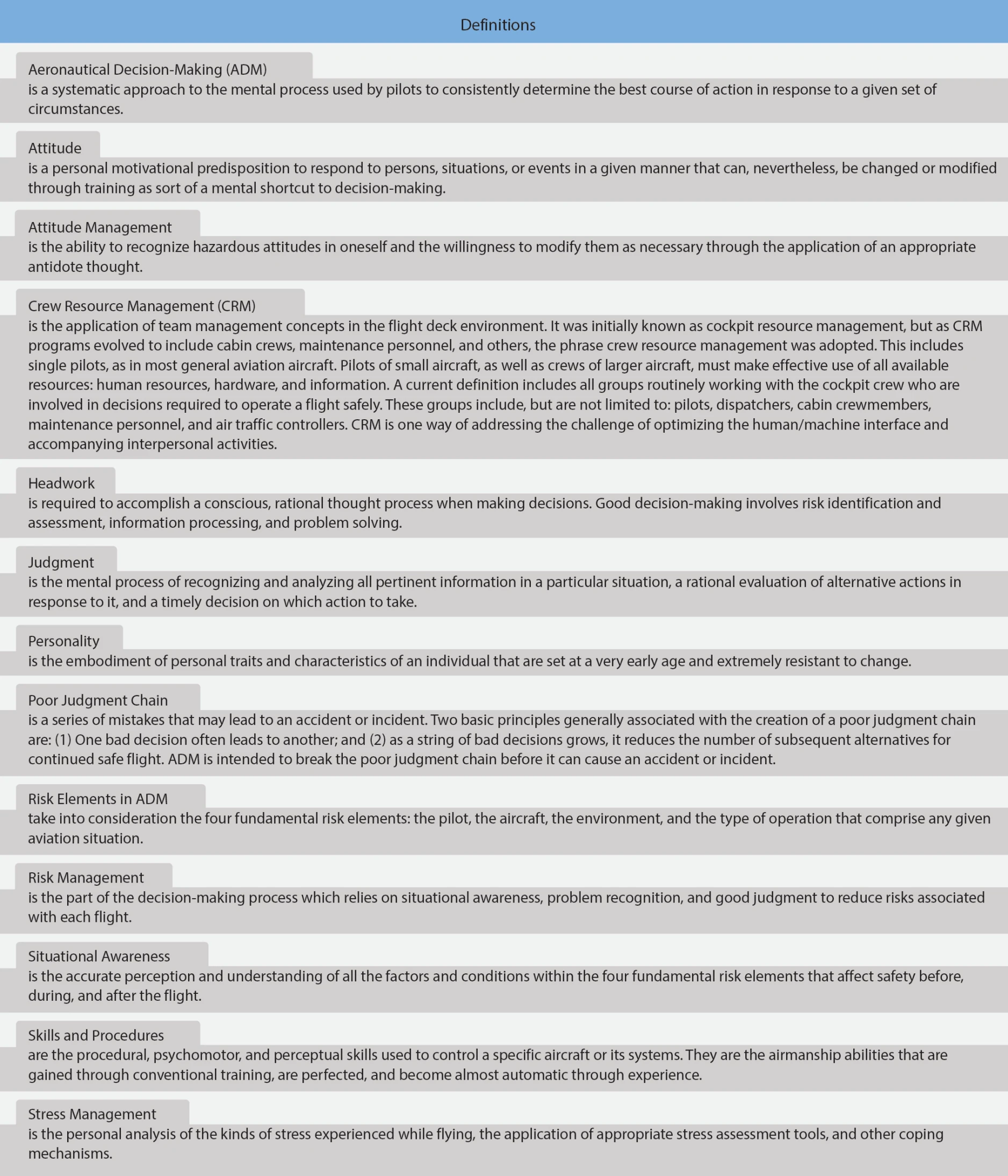
An understanding of the decision-making process provides learners with a foundation for developing ADM skills. Some situations, such as engine failures, require a pilot to respond immediately using established procedures with little time for detailed analysis. Traditionally, pilots have been well trained to react to emergencies but are not as well prepared to make decisions, which require a more reflective response. Typically during a flight, the pilot has time to examine any changes that occur, gather information, and assess risk before reaching a decision. The steps leading to this conclusion constitute the decision-making process. When the decision-making process is presented to learners it is essential to discuss how the process applies to an actual flight situation. To explain the decision-making process, the instructor can introduce the following steps with the accompanying scenario that places the learners in the position of making a decision about a typical flight situation.
Defining the Problem
The first step in the decision-making process is to define the problem. This begins with recognizing that a change has occurred or that an expected change did not occur. A problem is perceived first by the senses, and then is distinguished through insight and experience. These same abilities, as well as an objective analysis of all available information, are used to determine the exact nature and severity of the problem.
One critical error that can be made during the decision-making process is incorrectly defining the problem. For example, failure of a landing-gear-extended light to illuminate could indicate that the gear is not down and locked into place or it could mean the bulb is burned out. The actions to be taken in each of these circumstances would be significantly different. Fixating on a problem that does not exist can divert the pilot’s attention from important tasks. The pilot’s failure to maintain an awareness of the circumstances regarding the flight now becomes the problem. This is why once an initial assumption is made regarding the problem, other sources should be used to verify that the pilot’s conclusion is correct.
While on a cross-country flight, Brenda discovers her time en route between two checkpoints is significantly longer than the time she originally calculated. By noticing this discrepancy, she has recognized a change. Based on insight, cross-country flying experience, and knowledge of weather systems, she considers the possibility that she has an increased headwind. She verifies that the original calculations are correct and considers factors that may have lengthened the time between checkpoints, such as a climb or deviation off course. To determine if there is a change in the winds aloft forecast and to check recent pilot reports, she contacts Flight Service. After weighing each information source, she concludes that the headwind has increased. To determine the severity of the problem, she calculates a new groundspeed and reassesses fuel requirements.
Choosing a Course of Action
After the problem has been identified, the pilot evaluates the need to react to it and determines the actions that may be taken to resolve the situation in the time available. The expected outcome of each possible action should be considered, and the risks assessed before the pilot decides on a response to the situation.
Brenda determines the fuel burn if she continues to her destination and considers other options: turning around and landing at a nearby airport, diverting off course, or landing prior to her destination at an airport en route. She considers the expected outcome of each possible action and assesses the risks involved. After studying the chart, she concludes an airport with fueling services is within a reasonable distance along her route. She can refuel there and continue to her destination without a significant loss of time.
Implementing the Decision and Evaluating the Outcome
Although a decision may be reached and a course of action implemented, the decision-making process is not complete. It is important to think ahead and determine how the decision could affect other phases of the flight. As the flight progresses, the pilot should continue to evaluate the outcome of the decision to ensure that it is producing the desired result.
To implement her decision, Brenda plots the course changes and calculates a new estimated time of arrival. She also amends her flight plan and checks weather conditions at the new destination. As she proceeds to the airport, she continues to monitor groundspeed, aircraft performance, and weather conditions to ensure no additional steps need to be taken to guarantee the safety of the flight.
Factors Affecting Decision-Making
It is important to stress to a learner that being familiar with the decision-making process does not ensure he or she has the good judgment to be a safe pilot. The ability to make effective decisions as PIC depends on a number of factors. Some circumstances, such as the time available to make a decision, may be beyond the pilot’s control. However, a pilot can learn to recognize those factors that can be managed, and learn skills to improve decision-making ability and judgment.
Recognizing Hazardous Attitudes
While the ADM process does not eliminate errors, it helps the pilot recognize errors, and in turn enables the pilot to manage any errors to minimize their effects. In addition, two steps to improve flight safety are identifying personal attitudes hazardous to safe flight and learning behavior modification techniques.
Flight instructors should be able to spot hazardous attitudes in a learner because recognition of hazardous thoughts is the first step toward neutralizing them. Flight instructors should keep in mind that being fit to fly depends on more than just a pilot’s physical condition and recency of experience. Hazardous attitudes contribute to poor pilot judgment and affect the quality of decisions.
Attitude can be defined as a personal motivational predisposition to respond to persons, situations, or events in a given manner. Studies have identified five hazardous attitudes that can affect a pilot’s ability to make sound decisions and exercise authority properly. [Figure 1-11]
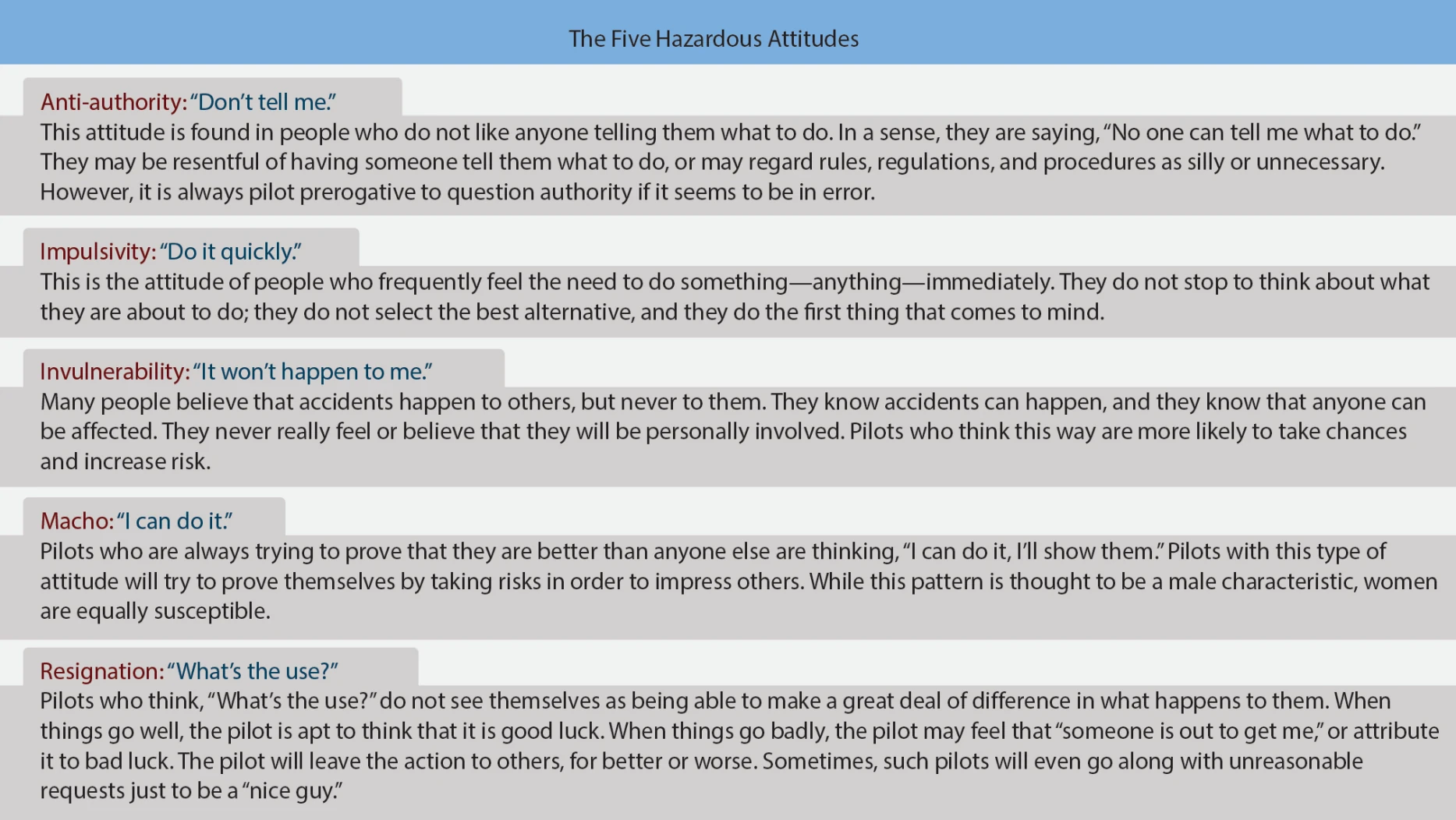
In order for a learner to self-examine behaviors during flight, the learner should be taught the potential risks caused from hazardous attitudes and, more importantly, the antidote for each. [Figure 1-12] For example, if a learner has an easy time with flight training and seems to understand things very quickly, there may be a potential for that learner to develop a hazardous attitude regarding their ability. A successful flight instructor points out the potential for the behavior and teaches the learner the antidote for that attitude. Hazardous attitudes need to be noticed immediately and corrected with the proper antidote to minimize the potential for any flight hazard.