
Chapter 1
Risk Management and Single-Pilot Resource Management
Stress Management
Learning how to recognize and cope with stress is another effective ADM tool. Stress is the body’s response to demands placed upon it. These demands can be either pleasant or unpleasant in nature. The causes of stress for a pilot can range from unexpected weather or mechanical problems while in flight to personal issues unrelated to flying. Stress is an inevitable and necessary part of life; it adds motivation and heightens an individual’s response to meet any challenge.
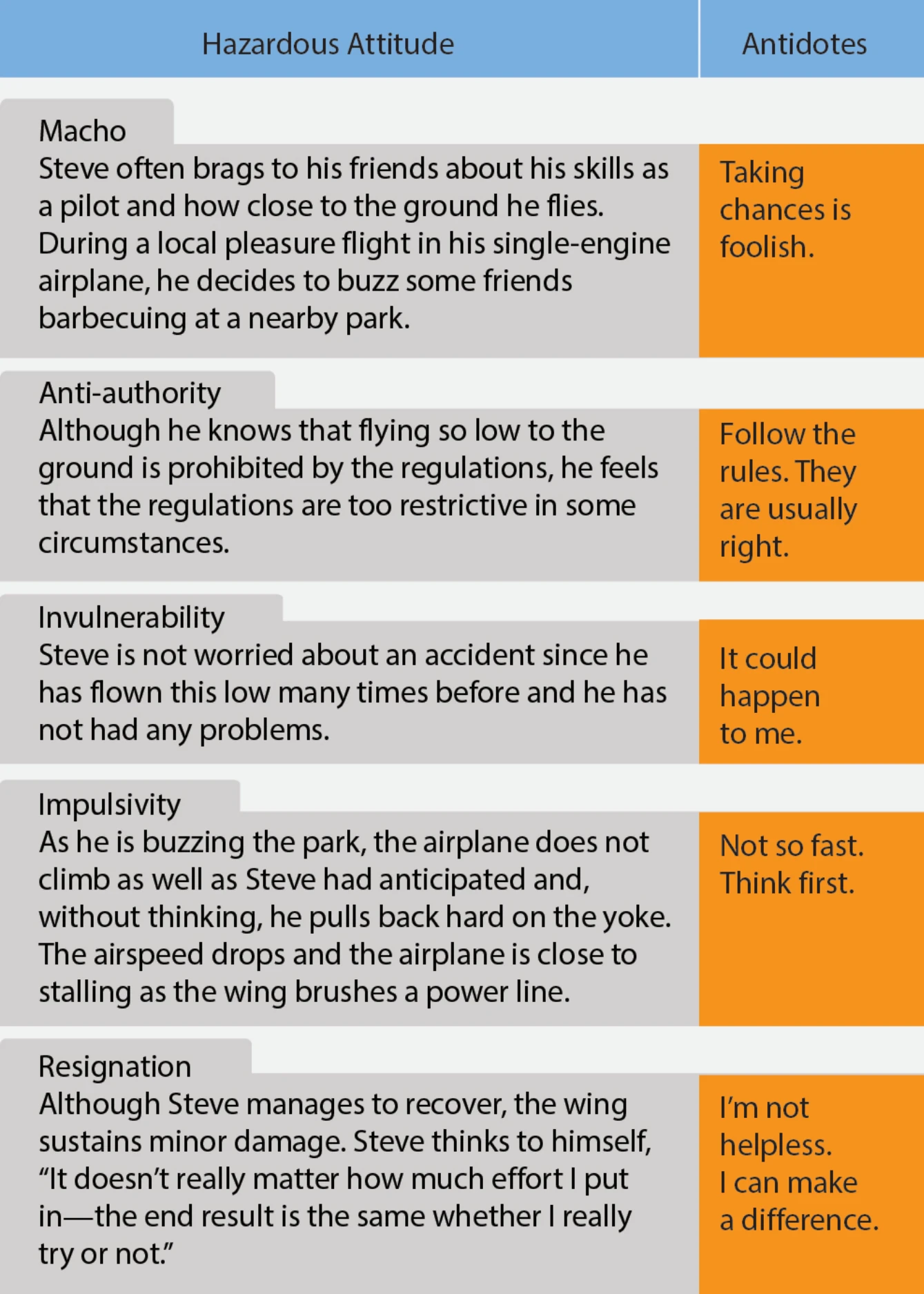
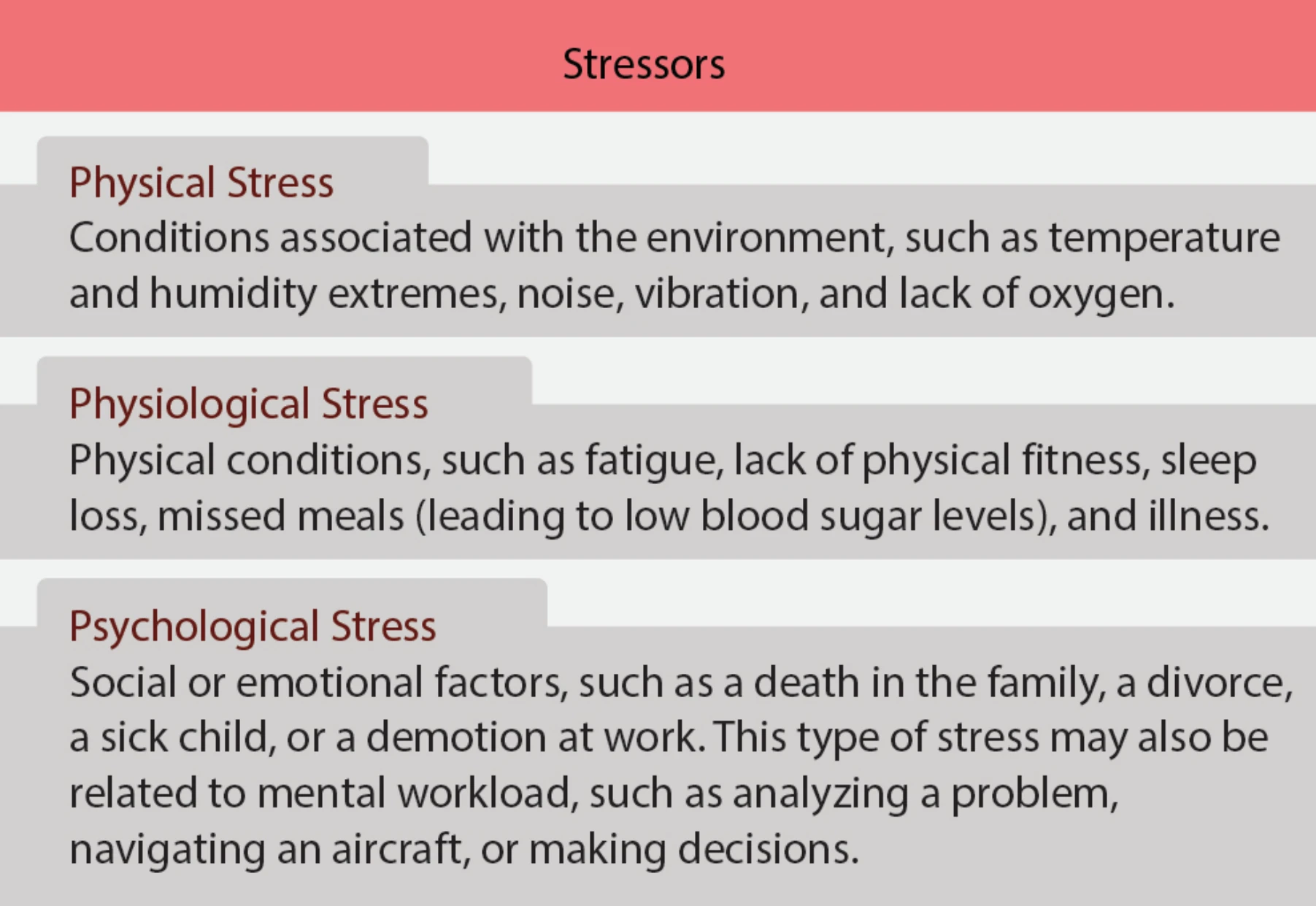
Everyone is stressed to some degree all the time. A certain amount of stress is good since it keeps a person alert and prevents complacency. However, the effects of stress are cumulative and, if not coped with adequately, they eventually add up to an intolerable burden. Performance generally increases with the onset of stress, peaks, and then begins to fall off rapidly as stress levels exceed a person’s ability to cope. The ability to make effective decisions during flight can be impaired by stress. Factors, referred to as stressors, can increase a pilot’s risk of error in the flight deck. [Figure 1-13]
One way of exploring the subject of stress with a learner is to recognize when stress is affecting performance. If a learner seems distracted, or has a particularly difficult time accomplishing the tasks of the lesson, the instructor can query the learner. Was the learner uncomfortable or tired during the flight? Is there some stress in another aspect of the learner’s life that may be causing a distraction? This may prompt the learner to evaluate how these factors affect performance and judgment. The instructor should also try to determine if there are aspects of pilot training that are causing excessive amounts of stress for the learner. For example, if the learner consistently makes a decision not to fly, even though weather briefings indicate favorable conditions, it may be due to apprehension regarding the lesson content. Stalls, landings, or an impending solo flight may cause concern. By explaining a specific maneuver in greater detail or offering some additional encouragement, the instructor may be able to alleviate some of the learner’s stress.
To help learners manage the accumulation of life stresses and prevent stress overload, instructors can recommend several techniques. For example, including relaxation time in a busy schedule and maintaining a program of physical fitness can help reduce stress levels. Learning to manage time more effectively can help pilots avoid heavy pressures imposed by getting behind schedule and not meeting deadlines. While these pressures may exist in the workplace, learners may also experience the same type of stress regarding their flight training schedule. Instructors can advise learners to self-assess to determine their capabilities and limitations and then set realistic goals. In addition, avoiding stressful situations and encounters can help pilots cope with stress.
Use of Resources
To make informed decisions during flight operations, learners should be familiar with the resources found both inside and outside the flight deck. Since useful tools and sources of information may not always be readily apparent, learning to recognize these resources is an essential part of ADM training. Resources should not only be identified, but learners should also develop the skills to evaluate whether they have the time to use a particular resource and the impact that its use would have upon the safety of flight. For example, the assistance of ATC may be very useful if a pilot is lost. However, in an emergency situation when action needs be taken quickly, time may not be available to contact ATC immediately. During training, flight instructors can routinely point out resources to learners.
Internal Resources
Internal resources are found in the flight deck during flight. However, some of the most valuable internal resources include ingenuity, knowledge, and skill. Pilots can enhance flight deck resources by improving their own capabilities. This can be accomplished by pursuing additional training and by frequently reviewing flight information publications including the Aeronautical Information Manual (AIM), instruction manuals for on board equipment, and safety journals.
With the advent of advanced avionics with glass displays, GPS, and autopilot, flying has become more complex. Avionics and automation systems are valuable resources, and flight instructors should teach learners how to use this equipment properly. If learners do not fully understand how to use the equipment, or if they rely on it so much that they become complacent, it can become a detriment to safe flight.
Checklists are essential flight deck resources for verifying that the aircraft instruments and systems are checked, set, and operating properly, as well as ensuring that the proper procedures are performed if there is a system malfunction or inflight emergency. Learners reluctant to use checklists can be reminded that pilots at all levels of experience refer to checklists, and that the more advanced the aircraft is, the more crucial checklists become. With the advent of electronic checklists, it has become easier to develop and maintain personal checklists from the manufacturer’s checklist with additions for specific aircraft and operations.
In addition, the AFM/POH, which is required to be carried onboard the aircraft, is essential for accurate flight planning and for resolving inflight equipment malfunctions. Other valuable flight deck resources include current aeronautical charts and publications, such as the Chart Supplement (CS).
It should be pointed out to learners that passengers can also be a valuable resource. Passengers can help watch for traffic and may be able to provide information in an irregular situation, especially if they are familiar with flying. A strange smell or sound may alert a passenger to a potential problem. The PIC should brief passengers before the flight to make sure that they are comfortable voicing any concerns.
External Resources
Possibly the greatest external resources during flight are air traffic controllers. ATC can help decrease pilot workload by providing traffic advisories, radar vectors, and assistance in emergency situations. When learners use ATC during training, they develop the confidence to ask controllers to clarify instructions and to use ATC as a resource for assistance in unusual circumstances or emergencies. Fight Service specialists can provide updates on weather, answer questions about airport conditions, and may offer direction-finding assistance on frequencies used for flight plan communications. These services can be invaluable in enabling pilots to make informed inflight decisions.
Throughout training, learners can be asked to identify internal and external resources, which can be used in a variety of flight situations. For example, if a discrepancy is found during preflight, what resources can be used to determine its significance? In this case, the learner’s knowledge of the aircraft, the POH, an instructor or other experienced pilot, or an AMT can be a resource which may help define the problem. During cross-country training, learners may be asked to consider the following situation. On a cross-country flight, you become disoriented. Although you are familiar with the area, you do not recognize any landmarks, and fuel is running low. What resources do you have to assist you? Learners should be able to identify their own skills and knowledge, aeronautical charts, ATC, Flight Service, and navigation equipment as some of the resources that can be used in this situation.
Workload Management
Effective workload management ensures that essential operations are accomplished by planning, prioritizing, and sequencing tasks to avoid work overload. As experience is gained, a pilot learns to recognize future workload requirements and can prepare for high workload periods during times of low workload. Instructors can teach this skill by prompting their learners to prepare for a high workload. For example, when en route, the learner can be asked to explain the actions that need to be taken during the approach to the airport. The learner should be able to describe the procedures for traffic pattern entry and landing preparation. Reviewing the appropriate chart and setting radio frequencies well in advance of need helps reduce workload as the flight nears the airport. In addition, the learner should listen to the Automatic Terminal Information Service (ATIS), Automated Surface Observing Systems (ASOS), or Automated Weather Observing System (AWOS), if available, and then monitor the tower frequency or Common Traffic Advisory Frequency (CTAF) to get a good idea of what traffic conditions to expect. Checklists should be performed well in advance so there is time to focus on traffic and ATC instructions. These procedures are especially important prior to entering a high-density traffic area, such as Class B airspace.