
Chapter 1
Risk Management and Single-Pilot Resource Management
To manage workload, items should be prioritized. This concept should be emphasized to learners and reinforced when training procedures are performed. For example, during a go-around, adding power, gaining airspeed, and properly configuring the aircraft are priorities. Informing the tower of the balked landing should be accomplished only after these tasks are completed. learners should understand that priorities change as the situation changes. If fuel quantity is lower than expected on a cross-country flight, the priority can shift from making a scheduled arrival time at the destination, to locating a nearby airport to refuel. In an emergency situation, the first priority is to fly the aircraft and maintain a safe airspeed.
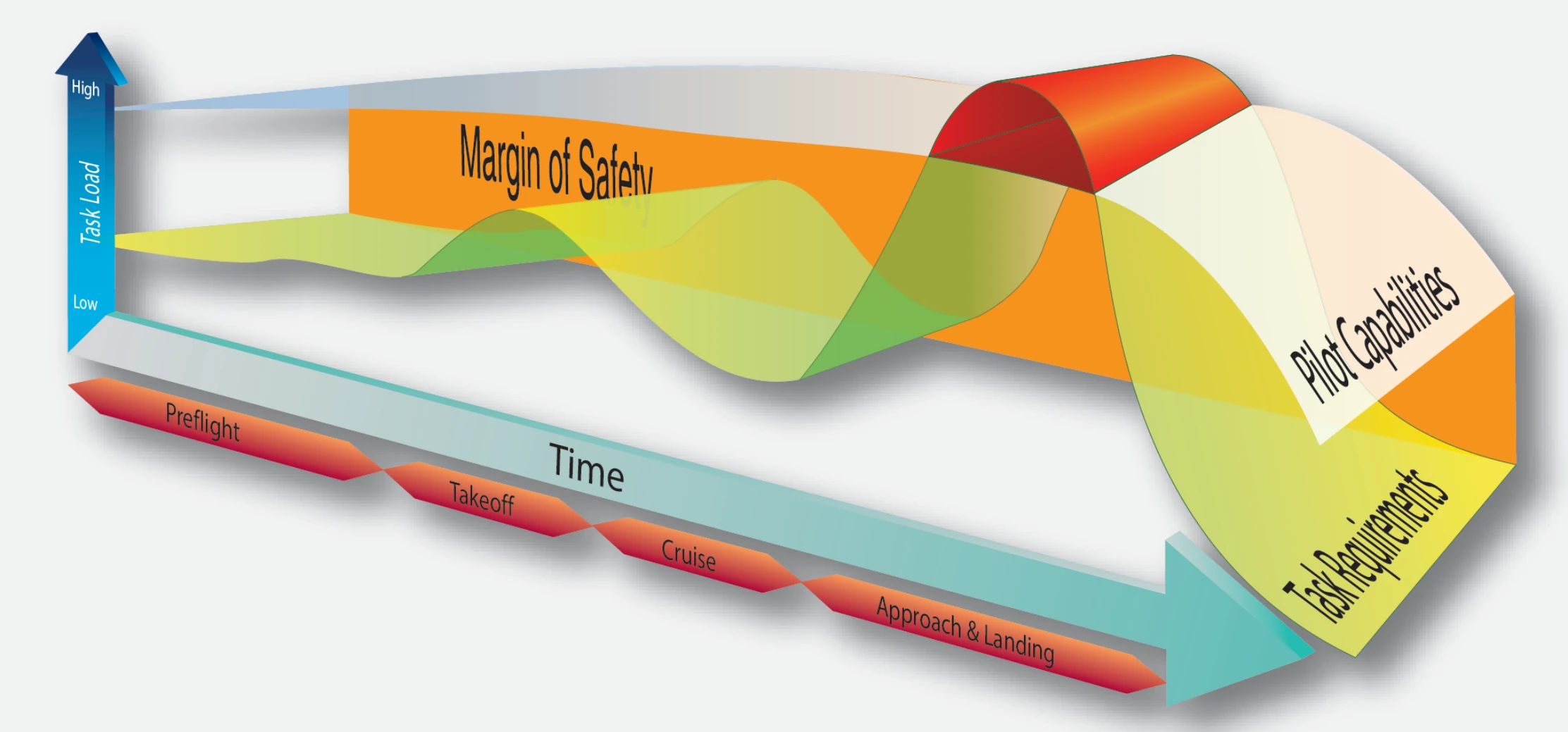
Another important part of managing workload is recognizing a work overload situation. The first effect of high workload is that the pilot begins to work faster. As workload increases, attention cannot be devoted to several tasks at one time, and the pilot may begin to focus on one item. When the pilot becomes task saturated, there is no awareness of inputs from various sources; decisions may be made on incomplete information, and the possibility of error increases. [Figure 1-14] During a lesson, workload can be gradually increased as the instructor monitors the learner’s management of tasks. The instructor should ensure that the learner has the ability to recognize a work overload situation. When becoming overloaded, the learner should stop, think, slow down, and prioritize. It is important that the learner understand options that may be available to decrease workload. For example, locating an item on a chart or setting a radio frequency may be delegated to another pilot or passenger, an autopilot (if available) may be used, or ATC may be enlisted to provide assistance.
Teaching Decision-Making Skills
When instructor pilots discuss system safety, they generally worry about the loss of traditional stick-and-rudder skills. The fear is that emphasis on items such as risk management, ADM, SRM, and situational awareness detracts from the training necessary in developing safe pilots.
It is important to understand that system safety flight training occurs in three phases. First, there are the traditional stick and rudder maneuvers. In order to apply the critical thinking skills that are to follow, pilots should develop a high degree of confidence in their ability to fly the aircraft. Next, the tenets of system safety are introduced into the training environment as learners begin to understand how best to identify hazards, manage risk, and use all available resources to make each flight as safe as possible. This can be accomplished through scenarios that emphasize the skill sets being taught. Finally, the learner may be introduced to more complex scenarios that focus on several safety-of-flight issues. Thus, scenarios should start out rather simply, then progress in complexity and intensity as the learner becomes able to handle the increased workload.
A traditional stick-and-rudder maneuver such as short field landings can be used to illustrate how ADM and risk management can be incorporated into instruction. In phase l the initial focus is on developing the stick-and-rudder skills required to execute this operation safely. These include power and airspeed management, aircraft configuration, placement in the pattern, wind correction, determining the proper aim point and sight picture, etc. By emphasizing these points through repetition and practice, a learner eventually acquires the skills needed to execute a short field landing.
Phase II introduces the many factors that come into play when performing a short field landing, which include runway conditions, no-flap landings, airport obstructions, and rejected landings. The introduction of such items need not increase training times. In fact, all of the hazards or considerations referenced in the short field landing lesson plan may be discussed in detail during the ground portion of the instructional program. For example, if training has been conducted at an airport that enjoys an obstruction-free 6,000-foot runway, consider the implications of operating the same aircraft out of a 1,800-foot strip with an obstruction off the departure end. Add to that additional considerations, such as operating the aircraft at close to its maximum gross weight under conditions of high density altitude, and now a single training scenario has several layers of complexity. The ensuing discussion proves a valuable training exercise, and it comes with little additional ground and no added flight training.
Finally, phase III takes the previously discussed hazards, risks, and considerations, and incorporates them into a complex scenario. This forces a learner to consider not only a specific lesson item (in this case, short-field landings), but also requires that it be viewed in the greater context of the overall flight. For example, on a cross-country flight, the learner is presented with a realistic distraction, perhaps the illness of a passenger. This forces a diversion to an alternate for which the learner has not planned. The new destination airport has two runways, the longest of which is closed due to construction. The remaining runway is short, but while less than ideal, should prove suitable for landing. However, upon entering the pattern, the learner finds the electrically driven flaps do not extend. The learner should now consider whether to press on and attempt the landing or proceed to a secondary alternate.
If he or she decides to go forward and attempt the landing, this proves an excellent time to test the requisite stick and rudder skills. If the learner decides to proceed to a second alternate, this opens new training opportunities. Proceeding further tests cross-country skills, such as navigation, communication, management of a passenger in distress, as well as the other tasks associated with simply flying the aircraft. The outlined methodology simply takes a series of seemingly unrelated tasks and scripts them into a training exercise requiring both mechanical and cognitive skills to complete it successfully.
Scenario-based training (SBT) helps the flight instructor effectively teach ADM and risk management. The what, why, and how of SBT will be discussed extensively throughout this handbook. In teaching ADM, it is important to remember the learning objective is for the learner to exercise sound judgment and make good decisions. Thus, the flight instructor should be ready to turn the responsibility for planning and execution of the flight over to the learner as soon as possible. Although the flight instructor continues to demonstrate and instruct skill maneuvers, when the learner begins to make decisions, the flight instructor should revert to the role of mentor and/or learning facilitator.
The flight instructor is an integral part of the systems approach to training and is crucial to the implementation of an SBT program, which underlies the teaching of ADM. Remember, for SBT instruction to be effective, it is vital the flight instructor and learner establish the following information:
- Scenario destination(s)
- Desired learning outcome(s)
- Desired level of learner performance
- Possible inflight scenario changes
It is also important for the flight instructor to remember that a good scenario:
- Is not a test.
- Will not have a single correct answer.
- Does not offer an obvious answer.
- Engages all three learning domains.
- Is interactive.
- Should not promote errors.
- Should promote situational awareness and opportunities for decision-making.
- Requires time-pressured decisions.
The flight instructor should make the situation as realistic as possible. This means the learner knows where he or she is going and what transpires on the flight. While the actual flight may deviate from the original plan, it allows the learner to be placed in a realistic scenario. The learner should plan the flight to include:
- Route
- Destination(s)
- Weather
- NOTAMS
- Possible emergency procedures
Since the scenarios may have several good outcomes and a few poor ones, the flight instructor should understand in advance which outcomes are positive and/or negative and give the learner the freedom to make both good and poor decisions. This does not mean that the learner should be allowed to make an unsafe decision or commit an unsafe act. However, it does allow the learners to make decisions that fit their experience level and result in positive outcomes.
Teaching decision-making skills has become an integral part of flight training. The word “decision” is used several times in each ACS and applicants are judged on their ability to make a decision as well as their ability to perform a task. Thus, it is important for flight instructors to remember that decision-making is a component of the ACS.