
Chapter 1
Risk Management and Single-Pilot Resource Management
AMTs should learn about risk management early in training. Instructors tasked with integrating risk management into instruction can turn to hazard assessments that identify the safety risks associated with the facility being used, the tools used in the procedure, and/or the job being performed.
The process for identifying hazards can be accomplished through the use of checklists, lessons learned, compliance inspections/audits, accidents/near misses, regulatory developments, and brainstorming sessions. For example, aviation accident reports from the National Transportation Safety Board (NTSB) can be used to generate discussions pertaining to faulty maintenance that led to aircraft accidents. All available sources should be used for identifying, characterizing, and controlling safety risks.
The 3P model can also be adapted for use in a nonflight environment, such as a maintenance facility. For example, the AMT perceives a hazard, processes its impact on shop or personnel safety, and then performs by implementing the best course of action to mitigate the perceived risk.
Pilot Self-Assessment
Setting personal minimums is an important step in mitigating risk, and safe pilots know how to properly self-assess. For example, in the opening scenario, the aircraft Mary plans to fly may have a maximum crosswind component of 15 knots listed in the aircraft flight manual (AFM), but she only has experience with 10 knots of direct crosswind. It could be unsafe to exceed a 10 knot-crosswind component without additional training. Therefore, the 10 knot-crosswind experience level should be Mary’s personal limitation until additional training with Daniel provides her with additional experience for flying in crosswinds that exceed 10 knots.
Pilots in training should be taught that exercising good judgment begins prior to taking the controls of an aircraft. Often, pilots thoroughly check their aircraft to determine airworthiness, yet do not evaluate their own fitness for flight. Just as a checklist is used when preflighting an aircraft, a personal checklist based on such factors as experience, currency, and comfort level can help determine if a pilot is prepared for a particular flight. The FAA’s “Personal Minimums Checklist” located in Appendix D is an excellent tool for pilots to use in self-assessment. This checklist reflects the PAVE approach to risk mitigation discussed in the previous paragraphs.
Worksheets for a more in-depth risk assessment are located in the “FAA/Industry Training Standards Personal and Weather Risk Assessment Guide” located online at www.faa.gov. This guide is designed to assist pilots in developing personal standardized procedures for accomplishing PIC responsibilities and in making better preflight and inflight weather decisions. Flight instructors should stress that frequent review of the personal guide keeps the information fresh and increases a pilot’s ability to recognize the conditions in which a new risk assessment should be made, a key element in the decision-making process. ([source link](https://www.faa.gov))
Situational Awareness
Situational awareness is the accurate perception and understanding of all the factors and conditions within the four fundamental risk elements that affect safety before, during, and after the flight. Maintaining situational awareness requires an understanding of the relative significance of these factors and their future impact on the flight. When situationally aware, the pilot has an overview of the total operation and is not fixated on one perceived significant factor. Some of the elements inside the aircraft to be considered are the status of aircraft systems, pilot, and passengers. In addition, an awareness of the environmental conditions of the flight, such as spatial orientation of the aircraft and its relationship to terrain, traffic, weather, and airspace should be maintained.
To maintain situational awareness, all of the skills involved in ADM are used. For example, an accurate perception of the pilot’s fitness can be achieved through self-assessment and recognition of hazardous attitudes. A clear assessment of the status of navigation equipment can be obtained through workload management and establishing a productive relationship with ATC can be accomplished by effective resource use.
Obstacles to Maintaining Situational Awareness
Many obstacles exist that can interfere with a pilot’s ability to maintain situational awareness. For example, fatigue, stress, or work overload can cause the pilot to fixate on a single perceived important item rather than maintaining an overall awareness of the flight situation. A contributing factor in many accidents is a distraction, which diverts the pilot’s attention from monitoring the instruments or scanning outside the aircraft. Many flight deck distractions begin as a minor problem, such as a gauge that is not reading correctly, but result in accidents as the pilot diverts attention to the perceived problem and neglects to properly control the aircraft.
Fatigue, discussed as an obstacle to learning, is also an obstacle to maintaining situational awareness. It is a threat to aviation safety because it impairs alertness and performance. [Figure 1-6] The term is used to describe a range of experiences from sleepy, or tired, to exhausted. Two major physiological phenomena create fatigue: sleep loss and circadian rhythm disruption.
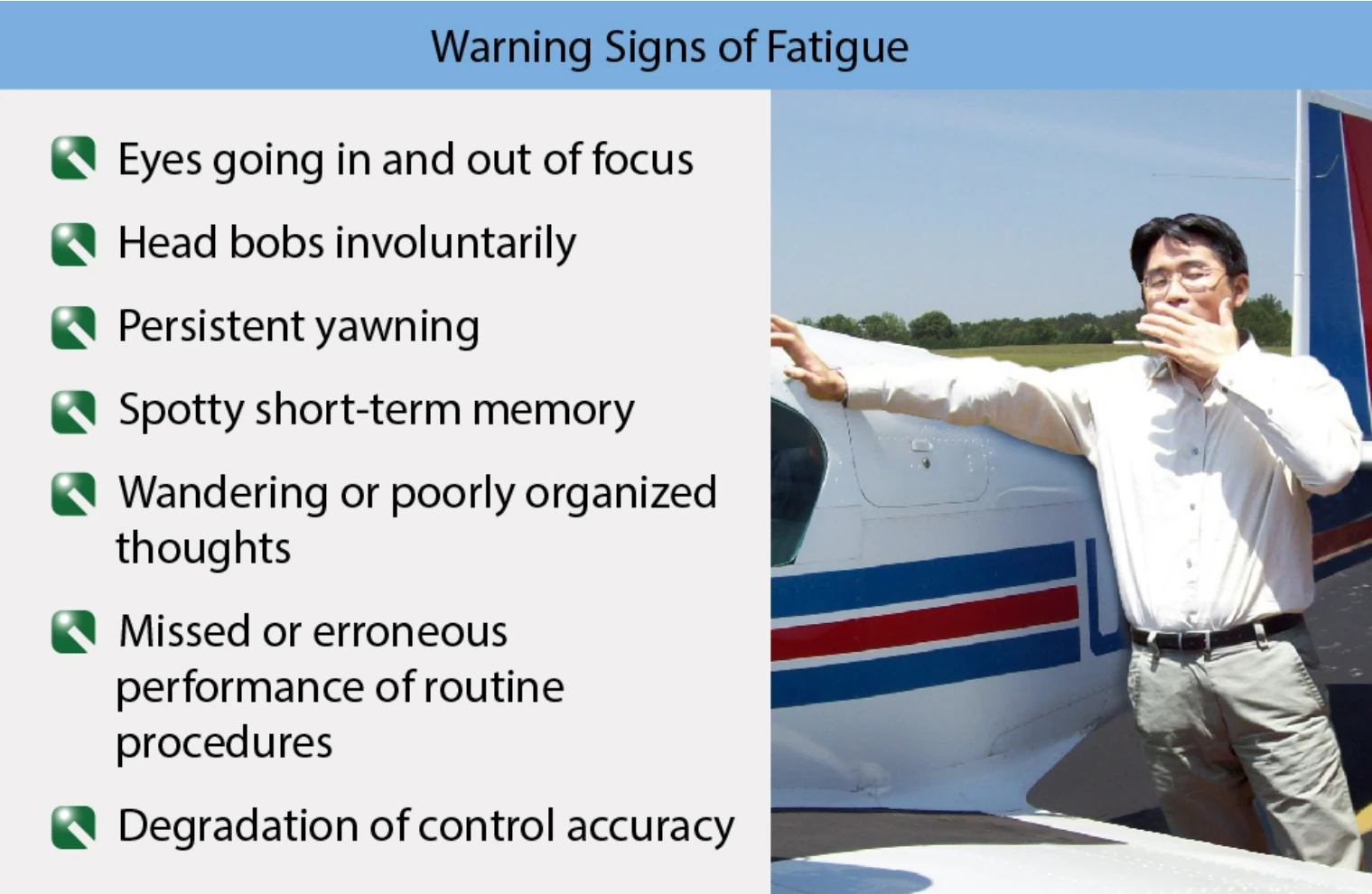
Fatigue is a normal response to many conditions common to flight operations because characteristics of the flight deck environment, such as low barometric pressure, humidity, noise, and vibration, make pilots susceptible to fatigue. The only effective treatment for fatigue is adequate sleep. As fatigue progresses, it is responsible for increased errors of omission, followed by errors of commission, and microsleeps, or involuntary sleep lapses lasting from a few seconds to a few minutes. For obvious reasons, errors caused by these short absences can have significant hazardous consequences in the aviation environment.
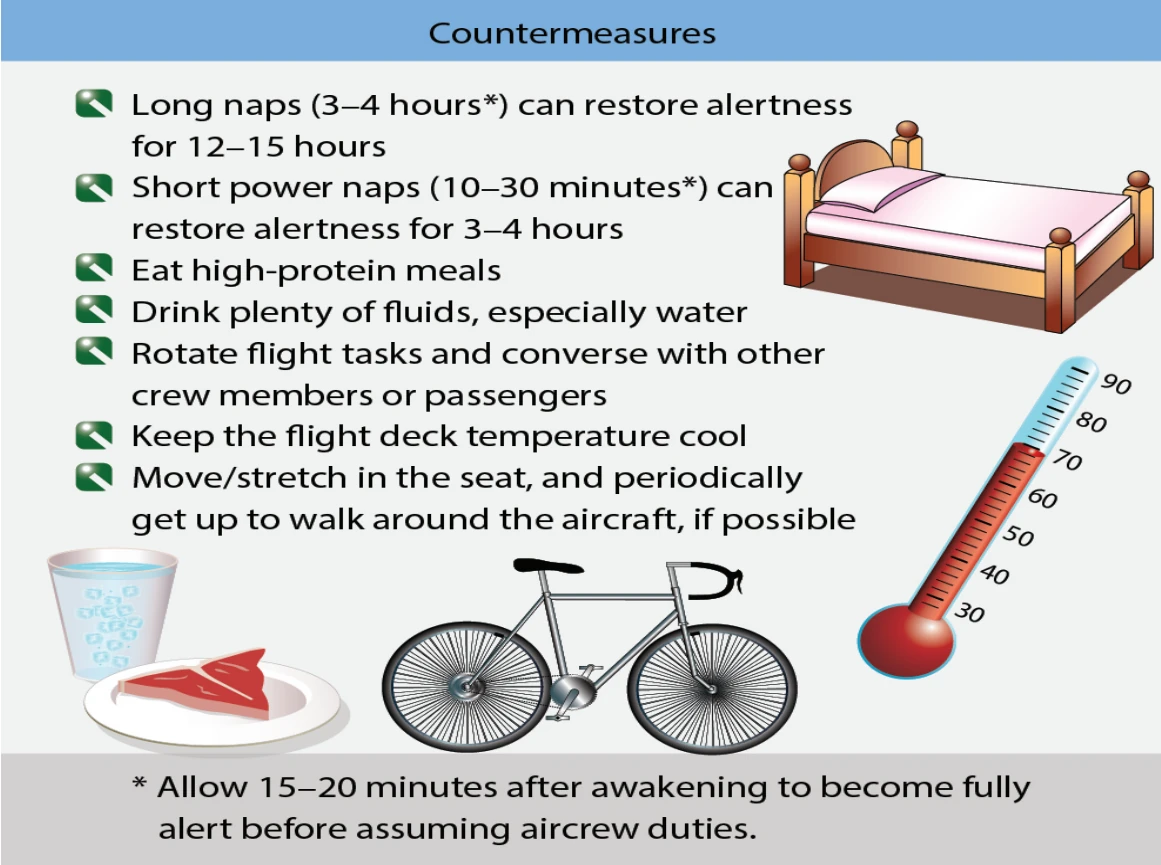
Sleep-deprived pilots may not notice sleepiness or other fatigue symptoms during preflight and departure flight operations. Once underway and established on altitude and heading, sleepiness and other fatigue symptoms tend to manifest themselves. Extreme fatigue can cause uncontrolled and involuntary shutdown of the brain. Regardless of motivation, professionalism, or training, an individual who is extremely sleepy can lapse into sleep at any time, despite the potential consequences of inattention. There are a number of countermeasures for coping with fatigue, as shown in Figure 1-7.
Complacency presents another obstacle to maintaining situational awareness. Defined as overconfidence from repeated experience on a specific activity, complacency has been implicated as a contributing factor in numerous aviation accidents and incidents. Like fatigue, complacency reduces the pilot’s effectiveness in the flight deck. However, complacency is harder to recognize than fatigue, since everything is perceived to be progressing smoothly. Highly reliable automation has been shown to induce overconfidence and complacency. This can result in a pilot following the instructions of the automation even when common sense suggests otherwise. If the pilot assumes the autopilot is doing its job, he or she does not crosscheck the instruments or the aircraft’s position frequently. If the autopilot fails, the pilot may not be mentally prepared to fly the aircraft manually. Instructors should be especially alert to complacency in learners with significant flight experience. For example, a pilot receiving a flight review in a familiar aircraft may be prone to complacency.
Advanced avionics have created a high degree of redundancy and dependability in modern aircraft systems, which can promote complacency and inattention. During flight training, the flight instructor should emphasize that routine flight operations may lead to a sense of complacency, which can threaten flight safety by reducing situational awareness.
By asking about positions of other aircraft in the traffic pattern, engine instrument indications, and the aircraft’s location in relation to references on a chart, the flight instructor can determine if the learner is maintaining situational awareness. The flight instructor can also attempt to focus the learner’s attention on an imaginary problem with the communication or navigation equipment. The flight instructor should point out that situational awareness is not being maintained if the learner diverts too much attention away from other tasks, such as controlling the aircraft or scanning for traffic. These are simple exercises that can be done throughout flight training, which help emphasize the importance of maintaining situational awareness.