
Chapter 1
Risk Management and Single-Pilot Resource Management
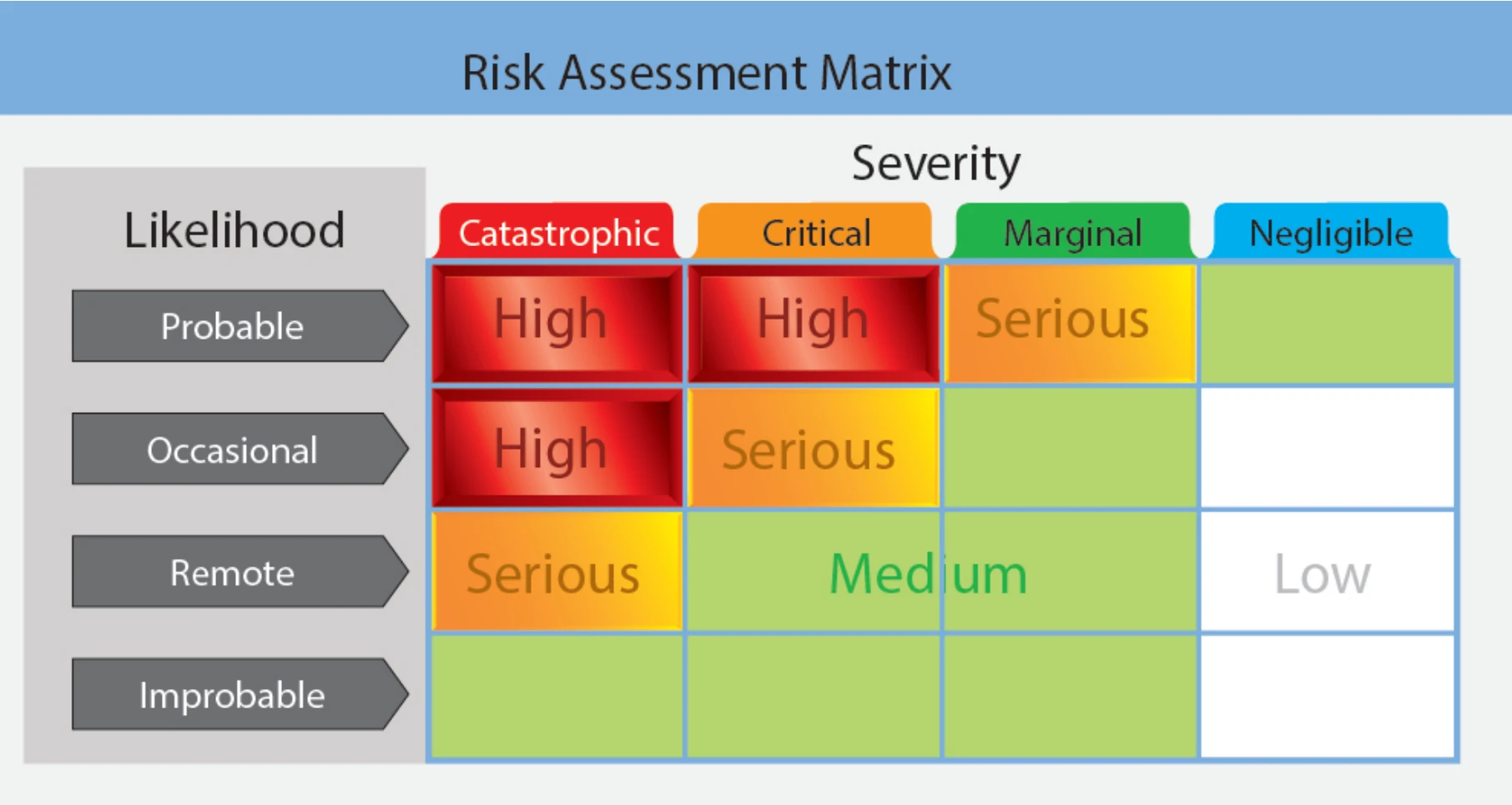
The most basic tool is the risk matrix. [Figure 1-4] It assesses two items: the likelihood of an event occurring and the consequence of that event.
Likelihood of an Event
Likelihood is nothing more than taking a situation and determining the probability of its occurrence. It is rated as probable, occasional, remote, or improbable. For example, a pilot is flying from point A to point B (50 miles) in marginal visual flight rules (MVFR) conditions. The likelihood of encountering potential instrument meteorological conditions (IMC) is the first question the pilot needs to answer. The experiences of other pilots, coupled with the forecast, might cause the pilot to assign “occasional” to determine the probability of encountering IMC.
The following are guidelines for making assignments.
- Probable—an event will occur several times.
- Occasional—an event will probably occur sometime.
- Remote—an event is unlikely to occur but is possible.
- Improbable—an event is highly unlikely to occur.
Severity of an Event
The next element is the severity or consequence of a pilot’s action(s). It can relate to injury and/or damage. If the individual in the example above is not an instrument flight rules (IFR) pilot, what are the consequences of encountering inadvertent IMC? In this case, because the pilot is not IFR rated, the consequences could be fatal. The following are guidelines for this assignment.
- Catastrophic—results in fatalities, total loss
- Critical—severe injury, major damage
- Marginal—minor injury, minor damage
- Negligible—less than minor injury, less than minor system damage
Assessing risk may be the most difficult part of risk management and applying the terms described above to specific risks takes some practice. Once you have assessed risk likelihood and severity for all identified risks, you can readily classify the overall risk level for that hazard. For example, simply connecting the two factors as shown in Figure 1-4 indicates the risk is high and the pilot may consider whether to not fly or fly only after finding ways to mitigate, eliminate, or control the risk.
Risk
The final step in risk management is mitigation, which is the payoff for accomplishing the entire risk management process and will often allow for mission accomplishment (the reason most pilots fly). By effectively mitigating known risks to acceptable levels, pilots can complete their planned flights safely or ensure that alternate options are selected for those rare occasions when the planned or ongoing flight cannot be completed.
There are almost an infinite number of actions you can take, depending on the nature of the hazard or risk. For example, the pilot flying from point A to point B (50 miles) in MVFR conditions has several ways to reduce risk:
- Drive.
- Wait for the weather to improve to good visual flight rules (VFR) conditions.
- Take a pilot who is rated as an IFR pilot.
- Delay the flight.
- Cancel the flight.
Risk mitigation often begins days, sometimes weeks, before a planned flight. For example, a pilot flying a single-engine piston aircraft without ice protection lives in the Pacific Northwest and is planning a trip in January for a scheduled speech. While keeping the long-range weather forecast in mind, planning in advance gives the pilot several options to mitigate risk:
- Book commercial flight/transfer the risk to the airlines.
- Change the date of the event to accommodate weather.
- Cancel flight altogether.
- Depart a day early from the Pacific Northwest to avoid an incoming low-pressure area that will bring low IFR and certain icing conditions.
After all mitigating steps have been completed, you may confront the possibility that a flight cannot be made or continued for a variety of reasons not only for yourself but also for your passengers. Remember that many pilots have ignored or failed to mitigate serious and high-risk hazards, and a tragic fatal accident is all too often the result.
Flight Risk Assessment Tools
Because every flight has some level of risk, it is critical that pilots can differentiate, in advance, between a low risk flight and a high-risk flight, establish a review process, and develop risk mitigation strategies. A Flight Risk Analysis Tool (FRAT) enables proactive hazard identification, is easy to use, and can visually depict risk. It is a tool many pilots use to make better go/no-go decisions.