
Chapter 1
Risk Management and Single-Pilot Resource Management
“In the thick” is no time to try to mitigate a potentially hazardous outcome. When preparing for a flight or maintenance task, pilots and maintenance technicians may set aside time to stop and think about the hazards involved.
Just thinking about this task may not consider the actual risk exposure. We may allow our personal desires to manipulate our risk assessment in order to meet personal goals. A formal process using pen and paper gives a perspective on the entire risk picture and is a good way to make a thorough analysis.
A risk assessment tool allows pilots to see the risk profile of a flight in its planning stages. Each pilot determines an acceptable level of risk for flight based on the type of operation, environment, aircraft used, training, and overall flight experience. When the risk for a flight exceeds the acceptable level, the hazards associated with that risk may be further evaluated and the risk reduced. A higher risk flight might not be operated if the hazards cannot be mitigated to an acceptable level.
What Do I Do with My Score?
When using a FRAT, the pilot creates numerical thresholds that trigger additional levels of scrutiny prior to a go/no-go decision for the flight. These thresholds help ensure that the safety standards of each individual flight are maintained. However, it is important that the pilot create realistic thresholds. If every flight is within the acceptable range under any condition, it is likely that the thresholds have not been set correctly.
An effective FRAT has at least three possible score ranges. These are often grouped into green, yellow and red sections.
- RED (HIGH): Risk likelihood and/or severity is normally reduced to lower levels before departure. Unless the risks involved in the flight can be mitigated (different crew/adding a copilot, better equipment, delayed launch time…) flight cancellation occurs.
- YELLOW (SERIOUS): Risk likelihood and/or severity needs reduction to lower levels before departure. Begin by mitigating some of the higher scoring items, and consider consulting with a flight instructor or mechanic if the score remains in the yellow.
- GREEN (MEDIUM): Flight can depart or continue, but risk severity and/or likelihood may be reduced.
No FRAT can anticipate all the hazards that may impact a particular flight but there are some common hazards that GA pilots encounter regularly. The National Business Aviation Association (NBAA) has developed a free online Flight Risk Awareness Tool (FRAT) to help flightcrews quickly assess threats to safety for a particular flight. Developed as part of a study, the FRAT presents operators with an easy-to-understand summary of the risks associated with each mission. No identifying data is collected to produce a risk analysis and pilots can try the tool before putting it to use on a live flight. This downloadable tool presents pilots with an easy-to-understand summary of the risks associated with each flight and can be found at https://nbaa.org/wp-content/uploads/2018/06/flight-risk-assessment-tool.pdf
Three-P Model for Pilots
As we have just learned with the Identify, Assess, & Mitigate model, risk management is a decision-making process designed to identify or perceive hazards systematically, assess the degree of risk associated with a hazard, and determine the best course of action to mitigate the risk. For example, the Perceive, Process, Perform (3P) model for aeronautical decision-making (ADM) offers a simple, practical, and structured way for pilots to manage risk. [Figure 1-5]
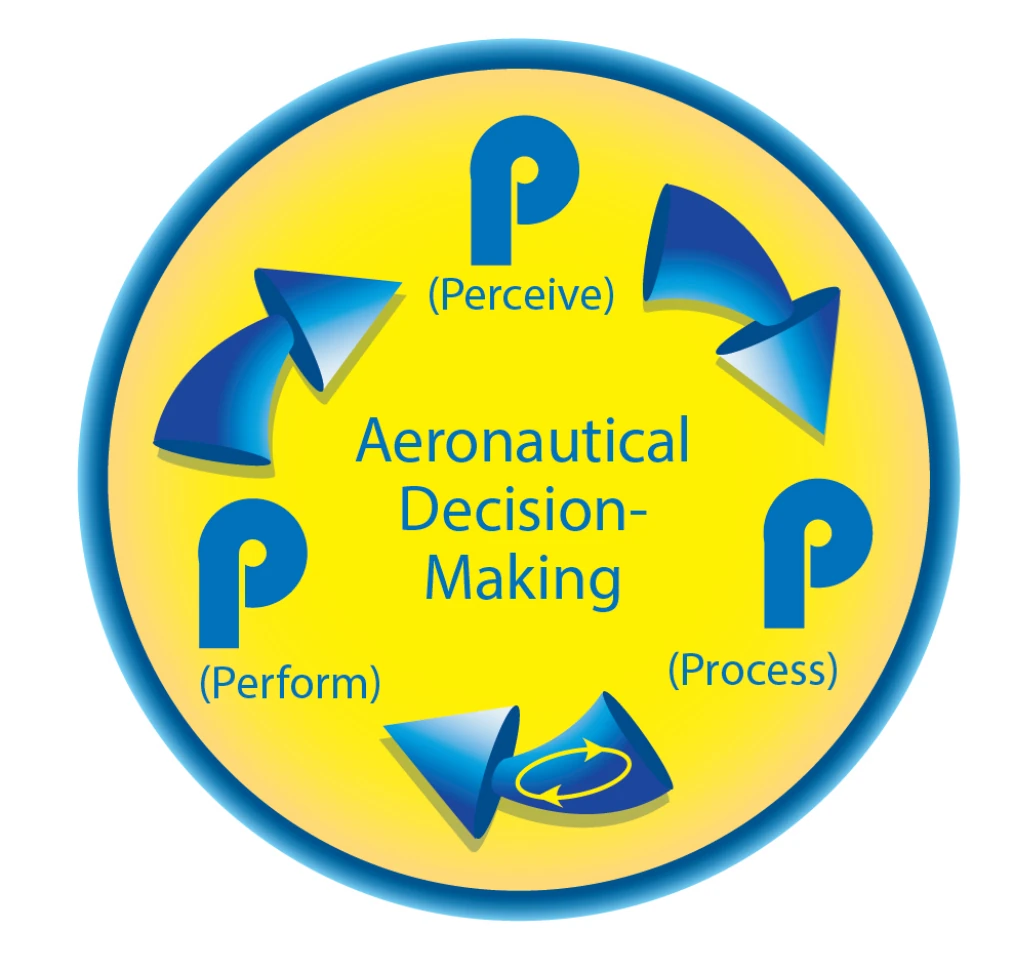
To help understand the 3P model, it may be easier to relate this concept to the three steps of the Risk Management Process discussed earlier in this chapter. Recall that these three steps include identifying the risk, assessing the risk, and finally mitigating the risk. Imagine the 3P model in parallel to those three steps by perceiving (identifying the risk), processing (assessing the risk), and performing (mitigating the risk).
To use the 3P model, the pilot:
- Perceives the given set of circumstances for a flight.
- Processes by evaluating the impact of those circumstances on flight safety.
- Performs by implementing the best course of action.
In the first step, the goal is to develop situational awareness by perceiving hazards, which are present events, objects, or circumstances that could contribute to an undesired future event. In this step, the pilot systematically identifies and lists hazards associated with all aspects of the flight: pilot, aircraft, environment, and external pressures. It is important to consider how individual hazards might combine. Consider, for example, the hazard that arises when a new instrument pilot with no experience in actual instrument conditions wants to make a cross-country flight to an airport with low ceilings in order to attend an important business meeting.
In the second step, the goal is to process this information to determine whether the identified hazards constitute risk, which is defined as the future impact of a hazard that is not controlled or eliminated. The degree of risk posed by a given hazard can be measured in terms of exposure (number of people or resources affected), severity (extent of possible loss), and probability (the likelihood that a hazard will cause a loss). If the hazard is low ceilings, for example, the level of risk depends on a number of other factors, such as pilot training and experience, aircraft equipment, and fuel capacity.
In the third step, the goal is to perform by taking action to eliminate hazards or mitigate risk, and then continuously evaluate the outcome of this action. With the example of low ceilings at destination, for instance, the pilot can perform good ADM by selecting a suitable alternate, knowing where to find good weather, and carrying sufficient fuel to reach it. This course of action would mitigate the risk. The pilot also has the option to eliminate it entirely by waiting for better weather.
Once the pilot has completed the 3P decision process and selected a course of action, the process begins again because the set of circumstances brought about by the course of action requires analysis. The decision-making process is a continuous loop of perceiving, processing, and performing.
It is never too early to start teaching risk management. Using the 3P model gives flight instructors a tool to teach them a structured, efficient, and systematic way to identify hazards, assess risk, and implement effective risk controls. Practicing risk management needs to be as automatic in general aviation (GA) flying as basic aircraft control. Consider making the 3P discussion a standard feature of the preflight discussion. As is true for other flying skills, risk management habits are best developed through repetition and consistent adherence to specific procedures.