
Chapter 2
Human Behavior
For example, the instructor finds a water bottle under the rudder pedal of an aircraft the student took on a solo flight and explains the hazards of loose objects in the cabin. The learner, unwilling to accept the reality that his or her inattention could have caused an aircraft accident, denies having been inattentive on previous day. Or, the learner minimizes the incident, accepting he or she left the water bottle pointing out that nothing bad happened as a result of the action.
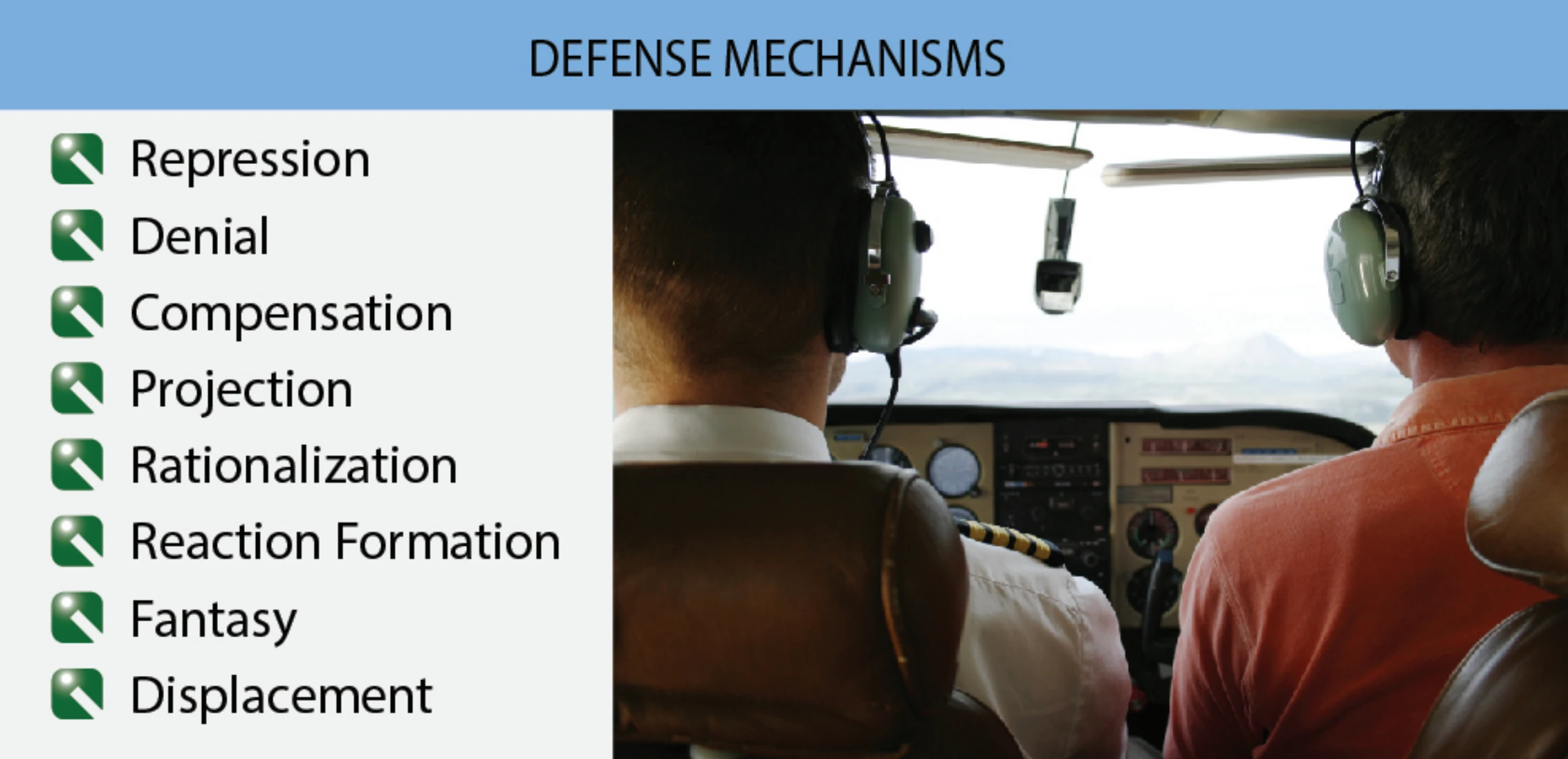
Other defense mechanisms include but are not limited to the following:
Compensation
Compensation is a process of psychologically counterbalancing perceived weaknesses by emphasizing strength in other areas. Through compensation, learners often attempt to disguise the presence of a weak or undesirable quality by emphasizing a more positive one. The “I’m not a fighter, I’m a lover” philosophy can be an example of compensation. Compensation involves substituting success in a realm of life other than the realm in which the person suffers a weakness.
Projection
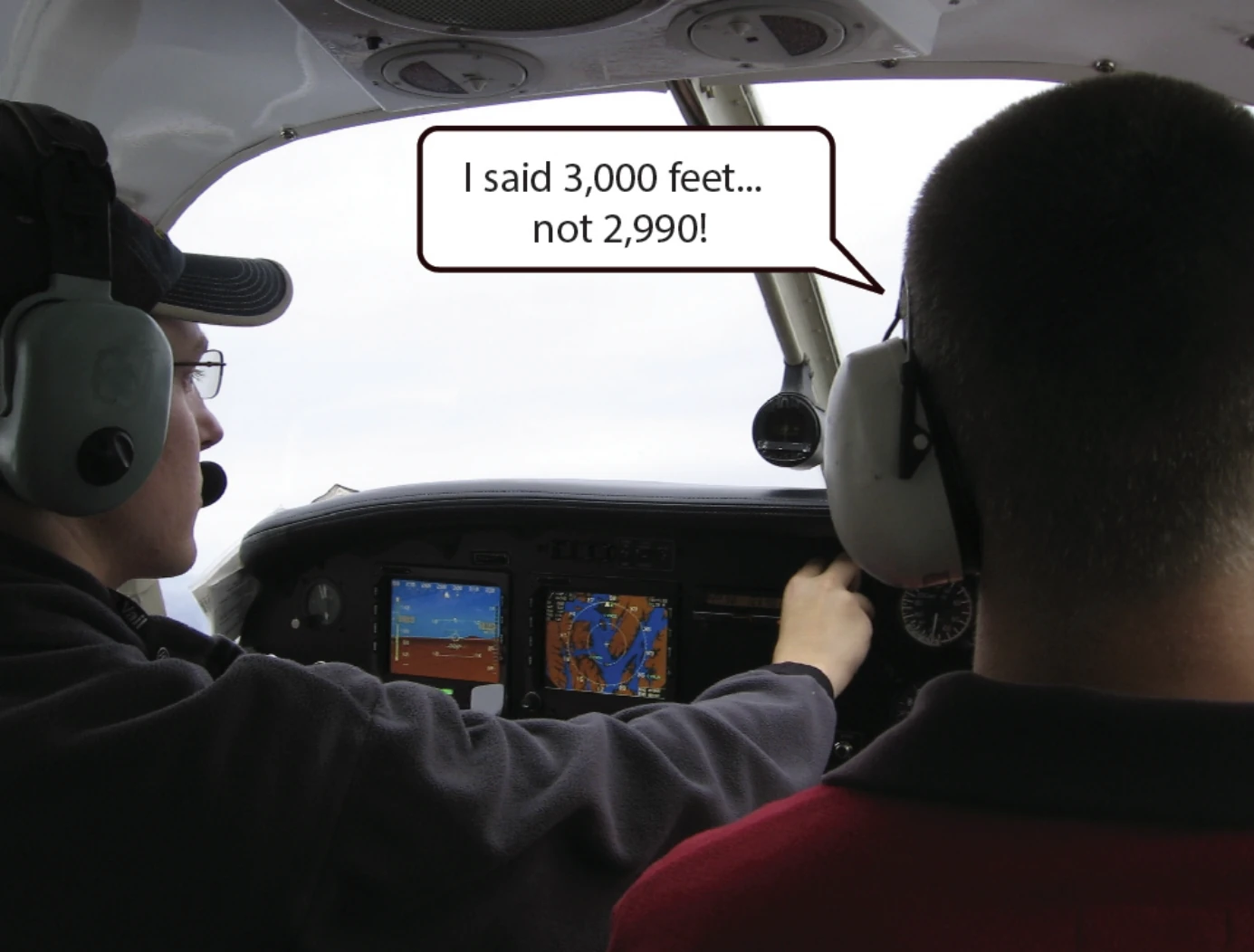
Through projection, an individual places his or her own unacceptable impulses onto someone else. A person relegates the blame for personal shortcomings, mistakes, and transgressions to others or attributes personal motives, desires, characteristics, and impulses to others. The learner pilot who fails a flight exam and says, “I failed because I had a poor examiner” believes the failure was not due to a lack of personal skill or knowledge. This learner projects blame onto an “unfair” examiner.
Learners who believe their instruction is inadequate, or that their efforts are not conscientiously considered and evaluated, do not learn well. In addition, their motivation suffers no matter how intent they are on learning to fly. Motivation also declines when a learner believes the instructor is making unreasonable demands for performance and progress. [Figure 2-6]
Assignment of difficult, but possible, goals usually provides a challenge and promotes learning. In a typical flight lesson, reasonable goals are listed in the lesson objectives and the desired levels of proficiency for the goals are included in statements that contain completion standards.
Rationalization
Rationalization is a subconscious technique for justifying actions that otherwise would be unacceptable. When true rationalization takes place, individuals sincerely believe in the plausible and acceptable excuses which seem real and justifiable. For example, a learner mechanic performs poorly on a test. He or she may justify the poor grade by claiming there was not enough time to learn the required information. The learner does not admit to failing to join the class study group or taking the computer quiz offered by the instructor.
Reaction Formation
In reaction formation a person fakes a belief opposite to the true belief because the true belief causes anxiety. The person feels an urge to do or say something and then actually does or says something that is the opposite of what he or she really wants. For example, a learner may develop a who-cares-how-other-people-feel attitude to cover up feelings of loneliness and a hunger for acceptance.
Fantasy
Fantasy occurs when a learner engages in daydreams about how things should be rather than doing anything about how things are. The learner uses his or her imagination to escape from reality into a fictitious world—a world of success or pleasure. However, if a learner gets sufficient satisfaction from daydreaming, he or she may stop trying to achieve goals altogether. Perhaps the transitioning pilot is having trouble mastering a more complex aircraft, which jeopardizes his or her dream of becoming an airline pilot. It becomes easier to daydream about the career than to achieve the certification. Lost in the fantasy, the learner spends more time dreaming about being a successful airline pilot than working toward the goal. When carried to extremes, the worlds of fantasy and reality can become so confused that the dreamer cannot distinguish one from the other.
Displacement
This defense mechanism results in an unconscious shift of emotion, affect, or desire from the original object to a more acceptable, less threatening substitute. Displacement avoids the risk associated with feeling unpleasant emotions and puts them somewhere other than where they belong. For example, the avionics learner is angry with the instructor over a grade received but fears displaying the anger could antagonize the instructor. The learner might choose to direct the anger towards a different object without risking consequences related to the class.
Psychology textbooks or online references offer more in-depth information about defense mechanisms. While most defense mechanisms fall within the realm of normal behavior and serve a useful purpose, in some cases they may be associated with mental health problems. Defense mechanisms involve some degree of self-deception and distortion of reality. Thus, they alleviate the symptoms, not the causes, and do not solve problems. Moreover, because defense mechanisms operate on an unconscious level, they are not subject to normal conscious checks and balances. Once an individual realizes there is a conscious reliance on one of these devices, behavior ceases to be an unconscious adjustment mechanism and becomes, instead, an ineffective way of satisfying a need.
It may be difficult for an instructor to identify excessive reliance on defense mechanisms by a learner, but a personal crisis or other stressful event is usually the cause. For example, a death in the family, a divorce, or even a failing grade on an important test may trigger harmful defensive reactions. Physical symptoms such as a change in personality, angry outbursts, depression, or a general lack of interest may point to a problem. Drug or alcohol abuse also may become apparent. Less obvious indications may include social withdrawal, preoccupation with certain ideas, or an inability to concentrate.