
Chapter 2
Human Behavior
Human Nature and Motivation
Human nature refers to the general psychological characteristics, feelings, and behavioral traits shared by all humans. Consider Jason, who came to aviation because he wanted to participate more actively in another realm of his business. Derek needs to capitalize on this motivation to keep Jason interested in the step-by-step procedures that need to be learned in order to fly safely. There is a gap between Jason and his goal of earning a pilot certificate. It is Derek’s job to close the gap. The successful instructor channels learner motivation and guides the learner toward the goal of obtaining aviation skills through education, experience, practice, and study.
The psychologist and Nobel Prize winner in Economics, Daniel Kahneman, summarized his findings of human behavior in his book titled, Thinking, Fast and Slow. Simply, he outlines that two systems of thought constantly compete for control over our behaviors that affect decision-making. The first system (fast) is the automatic reaction that individuals have developed through memory and experience. The second system (slow) relies on logic and reasoning to draw conclusions for the actions one takes. [Figure 2-4]
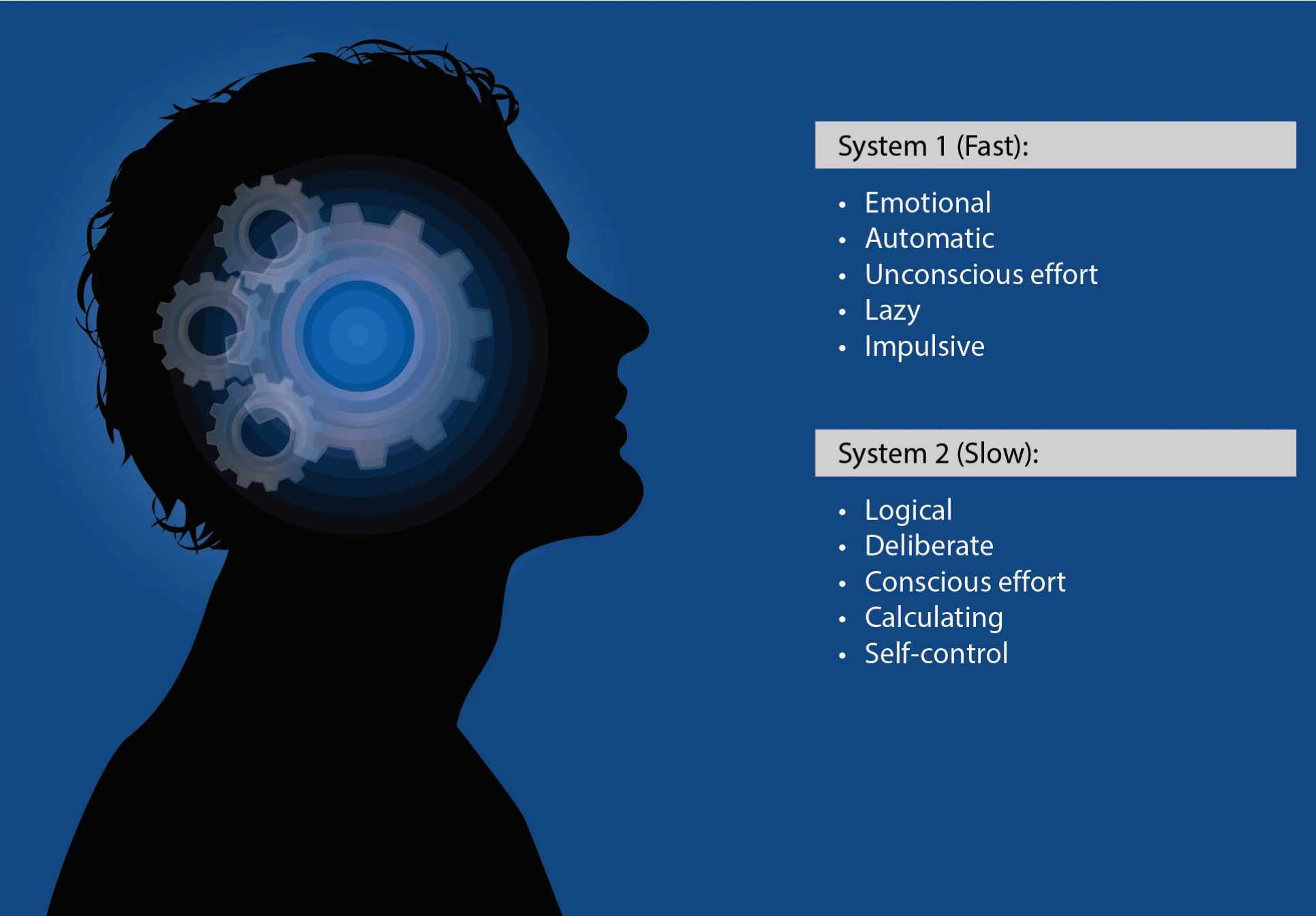
According to Kahneman's research, System 1 is primarily based in emotion and the unconscious mind. These are automatic “gut reactions” that require little thought or effort by the individual. For example, when presented with the simple math equation 2 + 2 = x, the individual can easily solve the problem where x = 4. The response is instant and likely correct in this example. The inherent risk in using this thought system is that, as Kahneman explains, we are inherently lazy. It is exhausting to put forth the effort required to deliberately concentrate on a problem, especially one that appears to be so easy. This can lead to poor decision-making due to the assumption that the task at hand is as simple as past, similar, experiences suggest it to be.
In contrast, individuals rely on System 2 less frequently as it requires conscious effort to calculate and reason through a problem, and because of this System 2 is comparatively slower than System 1. While someone can easily solve the equation 2 + 2 = x, the average person needs to pause and consider an answer if presented with a more difficult problem such as 48 × 76 = y. This system demands considerable effort and self-control of the individual and as a result, it is tempting to revert to the relative ease of System 1. In fact, once the immediate problem is solved, System 1 takes over again.
Understanding how these systems affect our decision-making can help instructors be more aware of learner pitfalls, such as assuming a complex problem is a simple one, or assuming that because a recent task led to a solution that the same solution can be used correctly for a similar task.
Since it is human nature to be motivated, the responsibility for discovering how to realize the potential of the learner lies with the instructor. How to mold a solid, healthy, productive relationship with a learner depends on the instructor’s knowledge of human behavior and needs. Being able to recognize factors that inhibit the learning process also helps the instructor in this process.
Defense Mechanisms
Defense mechanisms can be biological or psychological. The biological defense mechanism is a physiological response that protects or preserves organisms. For example, when humans experience a danger or a threat, the “fight or flight” response kicks in. Adrenaline and other chemicals are activated and physical symptoms such as rapid heart rate and increased blood pressure occur.
For example, when an anxious learner pilot reacts to impending and full stalls during practice, the anxiety that the learner pilot may feel may resolve itself into a “fight or flight” response. There may be limited time to analyze the problem. Therefore, the learner needs the opportunity to experience and develop a comfort level that mitigates the anxiety.
The instructor needs to recognize the learner’s apprehension about performing the recovery techniques and help them gain the necessary skill level to feel comfortable with the maneuver. In this case, the instructor could take the procedure apart and demonstrate each stage of an impending or full stall. Allowing the learner to then practice the stages in various realistic scenarios should instill the confidence needed to master the stall recovery.
Sigmund Freud introduced the psychological concept of the ego defense mechanism in 1894. The ego defense mechanism is an unconscious mental process to protect oneself from anxiety, unpleasant emotions, or to provide a refuge from a situation with which the individual cannot currently cope. For example, someone who blots out the memory of being physically assaulted is using a defense mechanism. People use these defenses to prevent unacceptable ideas or impulses from entering the conscious mind. Defense mechanisms soften feelings of failure, alleviate feelings of guilt, help an individual cope with reality, and protect one’s self-image. [Figure 2-5]
When anxiety occurs, the mind tries to solve the problem or find an escape, but if these tactics do not work, defense mechanisms are triggered. Defense mechanisms share two common properties:
- They often appear unconsciously.
- They tend to distort, transform, or otherwise falsify reality.
Because reality is distorted, perception changes, which allows for a lessening of anxiety, with a corresponding reduction in tension. Repression and denial are two primary defense mechanisms.
Repression
Repression is the defense mechanism whereby a person places uncomfortable thoughts into inaccessible areas of the unconscious mind. Things a person is unable to cope with now are pushed away, to be dealt with at another time, or hopefully never because they faded away on their own accord. The level of repression can vary from temporarily forgetting an uncomfortable thought to amnesia, where the events that triggered the anxiety are deeply buried. Repressed memories do not disappear and may reappear in dreams or slips of the tongue (“Freudian slips”). For example, a learner pilot may have a repressed fear of flying that inhibits his or her ability to learn how to fly.
Denial
Denial is a refusal to accept external reality because it is too threatening. It is the refusal to acknowledge what has happened, is happening, or will happen. It is a form of repression through which stressful thoughts are banned from memory. Related to denial is minimization. When a person minimizes something, he or she accepts what happened, but in a diluted form.