
Chapter 3
The Learning Process
According to research on the human brain, people have a preferred side of the brain to use for understanding and storing information. While both sides of the brain are involved in nearly every human activity, it has been shown that those with right-brain dominance are characterized as being spatially oriented, creative, intuitive, and emotional. Those with left-brain dominance are more verbal, analytical, and objective. Generally, the brain functions as a whole. For example, the right hemisphere may recognize a face, while the left associates a name to go with the face.
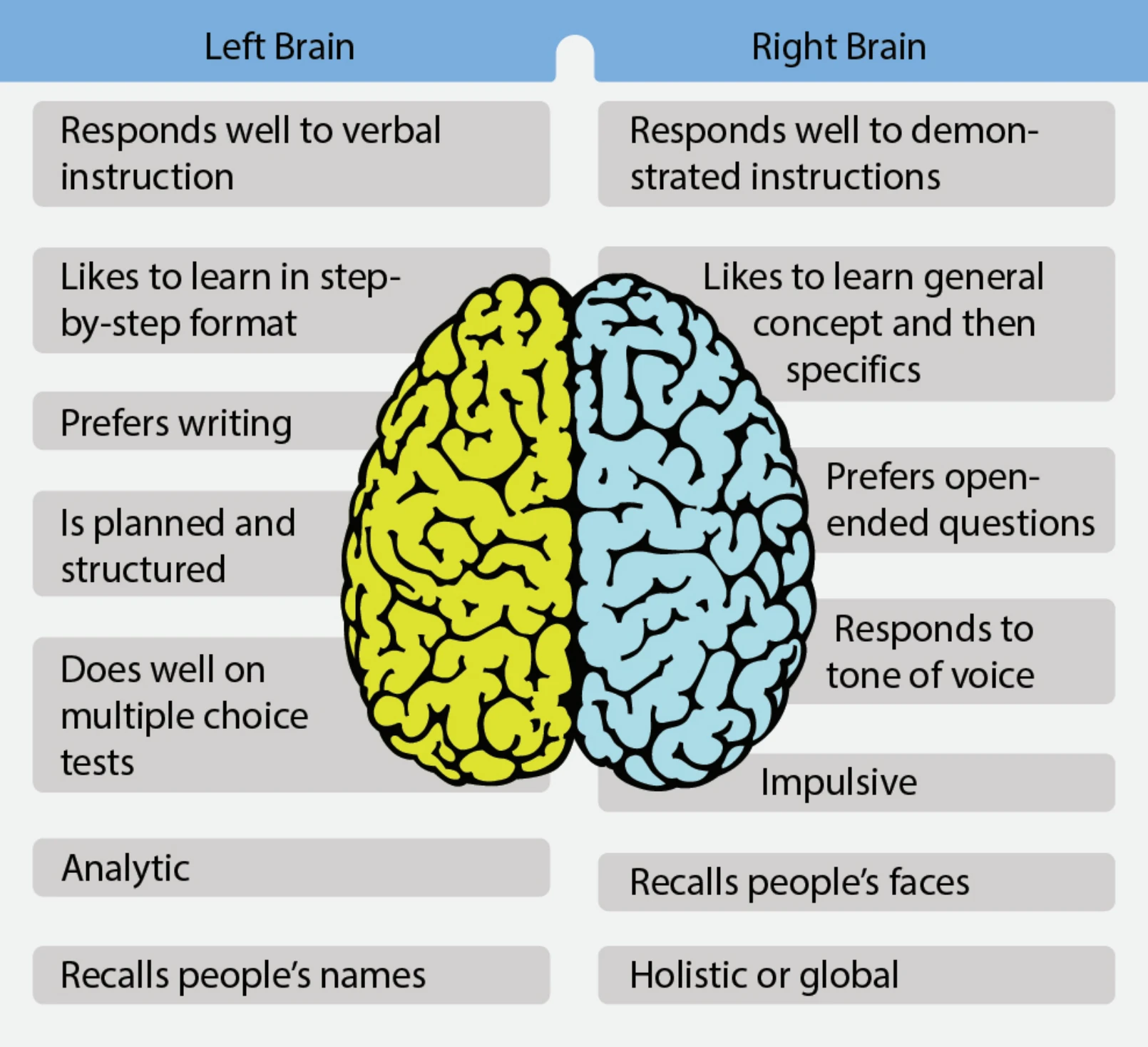
While most people seem to have a dominant side, it is a preference, not an absolute. On the other hand, when learning is new, difficult, or stressful, the brain seems to go on autopilot to the preferred side. Recognizing a learner’s dominant brain hemisphere gives the instructor a guide for ways to teach and reinforce material. There are also some people who use both sides of the brain equally well for understanding and storing information. [Figure 3-14]
Holistic/Serialistic Theory
As seen in Figure 3-14, right and left brain learners have preferences for how they process information. Based on information processing theory, left brain learners or serialistic learners have an analytic approach to learning. Because they gain understanding in linear steps, with each step logically following the previous one, these learners need well-defined, sequential steps where the overall picture is developed slowly, thoroughly, and logically. This is a bottom-up strategy.
Right brain or holistic learners favor the holistic strategy and prefer a big picture or global perspective. This is a top-down strategy and learners tend to learn in large jumps, absorbing material almost randomly without seeing connections, until suddenly “it” clicks and they get it. Global learners solve complex problems rapidly once they have grasped the big picture, but they often have difficulty explaining how they did it. This type of learner seeks overall comprehension; analogies help this individual.
Index of Learning Styles
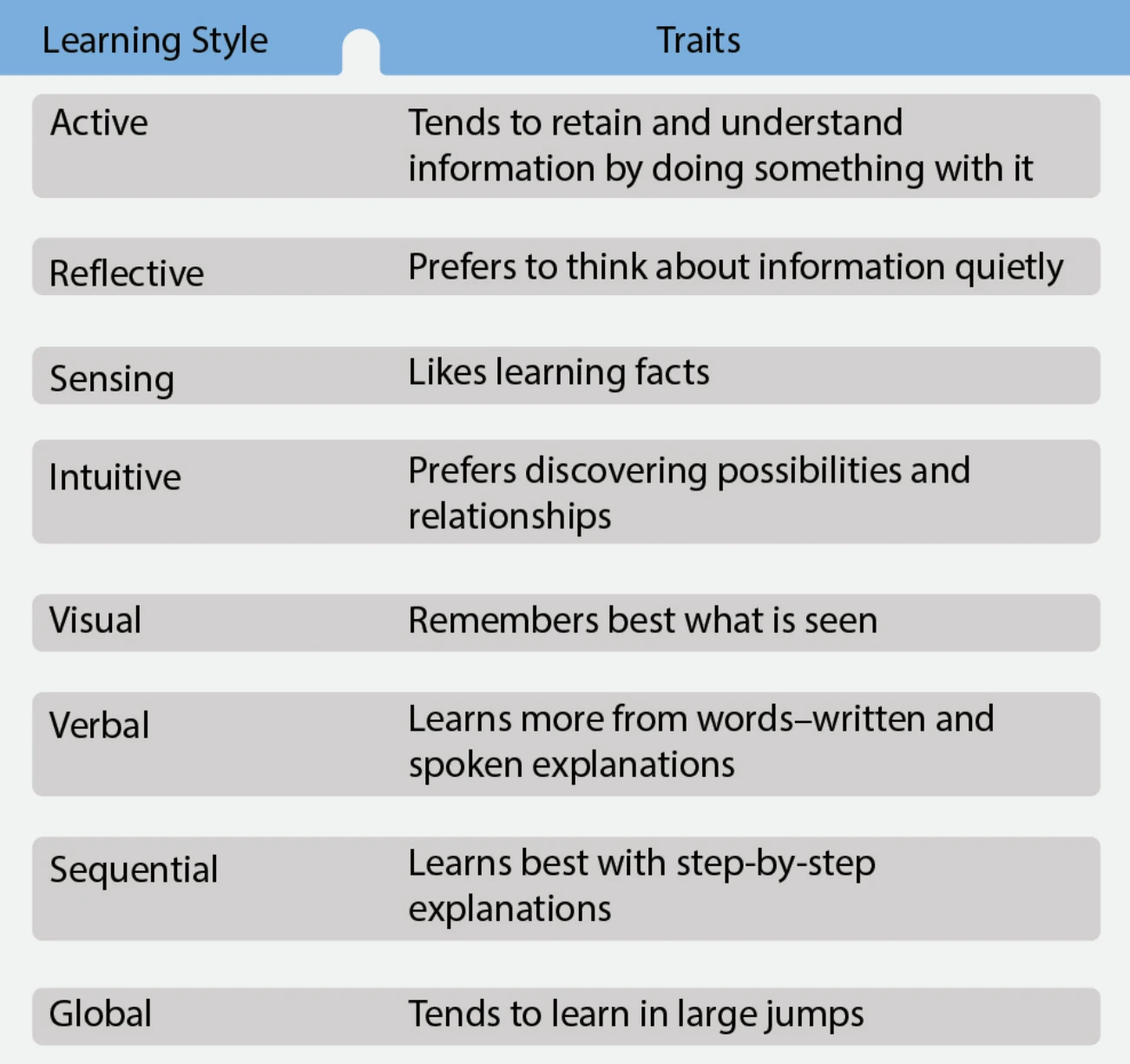
In 1988, Richard Felder and Linda Silverman designed a learning style model with parallel learning styles that classified individuals as having learning preferences in sensing or intuitive, visual or verbal, active or reflective, sequential or global (discussed under holistic/serialistic learning style). A questionnaire developed by Felder and Solomon that offers learners the opportunity to assess learning preferences at no cost for noncommercial purposes is available at www.webtools.ncsu.edu/learningstyles/. [Figure 3-15] ([source link](https://www.webtools.ncsu.edu/learningstyles))
Visual, Auditory Kinesthetic Learners
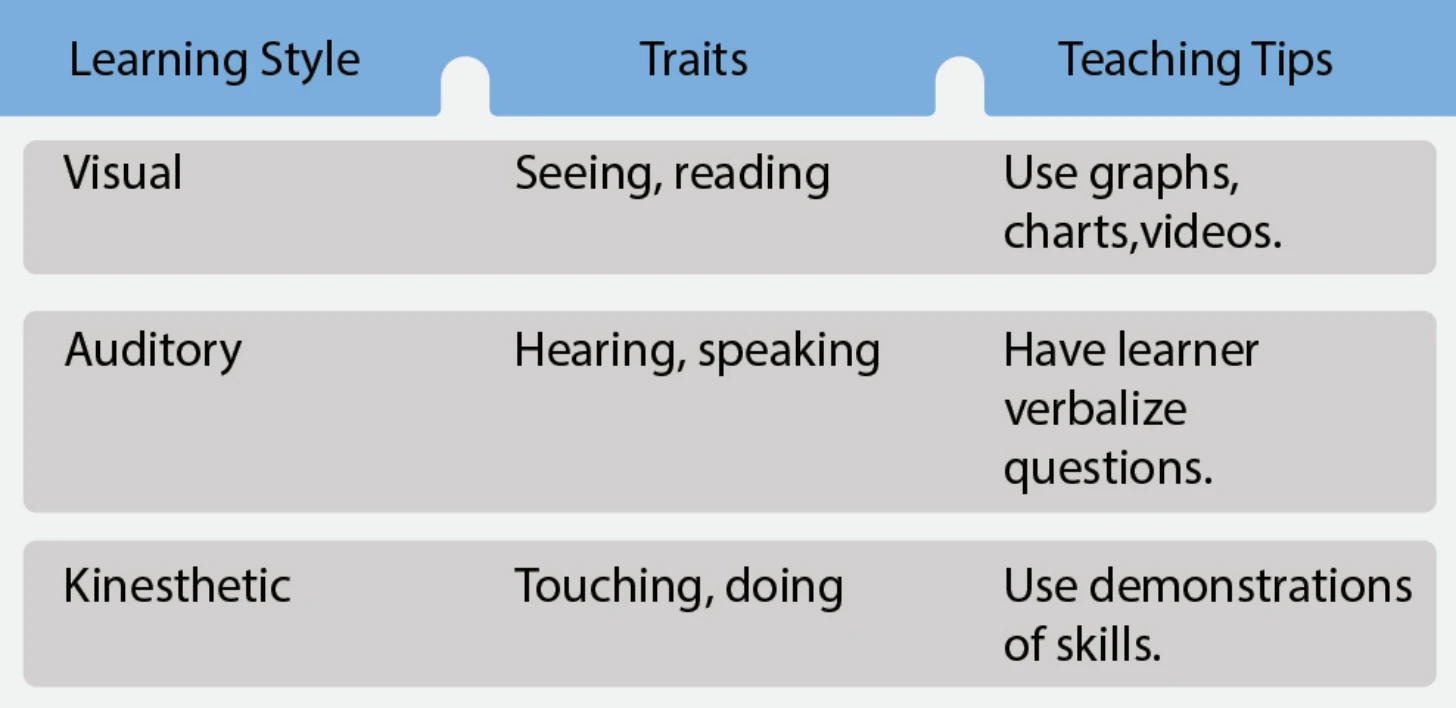
One of the most popular learning styles is based on the three main sensory receptors: vision, hearing, and touch. These are called visual, auditory, and kinesthetic learning styles (VAK). [Figure 3-16] Research in this area dates back to the early 20th century and the concepts were developed over many years by psychologists and teaching specialists. Others have augmented the VAK model with the addition of R for “reading” (VARK), or the addition of T for “tactile” (VAKT), or even a combination of the terms for VARKT.
Learners generally use all three styles to receive information, but one of these three ways of receiving information is dominant. Once again, the dominant style of receiving information is the best way for a person to learn new information, but this style may not be the same for every task. The learner may use one style of learning or a combination of styles depending on the task.
Visual learners rely on seeing information. They learn best if a major component of the lesson is something they can see, and work best with printed and graphic materials, visual displays including diagrams, illustrated text books, overhead presentations, videos, flip charts, and hand-outs. They store information in their brains as pictures or images. They like to take extensive notes. Statistically, most people are visual learners.
Auditory learners transfer knowledge through listening and speaking. These learners need an oral component to the lesson such as verbal instructions. These learners have excellent listening skills and remember what was discussed over what was seen. They are better at verbally explaining than at writing. Since auditory learners prefer to listen to material, they are not good note takers.
Kinesthetic learners process and store information through physical experience such as touching, manipulating, using, or doing. They like to move around while trying to solve a problem and learn best when the material being taught involves hands-on practical experiences. Their concentration tends to wander when there is no external stimulation. They also learn from demonstration by watching carefully, then imagining or mirroring the demonstrator’s movements.
Learners may prefer one of these three learning styles over another, but most employ all three depending on the material being taught. For example, when Beverly makes her first landing with Bill guiding her attempt, she employs visual, auditory, and kinesthetic learning. As the aircraft enters downwind, Beverly uses visual cues to recognize the airport and landing strip as she lines the aircraft up to land. As Bill talks her through the procedures, Beverly is using her auditory learning skills to learn how to land the aircraft. Finally, she needs to use kinesthetic skills to perform the actual landing.
Remember, good learners are capable of processing information in a variety of ways. The key to meeting individual needs is to ensure a variety of learning styles are addressed in every lesson.
Superlinks
In a theory proposed by Ricki Linksman, the learning style ideas discussed in the preceding paragraphs have been melded into a concept based on the VAKT learning styles plus brain hemisphere preference. This “superlink,” as she calls it, is the easiest way for a learner to process information in order to understand, remember, and retain it. Matching visual, auditory, kinesthetic, and tactile with right- and left-brain research, Linksman created eight superlinks: visual left-brain, visual right-brain, auditory left-brain, auditory right-brain, tactile left-brain, tactile right-brain, kinesthetic left-brain, and kinesthetic right-brain. These superlinks accelerate learning by targeting the best way a person learns.