
Chapter 3
The Learning Process
Knowledge of Results
In some simple skills, learners can discover their own errors quite easily. In other cases, such as learning complex aircraft maintenance skills, flight maneuvers, or flight crew duties, mistakes are not always apparent. A learner may know that something is wrong, but not know how to correct it. In any case, the instructor provides a helpful and often critical function in making certain that the learners are aware of their progress. It is perhaps as important for learners to know when they are right as when they are wrong. They should be told as soon after the performance as possible, and should not be allowed to practice mistakes. It is more difficult to unlearn a mistake, and then learn the skill correctly, than to learn correctly in the first place. One way to make learners aware of their progress is to repeat a demonstration or example and to show them the standards their performance should ultimately meet.
How to Develop Skills
Theories about how a skill evolves from the awkward and deliberate performance associated with the cognitive stage to the smooth and steady-handed performance of the automatic response stage have one thing in common: progress appears to depend on repeated practice. Making progress toward automating a skill seems to be largely a matter of performing the skill over and over again. In skill learning, the first trials are slow and coordination is lacking. Mistakes are frequent but each trial provides clues for improvement in subsequent trials. The learner modifies different aspects of the skill such as how to hold the yoke or how to weld.
How long does it take to become proficient at a skill? Studies of skill learning have demonstrated that progress tends to follow what is known as a power law of practice. This law simply states that the speed of performance of a task improves as a power of the number of times that the task is performed. The logarithm of the reaction time for a particular task decreases linearly with the logarithm of the number of practice trials taken. Qualitatively, the law simply says that practice improves performance.
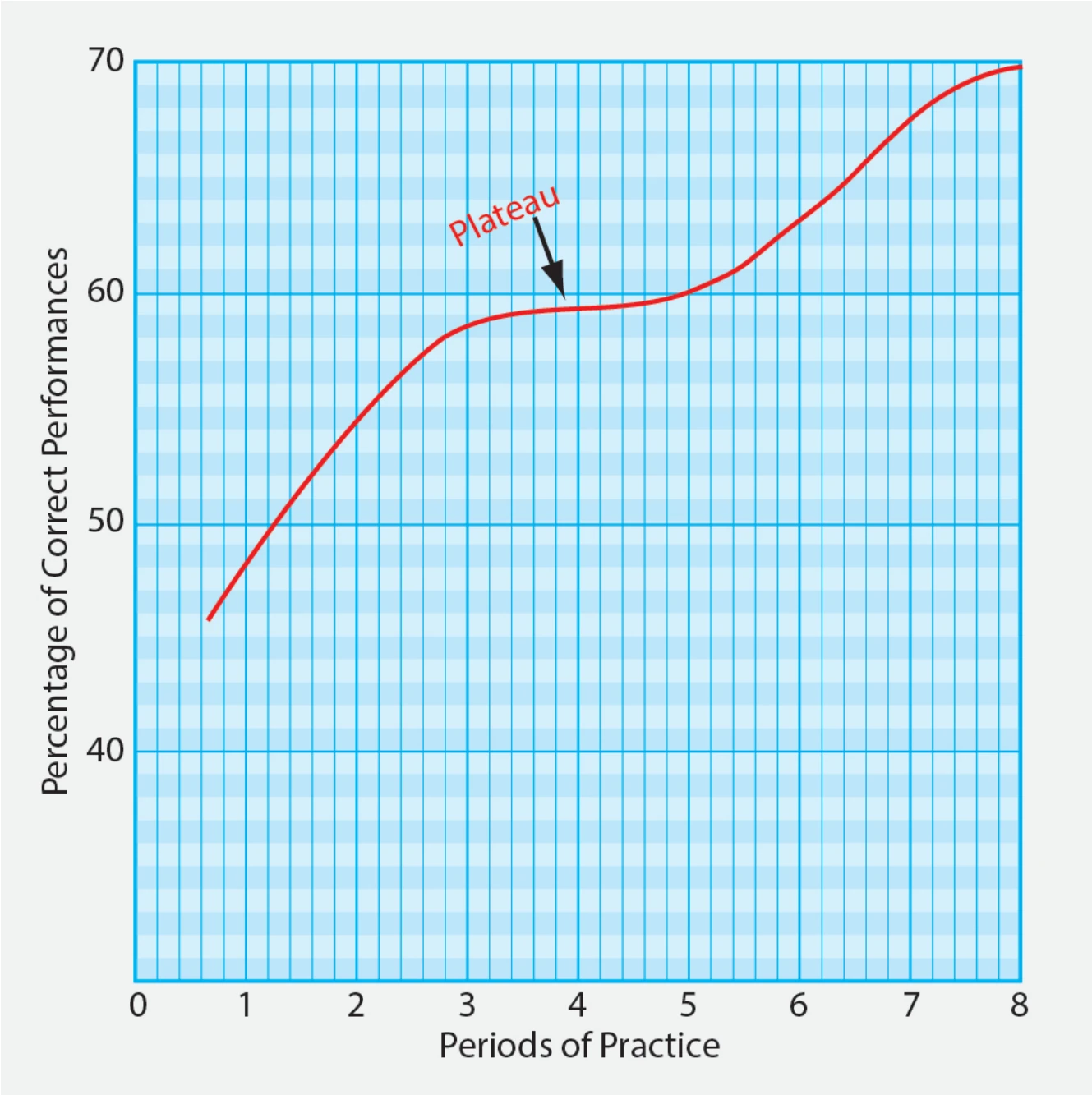
The graph in Figure 3-17 shows how the power law of practice relates the time required to perform a skill to the number of times the skill has been practiced. While it is impossible to predict how many practice trials a learner will require to develop a skill to maturity, the general shape of the power law of practice offers some clues. Learning progress proceeds at a fast pace in the beginning (when there is ample room for improvement) and tends to slow down as performance becomes more skilled. In later stages of learning, improvement is more gradual. Once the curve levels off, it may stay level for a significant period of time. Further improvement may even seem unlikely. This is called a learning plateau.
Learning Plateaus
A learning plateau may signify any number of conditions. For example, the learner may have reached capability limits, may be consolidating levels of skill, interest may have waned, or the learner may need a more efficient method for increasing progress. Keep in mind that the apparent lack of increasing proficiency does not necessarily mean that learning has ceased. When learning motor skills, a plateau, is normal and should be expected after an initial period of rapid improvement.
The instructor should prepare the learner for this situation to avert discouragement by explaining that the plateau is normal and temporary. Instructors can help learners who fall into a plateau by moving the learner to a different place in the curriculum and giving the current task a break. Instructors should also be aware that they can bring on a learning plateau by over-practice. Learning plateau problems can sometimes be alleviated also by the instructor better explaining the lesson, the reason for the lesson, and how it applies to the learner.
Types of Practice
Once a learner learns the skill, it is important to continue some practice to improve retention, but the power law of practice raises the question of whether or not there is a point at which continued practice no longer leads to improvement. Since athletic coaches, among others, are very interested in maximizing performance, much research has been done on the subject. Within the last few years, research has shown that how practice is structured makes an important impact on how well people retain what they have learned.
There are three types of practice, each of which yields particular results in acquiring skills: deliberate, blocked, and random.
Deliberate Practice
In order for a learner to gain skill knowledge on how to perform the skill automatically, he or she needs to engage in deliberate practice. This practice is aimed at a particular goal. During deliberate practice, the learner practices specific areas for improvement and receives specific feedback after practice. The feedback points out discrepancies between the actual performance and the performance goal sought. During deliberate practice, a learner focuses on eliminating these discrepancies. [Figure 3-18]

Studies of skill learning suggest a learner achieves better results if distractions are avoided during deliberate practice. When feedback is needed to correct learner performance, it should be brief and explicit. Examples of individual skills for pilots are landings, stalls, steep turns, and procedure flows. Examples for maintenance technicians are correct installation of piston rings on a reciprocating engine, setting timing on an aircraft engine, and installing a tach generator.
Unlike the acquisition of knowledge, skill learning does not benefit from the instructor introducing the learner to new ideas or prompting the learner to think about old ones in different ways. On the other hand, instructors should not confuse distractions during skill learning with the legitimate use of distractions to help a learner learn how to manage his or her attention while coordinating several tasks that have been mastered to some degree.
Blocked Practice
Blocked practice is practicing the same drill until the movement becomes automatic. Doing the same task over and over leads to better short-term performance, but poorer long-term learning. It tends to fool not only the learner but the instructor into thinking the skills have been well learned. While blocked practice enhances current performance, it does not improve either concept learning or retrieval from long-term memory. [Figure 3-19]