
Chapter 3
The Learning Process
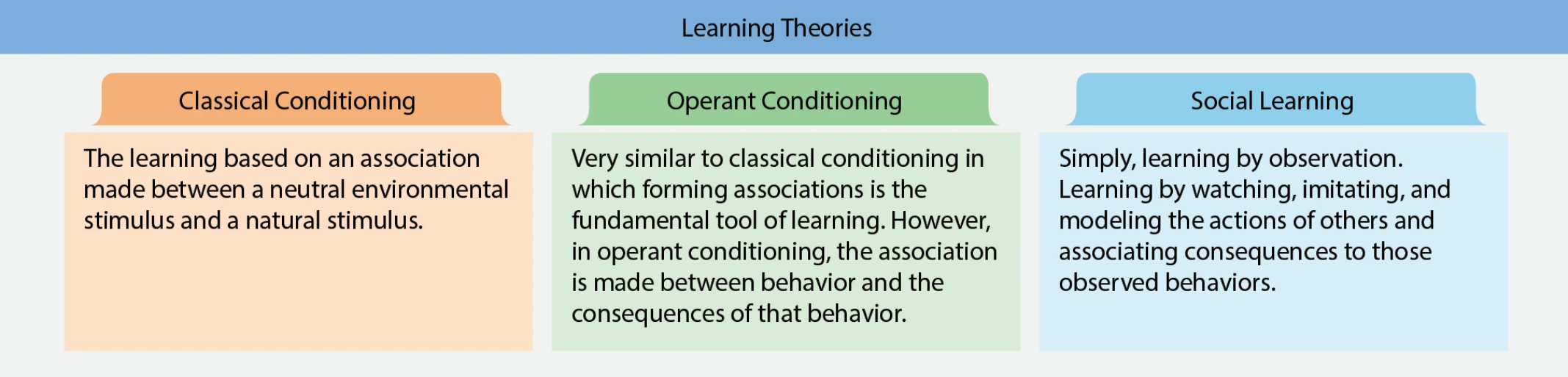
Classical conditioning is learning based on an association made between a neutral environmental stimulus and a natural stimulus. For example, the Russian psychologist Ivan Pavlov discovered that a dog could be trained to associate the sound of a beating metronome with being fed. Pavlov would start the metronome before presenting the dog with food. Over time, the dog learned to associate the unique sound with receiving food and, as a result, the dog would physically respond to only the sound of the metronome. Today, this experiment is commonly referred to as Pavlov’s Dog.
Operant conditioning is very similar to classical conditioning in which forming associations is the fundamental tool of learning. However, in operant conditioning, the association is made between behavior and the consequences of that behavior. In this learning method, a positive behavior creates a positive consequence; a negative behavior creates a negative consequence. The learner then makes an association between behaviors and consequences and then predicts that future behaviors will result in similar consequences.
Social learning is simply learning by observation. Psychologist Albert Bandura's Social Learning Theory suggests, basically, that we all learn from each other. Learning occurs by observing the actions of those around us, imitating those actions, and finally modeling those actions ourselves that others around us may then observe, effectively perpetuating the learning process through continued social interactions. Bandura's theory states that there are four stages associated to social learning:
- Attention—the ability of the observer to pay attention to others around him or her in order to learn.
- Retention—the ability to remember an observed behavior to later repeat that behavior.
- Reproduction—the act of producing a previously observed behavior. This may require additional skills beyond what was initially observed.
- Motivation—the reason to reproduce an observed behavior.
Various branches of learning theory are used in formal training programs to improve and accelerate the learning process. Key concepts such as desired learning outcomes, objectives of the training, and depth of training also apply. When properly integrated, learning principles can be useful to aviation instructors and developers of instructional programs for both pilots and AMTs.
Many psychologists and educators have attempted to explain how people learn. While variations abound, modern learning theories grew out of two concepts of how people learn: behaviorism and cognitive theory.
Behaviorism
Behaviorism explains animal and human behavior entirely in terms of observable and measurable responses to stimuli. Behaviorism was introduced in the twentieth century and its followers believed all human behavior is conditioned more or less by events in the environment. Thus, human behavior can be predicted based on past rewards and punishments. Classic behaviorist theory in education stressed a system of rewards and punishment or the “carrot and stick” approach to learning. In modern education circles, behaviorism stresses the importance of having a particular form of behavior positively reinforced by someone (other than the learner) who shapes or controls what is learned. In aviation training, the instructor provides the reinforcement.
Today, behaviorism is now used more to break unwanted behaviors, such as smoking, than in teaching. The popularity of behaviorism has waned due to research that indicates learning is a much more complex process than a response to stimuli. Humans, far from being passive products of experience, are always actively interacting with the environment.
Cognitive Theory
Cognitive theory focuses on what is going on inside the mind. It is more concerned with cognition (the process of thinking and learning)—knowing, perceiving, problem-solving, decision-making, awareness, and related intellectual activities—than with stimulus and response. Learning is not just a change in behavior; it is a change in the way a learner thinks, understands, or feels. Theories based on cognition are concerned with the mental events of the learner. Much of the recent psychological thinking and experimentation in education includes some facets of the cognitive theory.
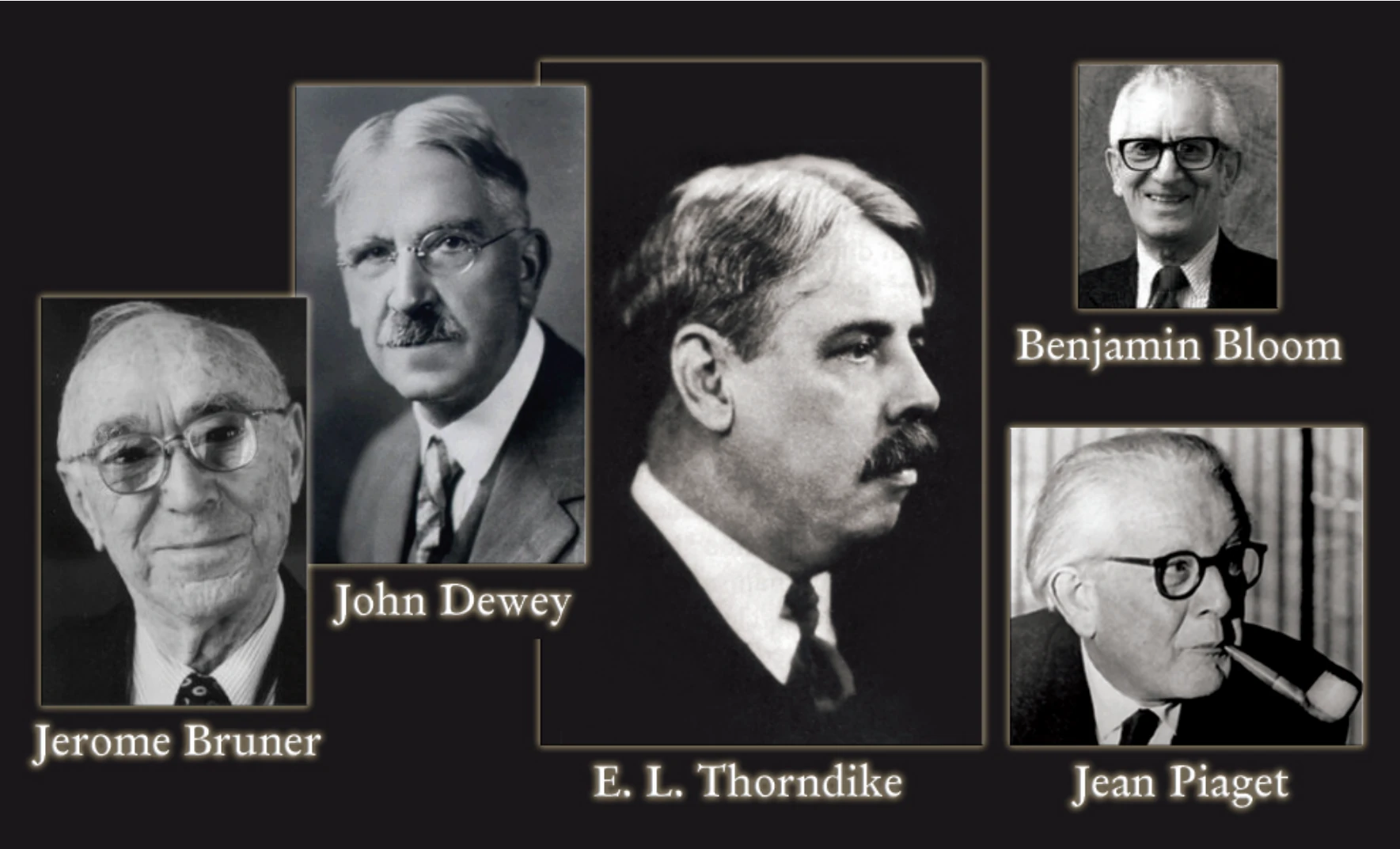
Theories of cognitive learning were established by psychologists and educators such as John Dewey, Jean Piaget, Benjamin Bloom, and Jerome Bruner. [Figure 3-3] There have been many interpretations of the research data dealing with cognitive theories. This has led to many different models for learning as well as some associated catch phrases.
For example, educator, psychologist, and philosopher, John Dewey introduced the concept “reflective thought.” Dewey believed learning improves to the degree that it arises out of the process of reflection. Over the years, terminology describing reflection has spawned a host of synonyms, such as “critical thinking,” “problem-solving,” and “higher level thought.”
For Dewey, the concept of reflective thought carried deep meaning. He saw reflection as a process that moves a learner from one experience into the next with deeper understanding of its relationships with and connections to other experiences and ideas. Thus, reflection leads the learner from the unclear to the clear.
Jean Piaget, who spent 50 years studying how children develop intellectually, became a major figure in the school of cognitive thought. His research led him to conclude there is always tension between assimilation (old ideas meeting new situations) and accommodation (changing the old ideas to meet the new situations). The resolution of this tension results in intellectual growth. Thus, humans develop cognitive skills through active interaction with the world (a basic premise of scenario-based training (SBT), discussed later in this chapter).
An American psychologist who studied with Piaget, Jerome Bruner became interested in how intellectual development related to the process of learning. His research led him to advocate learning from the known to the unknown, or from the concrete to the abstract, because humans best learn when relating new knowledge to existing knowledge. He introduced and developed the concept of the spiral curriculum, which revisits basic ideas repeatedly and builds on them in increasingly sophisticated ways as the learner matures and develops.
Consider the opening scenario with Bill and Beverly. Bill might effectively use this theory with Beverly because she arrived at her first class with a store of aviation facts. Building upon this knowledge, Bill can teach her how to keep the aircraft in straight and level flight while he reinforces what she knows about basic aerodynamics via demonstration and discussion. Since aerodynamics is a constant thread in the flight lessons, Bill is also able to employ the spiral curriculum concept in future lessons by repeatedly revisiting the basic concepts and building upon them as Beverly’s skill and knowledge increase.
A group of educators led by Benjamin Bloom tried to classify the levels of thinking behaviors thought to be important in the processes of learning. [Figure 3-4] They wanted to classify education goals and objectives based on the assumption that abilities can be measured along a continuum from simple to complex. The result, which remains a popular framework for cognitive theory, was Bloom’s Taxonomy of the Cognitive Domain. The taxonomy (a classification system according to presumed relationships) comprises six levels of intellectual behavior and progresses from the simplest to the most complex: knowledge, comprehension, application, analysis, synthesis, and evaluation. For more detailed information about the taxonomy, see Domains of Learning.