
Chapter 3
The Learning Process
SBT not only meets the challenge of teaching aeronautical knowledge to the application level of learning, but also enables the instructor to teach the underlying HOTS needed to improve ADM. The best use of scenarios draws the learner into formulating possible solutions, evaluating the possible solutions, deciding on a solution, judging the appropriateness of that decision and finally, reflecting on the mental process used in solving the problem. It causes the learner to consider whether the decision led to the best possible outcome and challenges the learner to consider other solutions.
SBT scenarios help learners better understand the decisions they have to make and also helps focus the learner on the decisions and consequences involved. It is being used to train people in everything from emergency response to hotel management. The strength of SBT lies in helping the learner gain a deeper understanding of the information and in the learner improving his or her ability to recall the information. This goal is reached when the material is presented as an authentic problem in a situated environment that allows the learner to “make meaning” of the information based on his or her past experience and personal interpretation.
SBT has become one of the primary methods to teach today’s aviation learners how to make good aeronautical decisions which in turn enhances the safety of all aviation related activities. For information on how to create an SBT lesson, refer to Chapter 5, The Teaching Process, and for how to incorporate SBT into a training syllabus, refer to Chapter 7, Planning Instructional Activity.
Perceptions
Initially, all learning comes from perceptions, which are directed to the brain by one or more of the five senses: sight, hearing, touch, smell, and taste. Psychologists have also found that learning occurs most rapidly when information is received through more than one sense. [Figure 3-5]
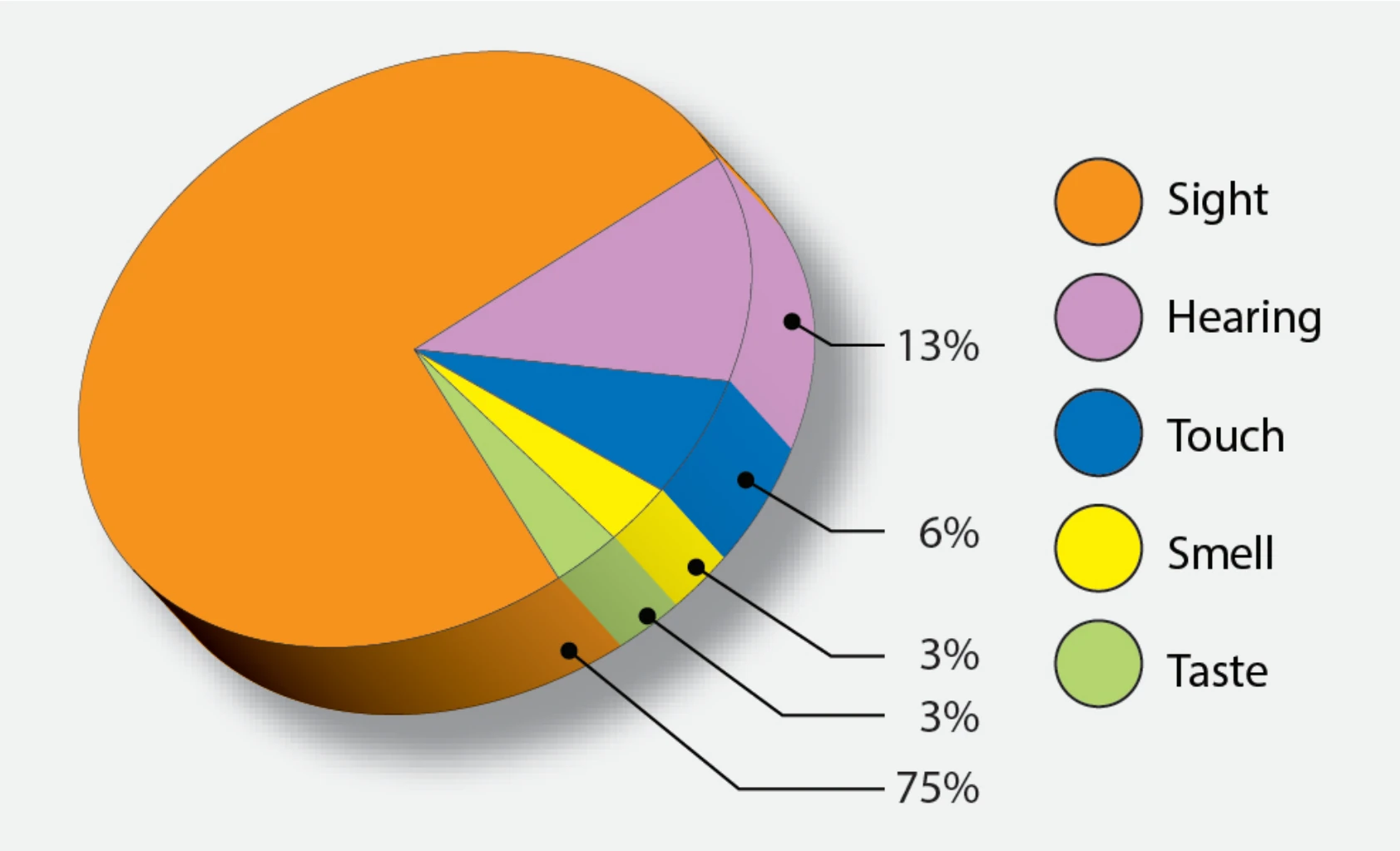
Perception involves more than the reception of stimuli from the five senses; it also involves a person giving meaning to sensations. People base their actions on the way they believe things to be. The experienced AMT, for example, perceives an engine malfunction quite differently than does an inexperienced learner. This occurs because the beginning aviation learner is overwhelmed by stimuli and often focuses on meaningless things, thus missing key information. It is important for the instructor to direct trainee’s perceptions initially so that the learner detects and perceives relevant information.
Real meaning comes only from within a person, even though the perceptions, which evoke these meanings, result from external stimuli. The meanings, which are derived from perceptions, are influenced not only by the individual’s experience, but also by many other factors. Knowledge of the factors that affect the perceptual process is very important to the aviation instructor because perceptions are the basis of all learning.
Factors that Affect Perception
Both internal and external factors affect an individual’s ability to perceive:
- Physical organism
- Goals and values
- Self-concept
- Time and opportunity
- Element of threat
Physical Organization
The physical organism provides individuals with the perceptual apparatus for sensing the world around them. Pilots, for example, need to see, hear, feel, and respond adequately while they are in the air.
Goals and Values
Perceptions depend on one’s values and goals. Every experience and sensation, which is funneled into one’s central nervous system, is colored by the individual’s own beliefs and value structures. Spectators at a ball game may see an infraction or foul differently depending on which team they support. The values of the learner are important for the instructor to know, because this knowledge assists in predicting how he or she interprets experiences and instructions.
Goals are also a product of one’s value structure. Things that are more highly valued and cherished are pursued; those accorded less value and importance are not sought after.
Self-Concept
Self-concept is a powerful determinant in learning. A learner’s self-image, described in such terms as “confident” or “insecure,” has a great influence on the total perceptual process. If a learner’s experiences tend to support a favorable self-image, the learner tends to remain receptive to subsequent experiences. If a learner has negative experiences, which tend to contradict self-concept, there is a tendency to reject additional training.
A negative self-concept inhibits the perceptual processes by introducing psychological barriers, which tend to keep the learner from perceiving. They may also inhibit the ability to properly implement what is perceived. That is, self-concept affects the ability to actually perform or do things. Learners who view themselves positively, on the other hand, are less defensive and more receptive to new experiences, instructions, and demonstrations.