
Chapter 4
Effective Communication
Introduction
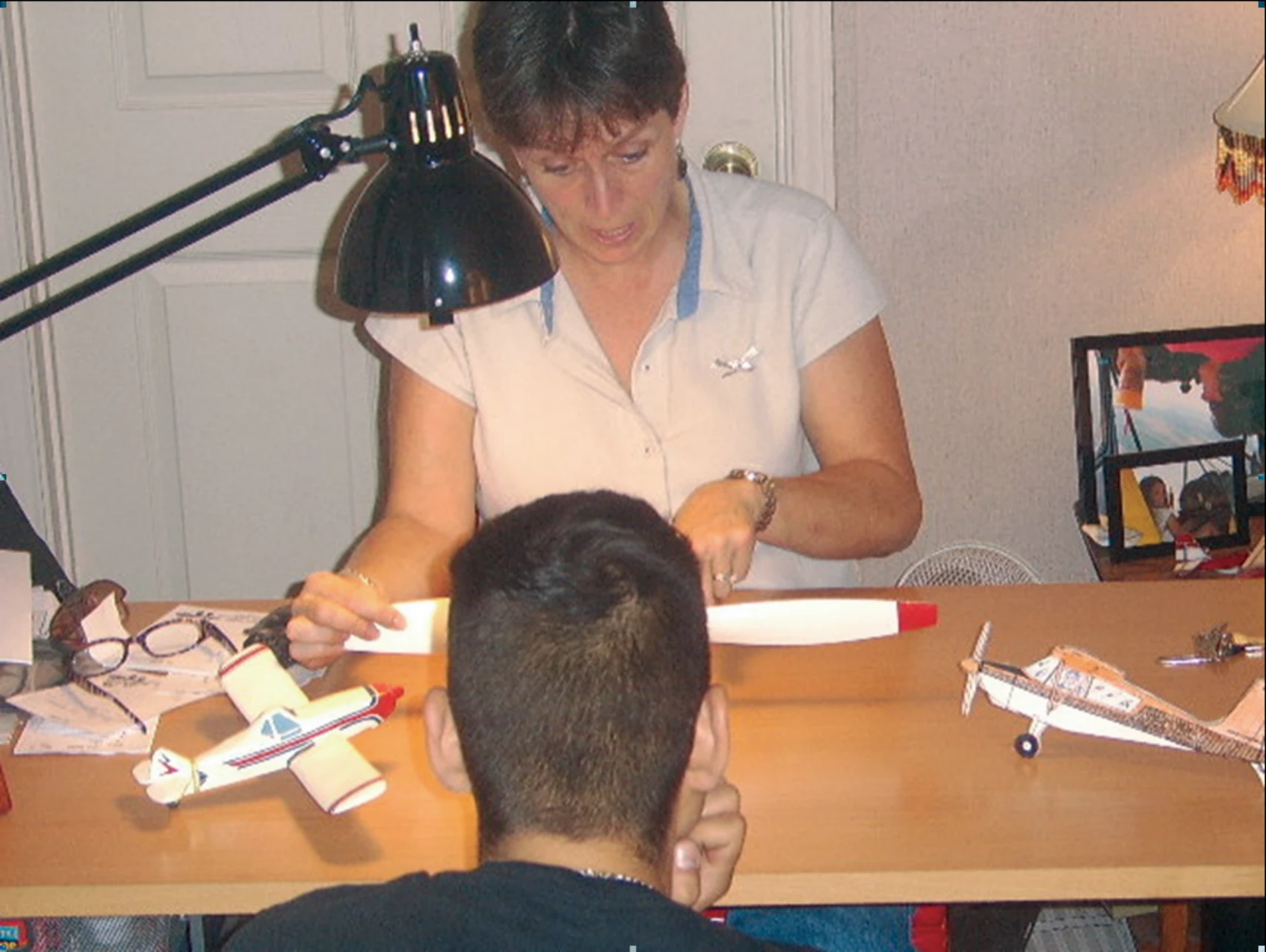
Carol, a flight instructor, has planned the first tailwheel flight with Jacob, her learner pilot. She begins the preflight briefing with an explanation of the tendency of tailwheel aircraft to yaw in normal takeoff. This yawing tendency gives the illusion that the tailwheel aircraft is unstable during the takeoff. Since this yawing tendency occurs on every takeoff, it is predictable and the pilot is able to compensate for it. Carol then discusses the precession, which causes the noticeable yaw when the tail is raised from a three-point attitude to a level flight attitude. This change of attitude tilts the horizontal axis of the propeller, and the resulting precession produces a forward force on the right side (90° ahead in the direction of rotation), yawing the aircraft’s nose to the left. To demonstrate the yawing tendency, she places a model aircraft prop under a desk lamp. [Figure 4-1] By moving the prop, the shadow it casts illustrates the pitch change of the propeller when the aircraft is on its tailwheel and when the aircraft is raised to a level flight attitude.
Effective communication is an essential element of instruction. An aviation instructor may possess a high level of technical knowledge, but he or she needs to cultivate the ability to communicate effectively in order to share this knowledge with learners. Although communication is a complex process, aviation instructors need to develop a comfortable style of communication that meets the goal of passing on desired information to learners.
Communicating effectively is based on similarity of the idea transmitted by the source and received by the receiver. Similarly, as the source, instructors have communicated effectively if the learner has understood the idea/concept/action transmitted in the manner in which it was intended to be understood.
It is also important to recognize that communication is a two-way process. Each instructor and learner may have a unique communication style, and bridging the gap between these styles is an important aspect of providing instruction. The elements of effective communication, the barriers to communication, and the development of communication skills are discussed in this chapter.
Basic Elements of Communication
Communication takes place when one person transmits ideas or feelings to another person or group of people. The effectiveness of the communication is measured by the similarity between the idea transmitted and the idea received. The process of communication is composed of three elements:
- Source (sender, speaker, writer, encoder, transmitter, or instructor)
- Symbols used in composing and transmitting the message (words or signs [model prop/desk lamp in Figure 4-1])
- Receiver (listener, reader, decoder, or learner)
The three elements are dynamically interrelated since each element is dependent on the others for effective communication to take place. The relationship between the source and the receiver is also dynamic and depends on the two-way flow of symbols between the source and the receiver. The source depends on feedback from the receiver to properly tailor the communication to the situation. The source also provides feedback to the receiver to reinforce the desired receiver responses.
Source
As indicated, the source in communication is the sender, speaker, writer, encoder, transmitter, or instructor. The effectiveness of persons acting in the role of communicators is related to at least three basic factors.
First, their ability to select and use language is essential for transmitting symbols that are meaningful to listeners and readers. It is the responsibility of the speaker or writer, as the source of communication, to realize that the effectiveness of the communication is dependent on the receiver’s understanding of the symbols or words being used. For example, if an aviation maintenance instructor were to use aviation acronyms like ADs, TCDS or STCs or a flight instructor were to use aviation acronyms like ILS, TCAS, or TAWS with a new maintenance learner or learner pilot respectively, effective communication would be difficult if not impossible.
Second, communicators consciously or unconsciously reveal information about themselves. This includes their self-image, their view of the ideas being communicated, and their feelings toward the receivers. Communicators need to be confident; they should illustrate that the message is important, and that the receivers have a need to know the ideas presented.
Third, successful communicators speak or write from accurate, up-to-date, and stimulating material. Communicators should convey the most current and interesting information available. Doing so holds the receiver’s interest. Out-of-date information causes the instructor to lose credibility, and uninteresting information may cause the receiver’s attention to be lost.
Symbols
At its basic level, all communication is achieved through symbols, which are simple oral, visual, or tactile codes. The words in the vocabulary constitute a basic code. Common gestures and facial expressions form another, but codes and symbols alone do not communicate complex concepts. These are communicated only when symbols are combined in meaningful wholes as ideas, sentences, paragraphs, speeches, or chapters that mean something to the receiver. When symbols are combined into these units, each portion becomes important to effective communication.
On a higher level, communication with symbols relies upon different perceptions, sometimes referred to as channels. While many theories have been proposed, one popular theory indicates that the symbols are perceived through one of three sensory channels: visual, auditory, or kinesthetic. As discussed in Chapter 3, visual learners rely on seeing, auditory learners prefer listening and speaking, while kinesthetic learners process and store information through physical experience such as touching, manipulating, using, or doing.
The instructor may gain and retain the learner’s attention by using a variety of channels. As an example, instead of telling a learner to adjust the trim, the instructor can move the trim wheel while the learner tries to maintain a given aircraft attitude. The learner experiences by feel that the trim wheel affects the amount of control pressure needed to maintain the attitude. At the same time, the instructor can explain to the learner that what is felt is forward or back pressure on the controls. After that, the learner begins to understand the correct meaning of control pressure and trim, and when told to adjust the trim to relieve control pressure, the learner responds in the manner desired by the instructor. Instructors commonly rely on the hearing and seeing channels of communication. However, using all channels may improve the learning process. For teaching motor skills, the sense of touch, or kinesthetic learning, is added as the learner practices the skill.
An instructor should constantly monitor feedback from the learner in order to identify misunderstandings and tailor the presentation of information. Periodically asking the learner to explain his or her understanding of new information while it is being conveyed is one way to obtain such feedback. The instructor may then modify the symbols he or she uses, as appropriate, to optimize communication. [Figure 4-2] In addition to feedback received by the instructor, learners also need feedback from the instructor on how they are doing. The feedback not only informs the learners of their performance, but can also serve as a valuable source of motivation. An instructor’s praise builds the learner’s self-confidence and reinforces favorable behavior. On the other hand, negative feedback should be used carefully. To avoid embarrassing a learner, use negative feedback only in private. This information should be delivered as a description of actual performance and given in a nonjudgmental manner.