
Chapter 4
Effective Communication
Confusion Between the Symbol and the Symbolized Object
Confusion between the symbol and the symbolized object results when a word is confused with what it is meant to represent. Although it is obvious that words and the connotations they carry can be different, people sometimes fail to make the distinction. An aviation maintenance technician (AMT) might be introduced as a mechanic. To many people, the term mechanic conjures up images of a person laboring over an automobile. Being referred to as an aircraft mechanic might be an improvement in some people’s minds, but neither really portrays the training and skill of the AMT. Words and symbols do not always represent the same thing to every person. To communicate effectively, speakers and writers should account for possible misinterpretation. Words and symbols can then be chosen to represent what the speaker or writer intends.
Overuse of Abstractions
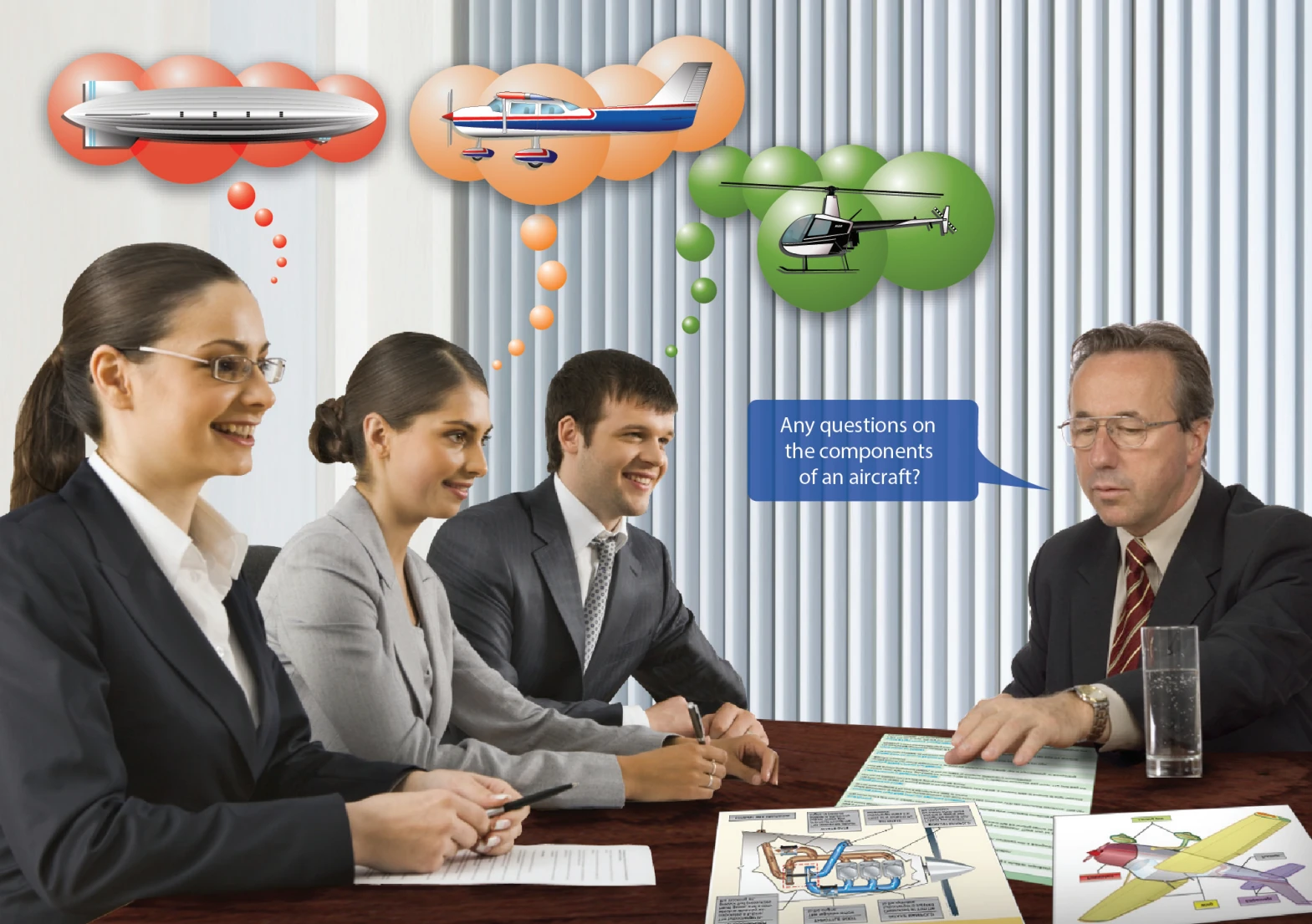
Abstractions are words that are general rather than specific. Concrete words or terms refer to objects people can relate directly to their own experiences. These words or terms specify an idea that can be perceived or a thing that can be visualized. Abstract words, on the other hand, stand for ideas that cannot be directly experienced, things that do not call forth mental images in the minds of the learners. The word aircraft is an abstract word. It does not call to mind a specific aircraft. One learner may visualize an airplane, while another might visualize a helicopter, and still another learner might visualize an airship. [Figure 4-4] Although the word airplane is more specific, various learners might envision anything from a Boeing 777 to a Piper Cub.
Aircraft engines represent another example of abstractions. When an instructor refers to aircraft engines in general, some learners might think of jet engines, while others would think of reciprocating engines. Even reciprocating engine is too abstract since it could be a radial engine, an inline engine, a V-type engine, or an opposed type engine. Use of the technical language of engines, as in Lycoming IO-360, would narrow the engine type, but would only be understood by learners who understand the terminology particular to aircraft engines.
Abstractions should be avoided in most cases, but there are times when abstractions are necessary and useful. Aerodynamics is applicable to all aircraft and is an example of an abstraction that can lead to understanding aircraft flight characteristics. The danger of abstractions is that they do not evoke the same specific items of experience in the minds of the learners that the instructor intends. When such terms are used, they should be linked with specific experiences through examples and illustrations.
For instance, when an approach to landing is going badly, telling a learner to take appropriate measures might not result in the desired action. It would be better to tell the learner to conduct a go-around since this is an action that has the same meaning. When maintenance learners are being taught to torque the bolts on an engine, it would be better to tell them to torque the bolts in accordance with the maintenance manual for that engine rather than simply to torque the bolts to the proper values. Whenever possible, the level of abstraction should be reduced by using concrete, specific terms. This better defines and gains control of images produced in the minds of the learners.
External Factors
Some barriers to effective communication can be controlled by the instructor. Others are external factors outside of the instructor’s control that prevent a process or activity from being carried out properly. These factors may include physiological, environmental, and psychological elements. To communicate effectively, the instructor should consider the effects of these factors and mitigate them where possible.
Physiological external factors include biological conditions such as hearing loss, injury, physical illness, or other congenital condition. These physiological factors may cause learner discomfort and inhibit communication. The instructor should adapt the presentation to allow the learner to feel better about the situation and be more receptive to new ideas. Adaptation could be as simple as putting off a lesson until the learner is over an illness. Another accommodation could be the use of a seat cushion to allow a learner to sit properly in the airplane.
With the advent of more sophisticated technology, multitasking has become a form of physiological external factors. The term multitask comes from a computer’s ability to simultaneously execute more than one program or task at a time. Although it now refers to humans performing multiple tasks simultaneously, humans are not computers. Research shows that although human comprehension can handle two simple, low-level cognitive tasks at once, a higher level cognitive task takes brain function and concentration to perform optimally. Adding even a simple activity diminishes the comprehension and recall of both. Research shows that multitasking is just a series of constant micro-interruptions and “stop-go” decisions, all of which tend to reduce mental and motor performance.
Environmental external factors are caused by external physical conditions. One example of this is the noise level found in many light aircraft. Noise not only impairs the communication process, but also can result in long-term damage to hearing. One solution to this problem is the use of headphones and an intercom system. If an intercom system is not available, a good solution is the use of earplugs. It has been shown that in addition to protecting hearing, use of earplugs actually clarifies speaker output. Vibration is another possible example of environmental external factors, applicable to rotary wing aircraft.
A psychological external factor is a product of how the instructor and learner feel at the time the communication process is occurring. If either instructor or learner is not committed to the communication process, communication is impaired. Fear of the situation or mistrust between the instructor and learner disrupts communication and severely inhibits the flow of information.
Interference
Interference occurs when the message gets disrupted, truncated, or added to somewhere in the communication sequence. While the instructor or learner may believe that an intact message has been sent and received, the assumption may be inaccurate. Noise and other factors may distort the message. Psychological factors also interfere with the receipt of a message. Instructors and learners confirm the message and its proper communication when observing the effect of a message. Additional feedback and confirmation reduce potential harmful effects from interference.
Developing Communication Skills
Communication skills need to be developed; they do not occur automatically. The ability to effectively communicate stems from experience. The experience of instructional communication begins with role playing during training to be an instructor, continues during the actual instruction, and is enhanced by additional training.
Role Playing
Role playing is a method of learning in which learners perform a particular role. In role playing, the learner is provided with a general description of a situation and then applies a new skill or knowledge to perform the role. Experience in instructional communication comes from actually doing it and is learned in the beginning by role playing during the instructor’s initial training. For example, a flight instructor applicant can fly with a flight instructor who assumes the role of a learner pilot. In this role, the flight instructor can duplicate known learner responses and then critique the applicant’s role as instructor. A mentor or supervisor can play the learner AMT for a maintenance instructor applicant.