
Chapter 4
Effective Communication
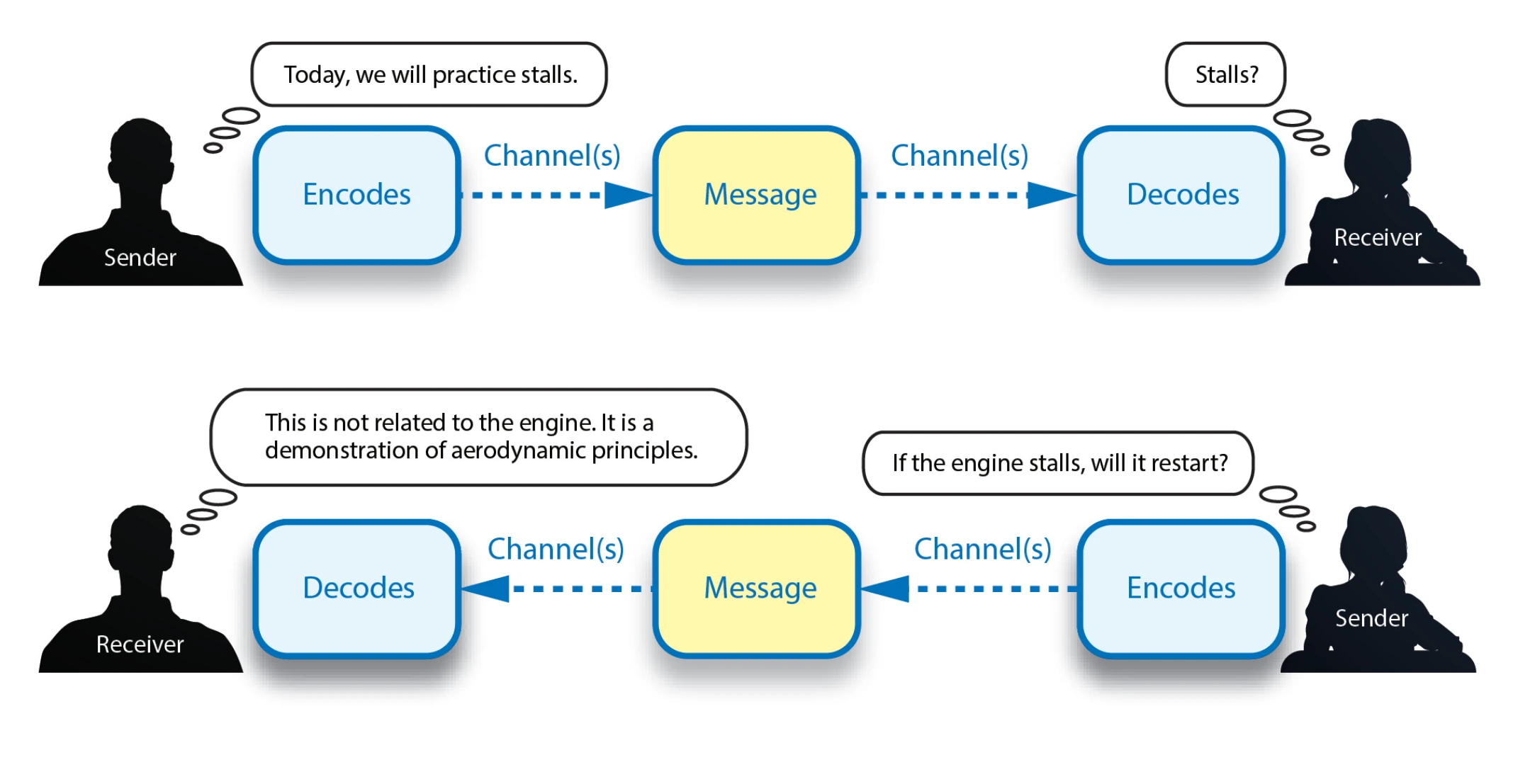
For example, it would be appropriate to tell a maintenance learner that a safety wire installation is not satisfactory. To refer to the work as careless would not be good and could do harm to the learner’s feeling of self-worth.
The parts of the total idea should be analyzed to determine which are most suited to starting or ending the communication, and which are best for the purpose of explaining, clarifying, or emphasizing. All of these functions are required for effective transmission of ideas. The process finally culminates in the determination of the medium best suited for their transmission.
Receiver
The receiver is the listener, reader, decoder, or learner—the individual or individuals to whom the message is directed. Effective communicators should always keep in mind that communication succeeds only in relation to the reaction of their receivers. When the receiver reacts with understanding and changes his or her behavior according to the intent of the source, effective communication has taken place.
In order to understand the process of communication, three characteristics of receivers need to be understood: abilities, attitudes, and experiences.
First, an instructor needs to determine the abilities of the learner in order to properly communicate. One factor that can have an effect on learner ability is his or her background. For example, consider how familiar the learner may be with aviation. The familiarity may range from having grown up around aviation to absolutely no familiarity at all. Some learners may have highly developed motor skills, and others have not had opportunities to develop these skills. These factors should be taken into consideration when presenting information to a learner.
The instructor should also understand that the viewpoint and background of people may vary because of cultural differences. The instructor should be aware of possible differences, but not overreact or make assumptions because of these differences. For example, just because a learner is a college graduate does not guarantee rapid advancement in aviation training. A learner’s education certainly affects the instructor’s style of presentation, but that style should be based on the evaluation of the learner’s knowledge of the aviation subject being taught.
Second, the attitudes learners exhibit may indicate resistance, willingness, or passive neutrality. To gain and hold learner attention, attitudes should be molded into forms that promote reception of information. A varied communicative approach works best in reaching most learners since they have different attitudes.
Third, instructors in aviation enjoy a unique advantage over other teachers, in that an aviation learner is usually an adult willing to expend time and money to further knowledge. The typical aviation learner exhibits a much more developed sense of motivation and self-concept than a typical school learner. Additionally, he or she usually comes into the learning environment with a significant amount of prior knowledge, many life experiences, and a number of decision-making skills. The learner's knowledge, abilities, and attitudes affect the instructor's communication strategy.
Barriers to Effective Communication
It is essential to understand the dynamics of communication, but the instructor also needs to be aware of several barriers to communication that can inhibit learning. The nature of language and the way it is used often lead to misunderstandings. These misunderstandings can be identified by four barriers to effective communication: lack of common experience, confusion between the symbol and the symbolized object, overuse of abstractions, and external factors. [Figure 4-3]
Lack of Common Experience
Lack of common experience between the communicator (instructor) and the receiver (learner) is probably the greatest single barrier to effective communication. Communication can be effective only to the extent that the experiences (physical, mental, and emotional) of the participants are similar.
Many people seem to believe that words transport meanings from speaker to listener in the same way that a truck carries bricks from one location to another. Words, however, rarely carry precisely the same meaning from the mind of the instructor to the mind of the learner. In fact, words, in themselves, do not transfer meanings at all. Whether spoken or written, words are merely stimuli used to arouse a response in the learner.
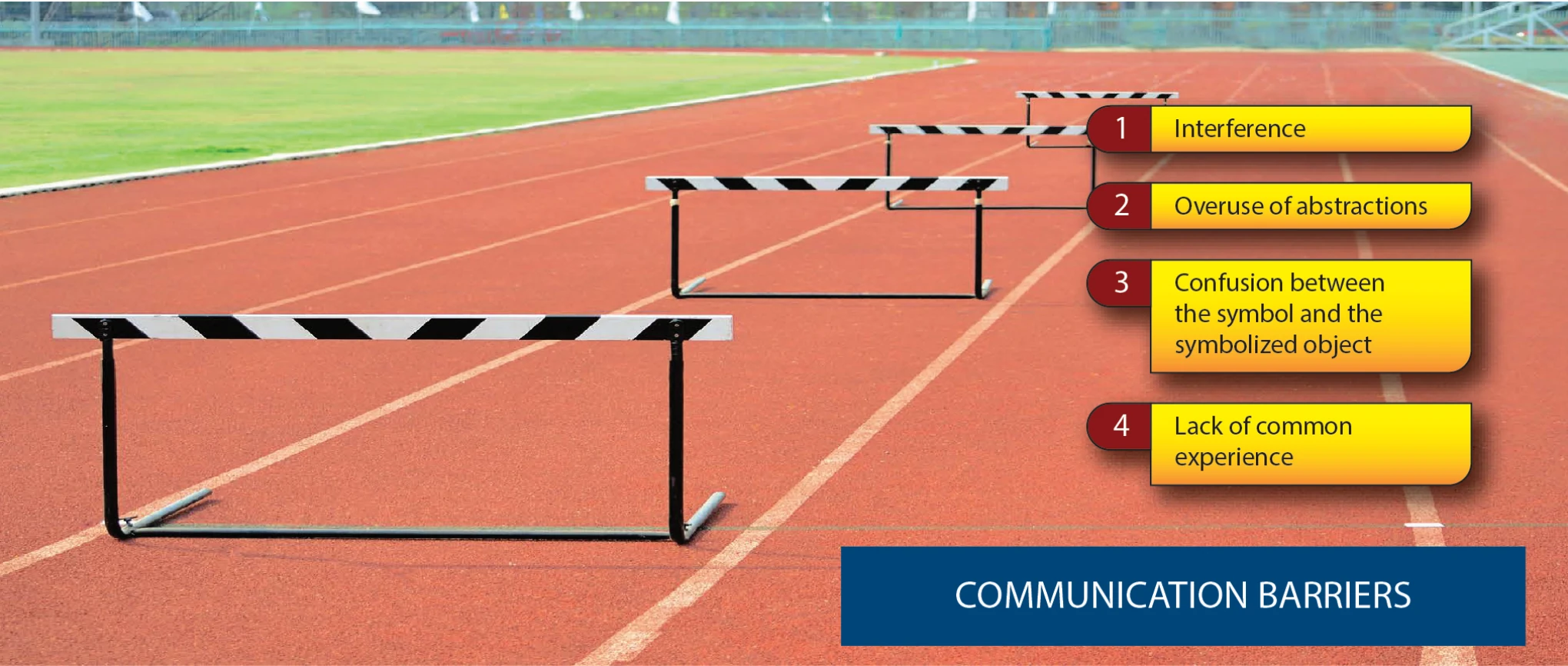
The learner’s past experience with the words and things to which they refer determines how the learner responds to what the instructor says. An instructor’s words cannot communicate the desired meaning to another person unless the learner has had some experience with the objects or concepts to which these words refer. Since it is the learners’ experience that forms vocabulary, it is also essential that instructors speak the same language as the learners. When the instructor’s terminology is necessary to convey the idea, some time needs to be spent making certain the learners understand that terminology.
For example, a maintenance instructor tells a learner to time the magnetos. A learner new to the maintenance field might think a stopwatch or clock would be necessary to do the requested task. Instruction would be necessary for the learner to understand that the procedure has nothing to do with the usual concept of time.
The English language abounds in words that mean different things to different people. To a farmer, the word “tractor” means the machine that pulls the implements to cultivate the soil; to a trucker, it is the vehicle used to pull a semitrailer; in aviation, a tractor propeller is the opposite of a pusher propeller. Each technical field has its own vocabulary. Technical words might mean something entirely different to a person outside that field, or perhaps mean nothing at all. In order for communication to be effective, the learners’ understanding of the meaning of the words needs to be the same as the instructor’s understanding.
When either the instructor, the learner, or both utilize English as a second language, the instructor notes whether this creates a significant barrier to communication. Except in cases of special accommodation for a medical disability, any learner seeking a pilot certificate or a maintenance learner seeking to become an AMT with operating privileges in the United States demonstrates the ability to communicate in English before certification or exercise of privilege. If reasonable doubt exists as to the ability of an aviation learner to communicate in English at an appropriate level, the instructor should refer to Advisory Circular (AC) 60-28, FAA English Language Standard for an FAA Certificate Issued Under 14 CFR Parts 61, 63, 65, and 107, for further guidance.