
Chapter 4
Effective Communication
It is essential for the flight instructor to develop good ground instruction skills, as well as flight instruction skills to prepare learners for what is to transpire in the air. Likewise, the maintenance instructor develops classroom teaching skills to prepare the maintenance learner for practical, hands-on tasks. In both cases, effective communication is necessary to reinforce the skills that have been attempted and to assess or critique the results. This development continues as an instructor progresses in experience. What worked early on might be refined or replaced by some other technique as the instructor gains more experience.
A new instructor is more likely to find a comfortable style of communication in an environment that is not threatening. For a prospective maintenance instructor, this might take the form of conducting a class on welding while under the supervision of a maintenance supervisor; the flight instructor applicant usually flies with a flight instructor who role plays as the learner.
Current Federal Aviation Administration (FAA) training emphasis has moved from a maneuvers-based training standard to what is called scenario-based training (SBT). SBT is a highly effective approach that allows learners to understand, then apply their knowledge as they participate in realistic scenarios. This method of instruction and learning allows learners to move from theory to practical application of skills during their training. Instructor applicants, flight or maintenance, need to think in terms of SBT while they are learners. Not only does it prepare them to react appropriately in the situations they encounter in the workplace, it also helps them as instructors when they are responsible for creating scenarios for their learners.
For example, James (the flight instructor applicant) designs a scenario in which Ray (the flight instructor playing the role of learner) is performing stalls to Airman Certification Standards (ACS). James briefs Ray on the maneuver before the flight, demonstrates the stall, and then talks Ray through the maneuver. Ray pretends to be an anxious learner pilot, replicating reactions he himself has experienced with flight learners. After the flight, James critiques their instruction period. As increased emphasis is placed on SBT, there will be a corresponding increase in the importance of role playing.
Instructional Communication
Instruction has taken place when the instructor explains a particular procedure and subsequently determines that the learner exhibits the desired response. Even so, the instructor can improve communication by adhering to techniques of good communication.
One of the basic principles used in public speaking courses is to encourage participants to make presentations about something they understand. It would not be good if an instructor without a maintenance background tried to teach a course for aviation maintenance. Instructors perform better when speaking of something they know very well and for which they have a high level of confidence.
The instructor should not be afraid to use examples of past experiences to illustrate particular points. When teaching the procedures to be used for transitioning from instrument meteorological conditions (IMC) to visual cues during an approach, it would be helpful to be able to tell the learner about encountering these same conditions. An instructor’s personal experiences make instruction more valuable than reading the same information in a textbook. The instructor should be cautioned, however, to exercise restraint with this technique of illustration, as these types of discussions frequently degrade into a “war story” or “there I was” discussion.
The instructor needs some way of determining results, and the method used should be related to the expected outcome. In the case of flight training, the instructor can judge the actual performance of a maneuver. For a maintenance learner, the instructor can judge the level of accomplishment of a maintenance procedure. In both cases, the instructor determines whether the learner has actually received and retained the knowledge or if acceptable performance was a one-time event.
The aviation learner should know how and why something should be done. For example, a maintenance learner may know how to tighten a particular fastener to a specified torque, but it is more important to know that the security and integrity of any fastener depends on proper torque. In this way, the learner would be more likely to torque all fasteners properly in the future. For a flight learner, simply knowing the different airspeeds for takeoffs and landings is not enough. It is essential to know the reasons for different airspeeds in specific situations to fully understand the importance of proper airspeed control. Normally, the instructor determines the level of understanding by use of some type of evaluation. See Chapter 6, Assessment, for more information.
Listening
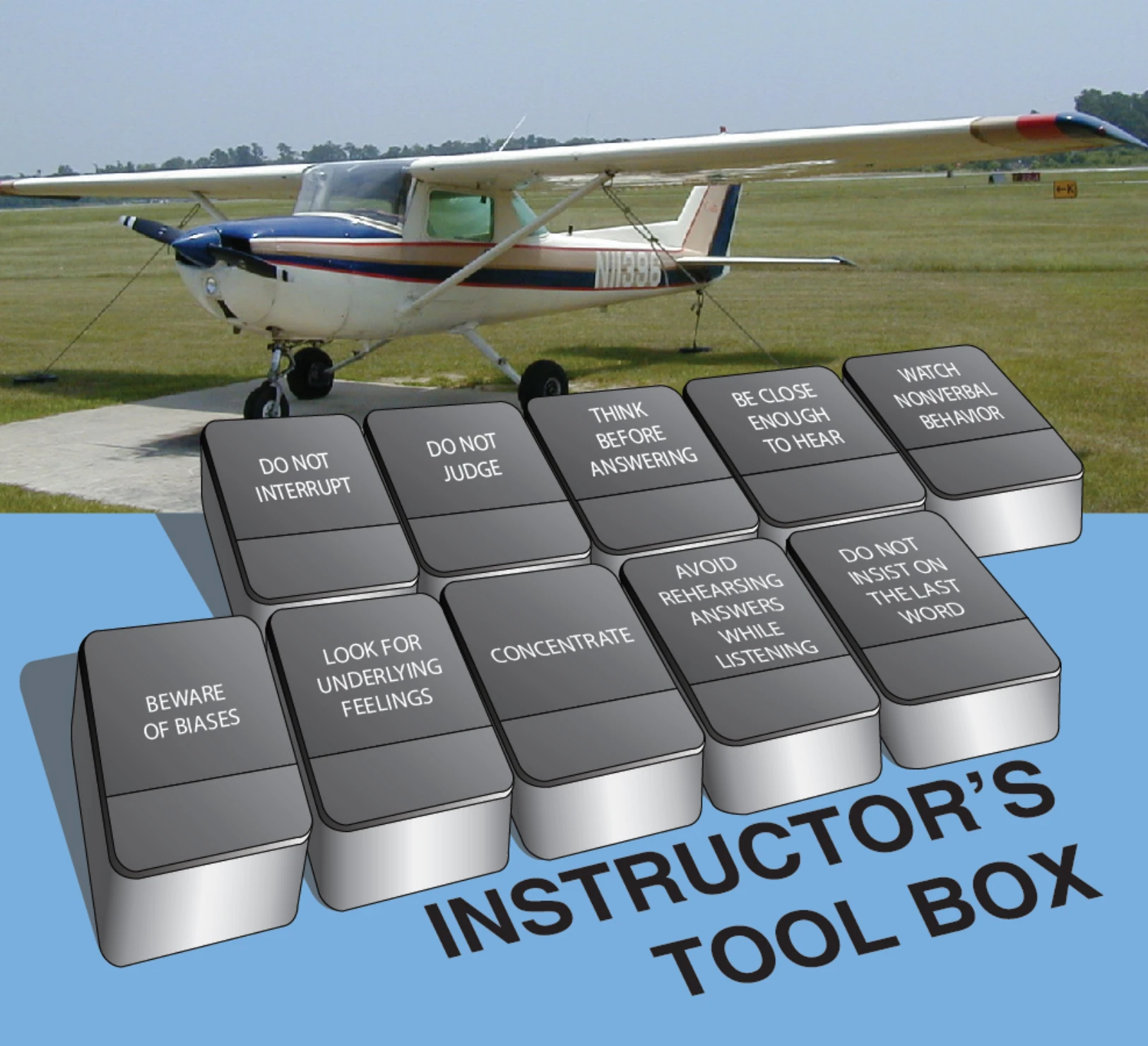
Instructors should know something about their learners in order to communicate effectively. As discussed earlier, an instructor needs to determine the abilities of the learners and properly communicate, and one way of becoming better acquainted with learners is to be a good listener. Good instructors work to master listening ability and frequently self-evaluate in this area. Instructors can use a number of techniques to become better at listening. [Figure 4-5]
Just as it is important for instructors to want to listen in order to be effective listeners, it is necessary for learners to want to listen. Wanting to listen is just one of several techniques that allow a learner to listen effectively. Instructors can improve the percentage of information transfer by teaching learners how to listen. [Figure 4-6]
Listening is more than hearing. Most instructors are familiar with the concept that listening is “hearing with comprehension.” When the learner hears something being communicated, he or she may or may not comprehend what is being transmitted. On the other hand, when the learner truly hears the communication, he or she then interprets the communication based on their knowledge to that point, processes the information to a level of understanding, and attempts to make a correlation of that communicated information to the task at hand. The increased level of motivation of typical flight and aviation maintenance learners makes this process much easier.
Remind learners that certain emotions interfere with how they listen. For example, an instrument learner pilot anticipating drastic changes in requested routing becomes anxious. In this frame of mind, it is very difficult for the learner to listen and process the new route. If a learner who is terrified of the prospect of spins attempts to listen to a lesson on spins, the emotions felt might overwhelm the attempt to listen. This requires a means to allay the anxiety and fear. If the instructor or learner knows that certain areas arouse emotion, they may consider additional conditioning that prepares the learner to listen.
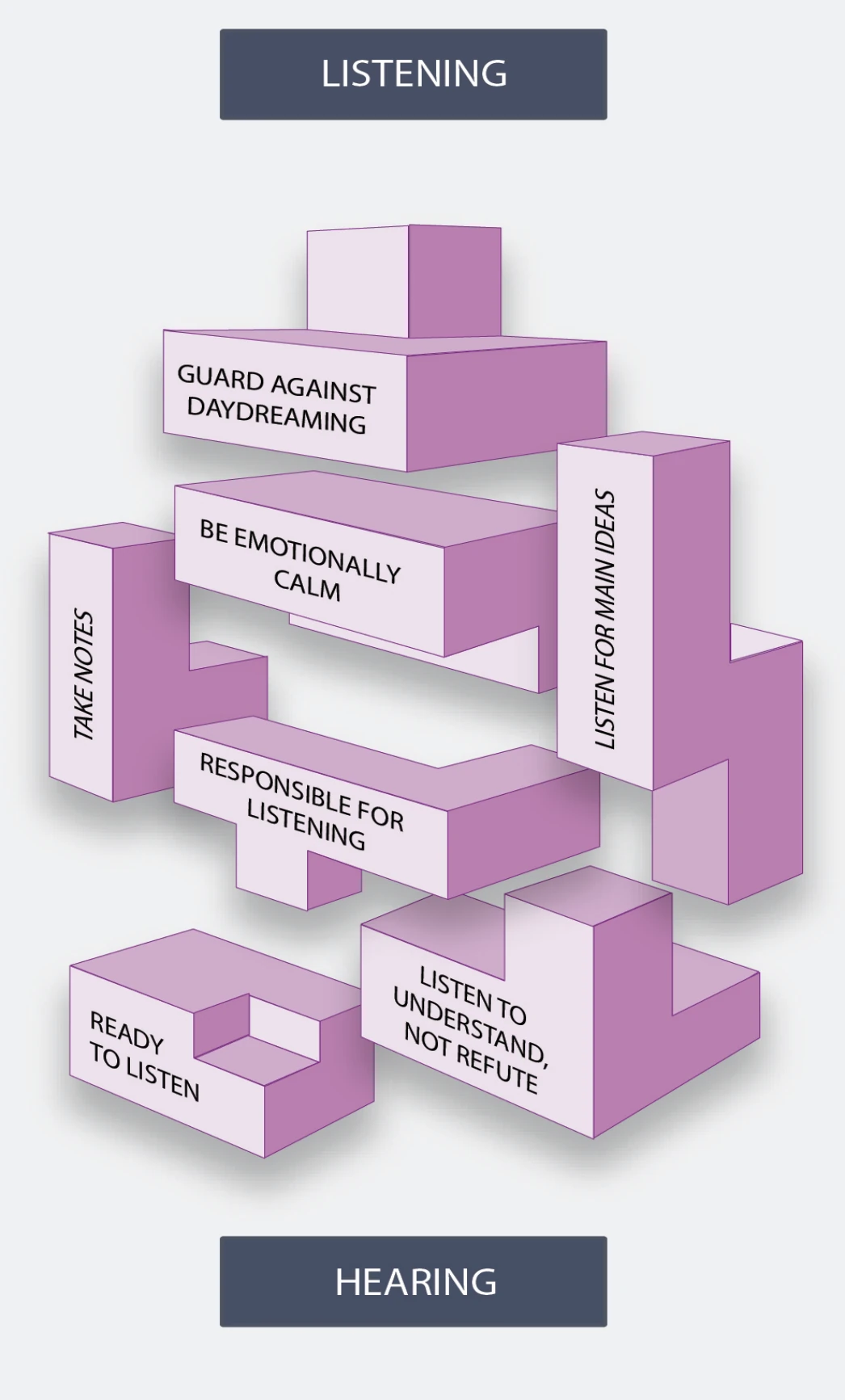
Listening for main ideas is another listening technique. Primarily a technique for listening to a lecture or formal lesson presentation, it sometimes applies to hands-on situations as well. People who concentrate on remembering or recording facts might very well miss the message because they have not picked up on the big picture. A listener should always ask, what is the purpose of what I am listening to? By doing this, the listener can relate the words to the overall concept.
The instructor should ensure that the learner is aware of the danger of daydreaming. Most people can listen much faster than even the fastest talker can speak. This leaves room for the mind to get off onto some other subject. The listener who is aware of this problem can concentrate on repeating, paraphrasing, or summarizing the speaker’s words. Doing so uses the extra time to reinforce the speaker’s words, allowing the learner to retain more of the information.
Nobody can remember everything. Note taking allows the learner to use an organized system to reconstruct what was said during the lesson. Every learner has a slightly different system, but no attempt to record the lecture verbatim should be made.