
Chapter 5
The Teaching Process
Effective instructors have a sincere interest in learning and professional growth. There are a number of professional development opportunities for aviation instructors, such as Federal Aviation Administration (FAA) seminars, industry conventions, professional organizations, and online classes. Networking with and observing other instructors and seeking mentoring from an experienced instructor to learn new strategies is also helpful. By being a lifelong learner, the aviation professional remains current in both aviation and education. This topic is explored more thoroughly in the section titled Professional Development found within Chapter 8 of this handbook: Instructor Responsibilities and Professionalism
Management Skills
Management skills generally include the ability to plan, organize, lead, and supervise. For the effective instructor, this translates into being able to plan, organize, and carry out a lesson. A well-planned lesson means the instructor is also practicing time management skills and ensures the time allocated for the lesson is used effectively.
To manage time well, it is important that an instructor plans how to use the time to achieve the lesson goals. This includes time for what needs to be done as well as time to handle the unexpected. It minimizes stress by not planning too much for the allotted time.
Time management also come into play for the aviation instructor who is teaching a class. Consider the opening scenario in which Bob arrived early for the class and ensured the classroom was ready by completing a series of tasks.
Another management skill that enhances the effectiveness of aviation instructors is supervision of the learners. For the flight instructor, this may entail overseeing the preflight procedures. For the maintenance instructor, this may mean monitoring a maintenance procedure. While it is important to provide hands-on tasks in the lesson plan to engage learners, it is also important to ensure the learners complete the tasks correctly.
Assessment Skills
In Chapter 3, The Learning Process, learning was defined as a change in the behavior as a result of experience. The behavior can be physical and overt, or it can be intellectual or attitudinal. This change is measurable and therefore can be assessed.
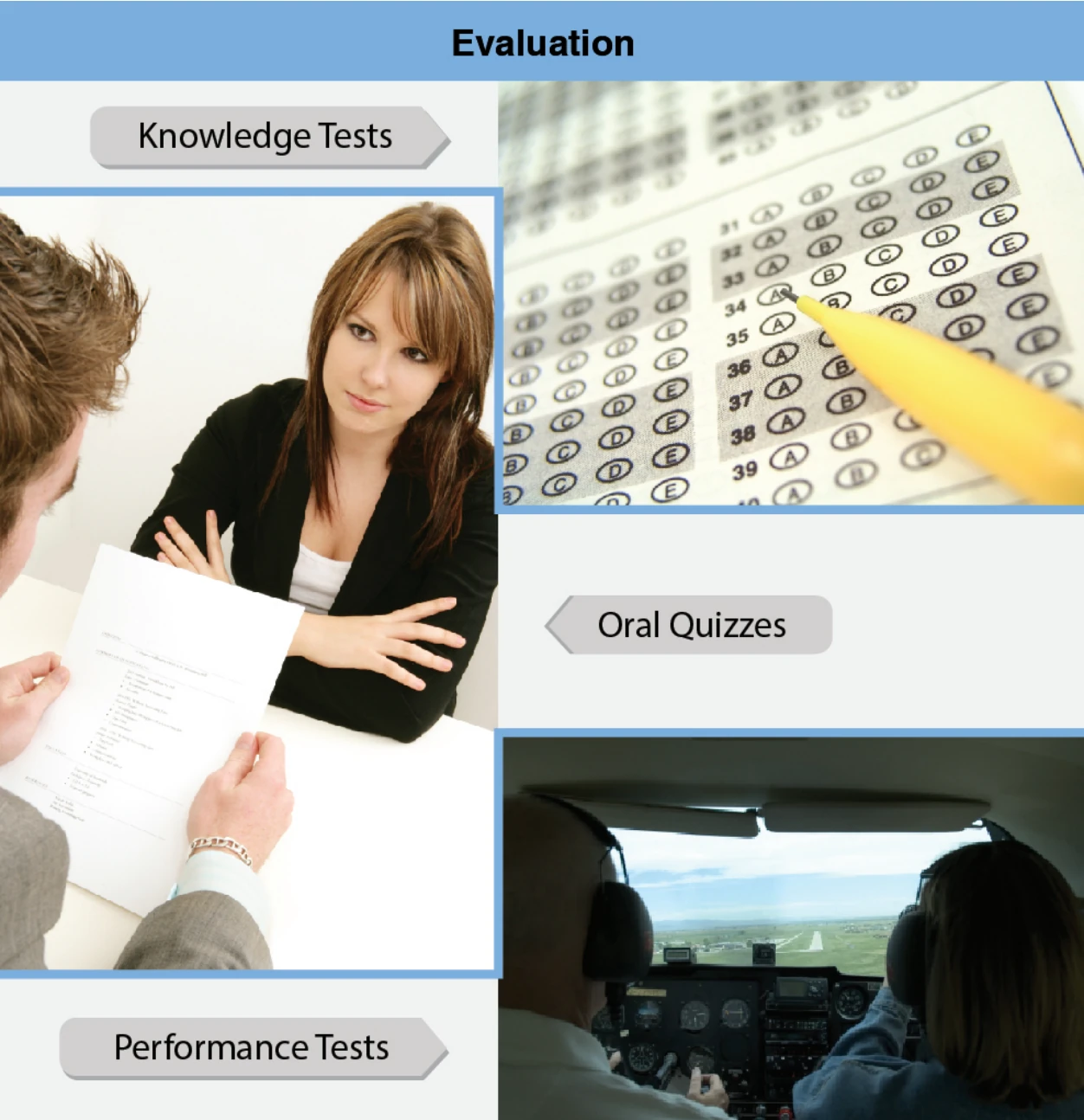
Assessment of learning is a complex process, and it is important to be clear about the purposes of the assessment. There are several points at which assessments can be made: before training, during training, and after training. Assessment of learning is another important skill of an effective instructor. [Figure 5-2] This topic is discussed in detail in Chapter 6, Assessment.
Instructor's Code of Ethics
While many of the characteristics of effective instructors discussed in the previous paragraphs hold true for any instructor, the aviation instructor has the added responsibility of molding an aviation citizen—a pilot or maintenance technician who will be an asset to the rest of the aviation community. The following code describes the concept of a good aviation citizen.
An aviation instructor needs to remember he or she is teaching a pilot or technician who should:
- Make safety the number one priority,
- Develop and exercise good judgment in making decisions,
- Recognize and manage risk effectively,
- Be accountable for his or her actions,
- Act with responsibility and courtesy,
- Adhere to prudent operating practices and personal operating parameters, and
- Adhere to applicable laws and regulations.
In addition, an aviation instructor needs to remember he or she is teaching a pilot who should:
- Seek proficiency in control of the aircraft,
- Use flight deck technology in a safe and appropriate way,
- Be confident in a wide variety of flight situations, and
- Be respectful of the privilege of flight.
These concepts are also part of the Flight Instructors Model Code of Conduct (FIMCC), designed to enhance flight and ground instructor safety and professionalism. Developed by a diverse team of aviation professionals and extensively peer-reviewed within the aviation community, the FIMCC offers a vision of excellence to help flight and ground instructors build professional relationships with their learners.
A formal code of conduct/ethics serves as a tool to promote safety, good judgment, ethical behavior, and personal responsibility—all components of professionalism. The code offers a vision of flight education excellence, and it recommends operating practices to improve the quality and safety of flight instruction. The FIMCC is one of several similar codes that can be found at www.secureav.com. such as the Aviator’s Model Code of Conduct and a Student Pilot’s Model Code of Conduct. The National Association of Flight Instructors (NAFI) and the Society of Aviation and Flight Educators (SAFE), as well as similar groups, also have a code of ethics for instructors posted on their websites. ([source link](https://www.secureav.com))
Course of Training
In education, a course of training is a complete series of studies leading to attainment of a specific goal. The goal might be a certificate of completion, graduation, or an academic degree. For example, a learner pilot may enroll in a private pilot certificate course, and upon completion of all course requirements, be awarded a graduation certificate. A course of training also may be limited to something like the additional training required for operating high-performance airplanes.