Chapter 5
The Teaching Process
Other terms closely associated with a course of training include curriculum, syllabus, and lesson plan.
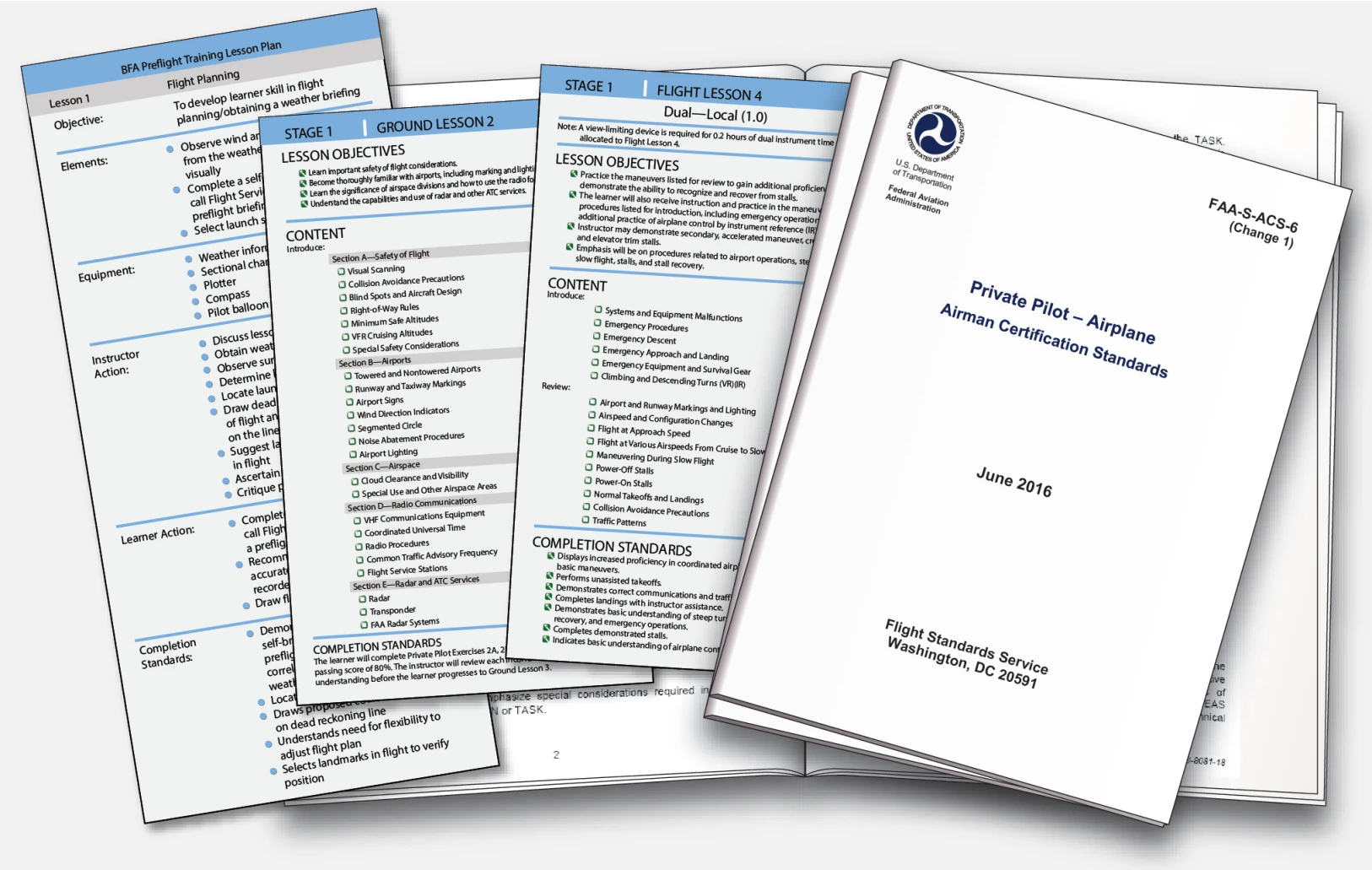
A curriculum for pilot training usually includes courses for the various pilot certificates and ratings, while the curriculum for an aviation maintenance technician (AMT) addresses the subject areas described in Title 14 of the Code of Federal Regulations (14 CFR) part 147. A syllabus is a summary or outline of an individual course of study that generally contains multiple lessons. The syllabus contains a description of each lesson, including objectives and completion standards. In aviation, the term “training syllabus” is commonly used and in this context it is a step-by-step, building block progression of learning with provisions for regular review and assessments at prescribed stages of learning. [Figure 5-3] A lesson plan is a detailed plan for how a specific lesson will be conducted. It includes the lesson objectives, organization of material being covered, description of teaching aids, instruction and learner actions, and evaluation criteria and completions standards.
Preparation of a Lesson
A determination of objectives and standards precedes instruction. Although some schools and independent instructors may develop their own syllabus, in practice, many instructors use a commercially-developed syllabus. For the aviation instructor, the objectives listed in the syllabus are a beginning point for instruction.
Training Objectives and Standards
Aviation training involves two types of objectives: performance-based and decision-based. Performance-based objectives help define exactly what needs to be done and how it is done during each lesson. As the learner progresses through higher levels of performance and understanding, the instructor should shift the training focus to decision-based training objectives. Decision-based training objectives rely on a more dynamic training environment and are ideally suited to scenario-based training and teach aviation learners critical thinking skills, such as risk management and aeronautical decision-making (ADM).
As indicated in Chapter 3, The Learning Process, training objectives apply to all three domains of learning—cognitive (knowledge), affective (attitudes, beliefs, values), and psychomotor (physical skills). Objectives should incorporate the desired level of learning, and these level of learning objectives may apply to one or more of the three domains of learning. Since each domain includes several educational or skill levels, the instructor adapts training objectives to a specific performance level of knowledge or skill. Clearly defined training objectives that the learner understands are essential to the teaching process regardless of the teaching technique used.
Standards are closely tied to objectives since they include a description of the desired knowledge, behavior, or skill stated in specific terms, along with conditions and criteria. When a learner performs according to well-defined standards, evidence of learning is apparent. Standards should contain comprehensive examples of the desired learning outcomes, or behaviors. As indicated in Chapter 3, The Learning Process, standards for the level of learning in the cognitive and psychomotor domains are easily established. However, the design of standards to evaluate a learner’s level of understanding or overt behavior in the affective domain (attitudes, beliefs, and values) is more difficult.
The overall objective of an aviation training course is usually well established, and the general standards are included in various rules and related publications. For example, eligibility, knowledge, proficiency, and experience requirements for pilots and AMT learners are stipulated in the regulations, and the standards are published in the applicable Airman Certification Standards (ACS)/Practical Test Standards (PTS) or oral and practical tests (O&Ps). It should be noted that ACS/PTS and O&P standards are limited to the most critical job tasks. Certification tests do not represent an entire training syllabus.
A broad, overall objective of any pilot training course is to qualify the learner to be a competent, efficient, safe pilot for the operation of specific aircraft types under stated conditions. Similar objectives and standards are established for AMT learners. While the established criteria or standards to determine whether the training has been adequate use the 14 CFR certification requirements, professional instructors should not limit their objectives to meeting the minimum published requirements for pilot or AMT certification.
Successful instructors teach their learners not only how, but also why and when. By incorporating ADM and risk management into each lesson, the aviation instructor helps the learner understand, develop, and reinforce the decision-making process which ultimately leads to sound judgment and good decision-making skills.
Performance-Based Objectives
Performance-based objectives set measurable, reasonable standards describing the learner's desired performance, and may be referred to as a behavioral, performance, instructional, or educational objective. All refer to the same thing, the behavior of the learner.
These objectives provide a way of stating the level of performance a learner needs to demonstrate before he or she progresses to the next stage of instruction. Again, the objectives should be clear, measurable, and repeatable and mean the same thing to any knowledgeable reader. The objectives should be written to avoid the fallibility of recall, interpretation, or loss of specificity with time.
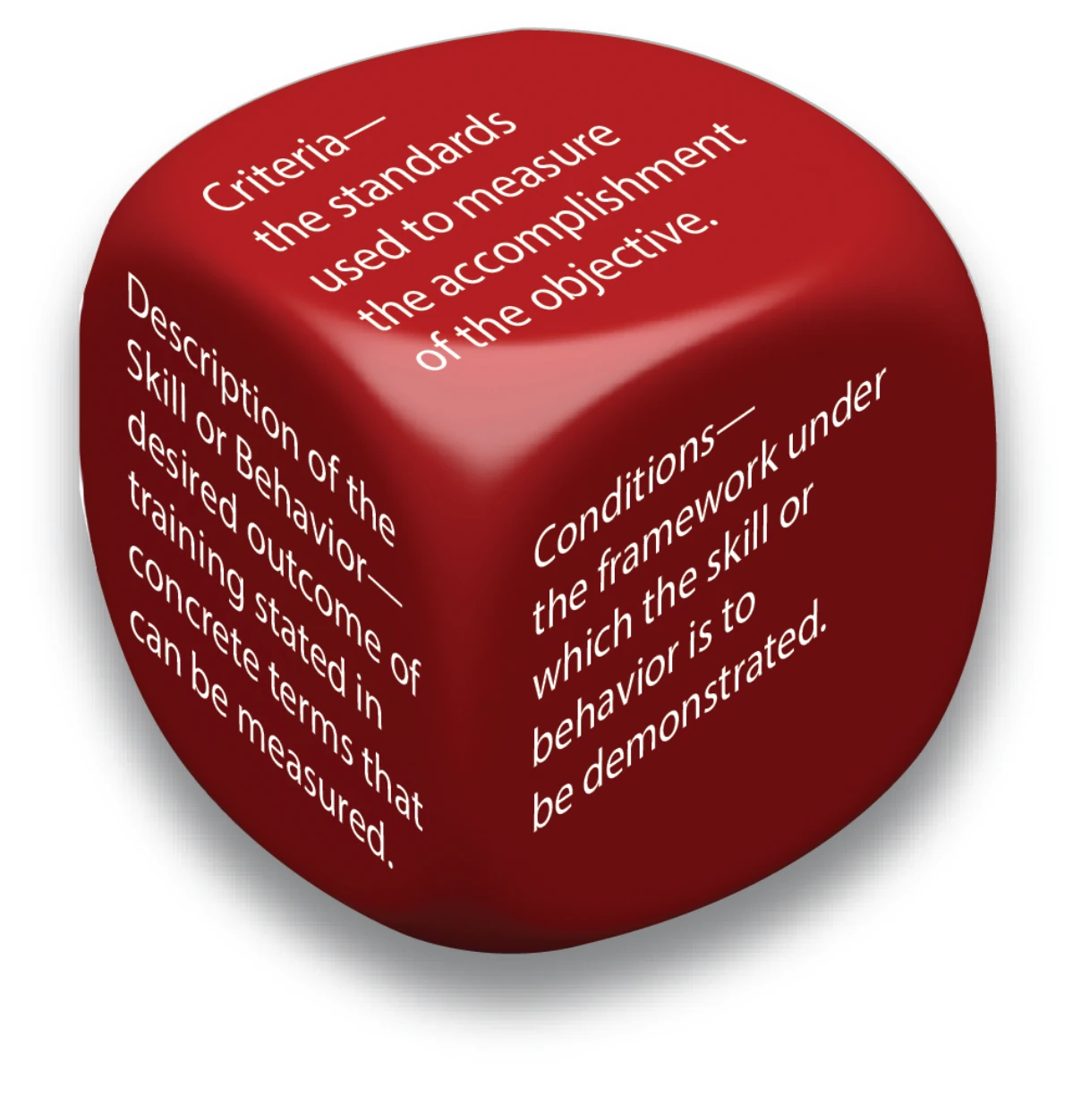
Performance-based objectives consist of three elements: description of the skill or behavior, the conditions, and the criteria. Each part should be stated in a way that leaves every reader with the same picture of the objective, how it is performed, and at the level of performance. [Figure 5-4]
Description of the Skill or Behavior
The description of the skill or behavior explains the desired outcome of the instruction as a change in knowledge, skill, or attitude. The skill or behavior should be in concrete and measurable terms. Phrases such as “knowledge of...” and “awareness of...” cannot be measured very well and should be avoided. Phrases like “able to select from a list of...” or “able to repeat the steps to...” are better because they describe something measurable.