
Chapter 5
The Teaching Process
Conditions explain the rules for demonstration of the skill. If the desired objective is to navigate from point A to point B, the objective, as stated, is not specific enough for all learners to do it in the same way. Information such as equipment, tools, reference material, and limiting parameters should be included. For example, inserting several conditions narrows the objective as follows: “Using appropriate charts, a prepared flight log, and training aircraft, navigate from point A to point B while maintaining standard hemispheric altitudes.” Sometimes, in the process of reading the objective, someone might say, “But, what if...?” This is a good indication that the conditions are confusing and need clarification.
Criteria
Criteria are the standards that measure the accomplishment of the objective. Good criteria define performance so there can be no question whether or not the performance meets the objective. In the previous example, the criteria may include that navigation from point A to point B be accomplished within 5 minutes of the preplanned flight time and that en route altitude be maintained within 200 feet. The revised performance-based objective may now also include arrival at point B within 5 minutes of planned arrival time and cruise altitude should be maintained within 200 feet during the en route phase of the flight.” The alert reader has already noted that the conditions and criteria changed slightly during the development of these objectives. In real-world objective development, that is exactly the way it will occur. Conditions and criteria may be refined as necessary.
The Importance of the ACS in Aviation Training Curricula
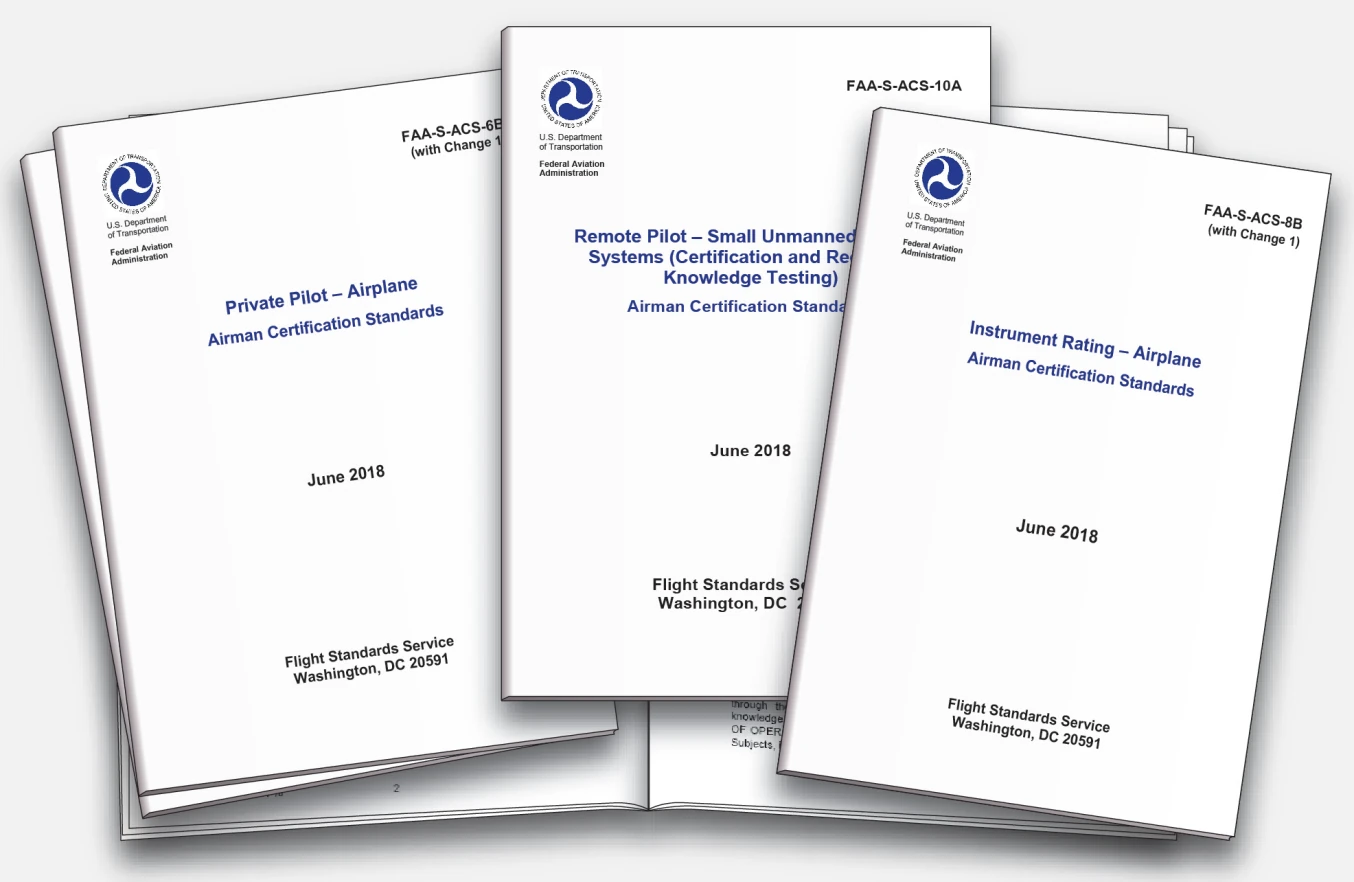
ACS documents hold an important position in aviation training curricula because they supply the instructor with specific performance objectives based on the standards for the issuance of a particular aviation certificate or rating. [Figure 5-5] The FAA frequently reviews the ACS test Areas of Operation and Tasks to maintain their relevance to the current aviation environment. Test items included as part of a test or evaluation should be both content valid and criterion valid. Content validity means that a particular maneuver or procedure closely mimics what is required in actual flying. Criterion validity means that the completion standards for the test are reflective of acceptable standards.
For example, in flight training, content validity is reflected by a particular maneuver closely mimicking a maneuver required in actual flight, such as the learner pilot being able to recover from a power-off stall. Criterion validity means that the completion standards for the test are reflective of acceptable standards in actual flight. Thus, the learner pilot exhibits knowledge of all the elements involved in a power-off stall as listed in the ACS.
As discussed in Chapter 3, The Learning Process, humans develop cognitive skills through active interaction with the world. This concept has led to the adoption of scenario-based training in many fields, including aviation. An effective aviation instructor uses the maneuver-based approach of the ACS but presents the objectives in a scenario situation.
It has been found that flight learners using SBT methods demonstrate flying skills equal to or better than those trained under the maneuver-based approach only. Of even more significance is that the same data also suggest that SBT learners demonstrate better decision-making skills than maneuver-based learners—most likely because their training occurred while performing realistic flight maneuvers and not artificial maneuvers designed only for teaching that maneuver.
The incorporation of SBT as part of the lesson is discussed in more detail later in this chapter, as well as in Chapter 7, Planning Instructional Activity.
Decision-Based Objectives
The design and use of decision-based objectives specifically develops pilot judgment and ADM skills. Improper pilot decisions cause a significant percentage of all accidents, and the majority of fatal accidents in aircraft. Decision-based objectives facilitate a higher level of learning and application. By using dynamic and meaningful scenarios, the instructor teaches the learner how to gather information and make informed, safe, and timely decisions.
Decision-based training is not a new concept. Experienced instructors have been using scenarios that require dynamic problem solving to teach cross-country operations, emergency procedures, and other flight skills for years.
Decision-based learning objectives and the use of flight training scenarios do not preclude traditional maneuver-based training. Rather, flight maneuvers are integrated into the flight training scenarios and conducted as they would occur in the real-world. Those maneuvers requiring repetition may still be taught during concentrated settings. However, once they are learned, they are integrated into realistic and dynamic flight situations.
Decision-based objectives are also important for the aviation instructor planning AMT training. An AMT uses ADM and risk management skills during the repair and maintenance of aircraft.
Other Uses of Training Objectives
Performance-based and decision-based objectives help an instructor design a complete lesson plan. An instructor can use the standards of assessment, objectives, conditions, and criteria to fashion many of the details on the lesson plan. For example, many of the objective components may be used to determine the elements of the lesson and the schedule of events. The equipment necessary and the instructor and learner actions anticipated during the lesson have also been specified. By listing the criteria for the training objectives, the instructor has already established the completion standards normally included as part of the lesson plan.
Use of training objectives also provides the learner with a better understanding of the big picture, as well as knowledge of what is expected. This overview can alleviate a significant source of uncertainty and frustration on the part of the learner.
Presentation of a Lesson
How does an instructor keep the attention of a class? The steps in Figure 5-6 form a guideline for lesson presentation. Many of them can be combined during the actual presentation. For example, consider a video presentation given during the weight and balance lecture. The video adds a multimedia element to the lecture, is a good attention getter, and can visually demonstrate the learning objective.