
Chapter 9
Techniques of Flight Instruction
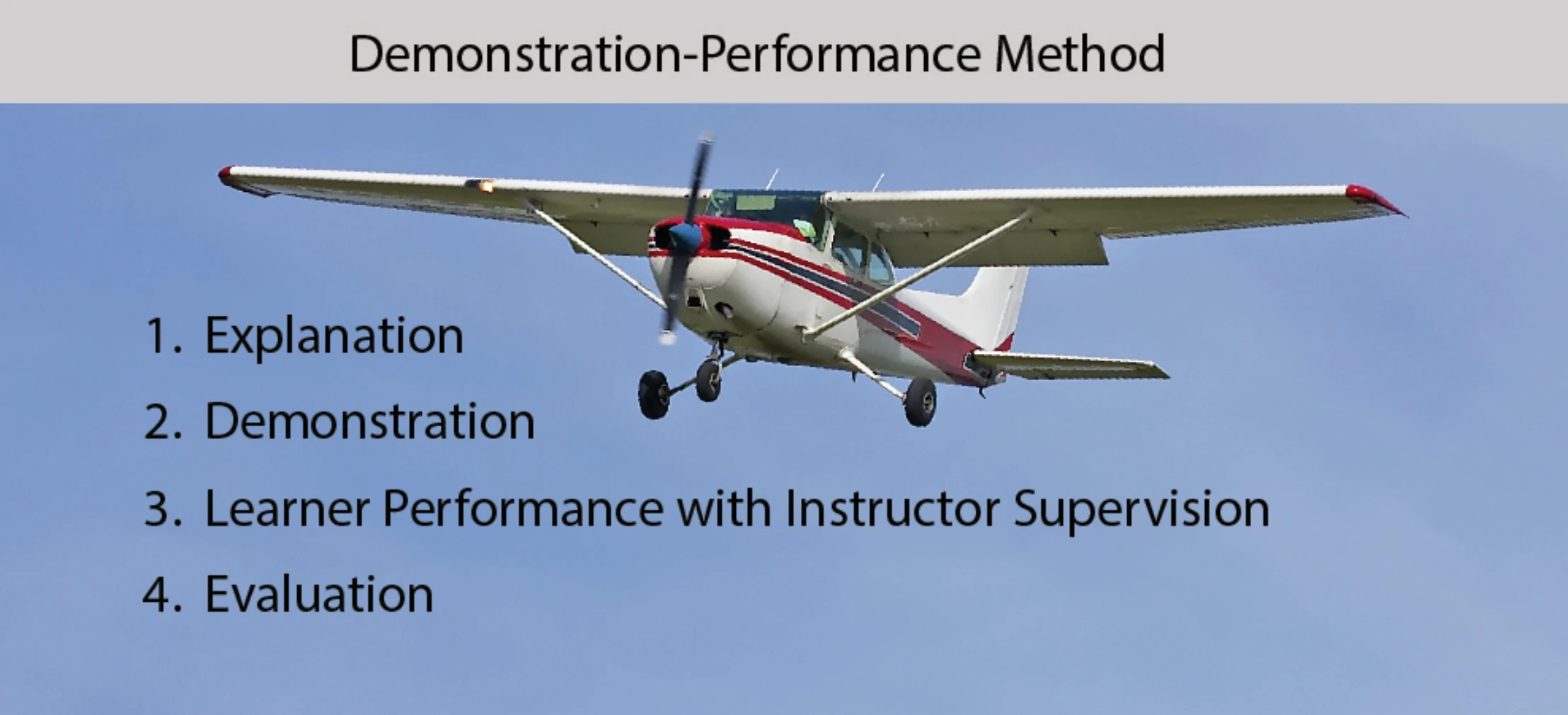
Learner Performance and Instruction Supervision Phases
As discussed in Chapter 5, The Teaching Process, these two phases involve separate actions that are performed concurrently. The first of these phases is the learner’s performance of the physical or mental skills that have been explained and demonstrated. The second activity is the instructor’s supervision.
Learner performance requires learners to act and do. To gain skills, learners must practice. The instructor must, therefore, allot enough time for meaningful activity. Through doing, learners can follow correct procedures and reach established standards. It is important that learners be given an opportunity to perform the skill as soon as possible after a demonstration.
Then, the instructor reviews what has been covered during the instructional flight and determines to what extent the learner has met the objectives outlined during the preflight discussion. The instructor should be satisfied that the learner is well prepared and understands the task before starting. The instructor observes as the learner performs, and then makes appropriate comments.
Evaluation Phase
In this phase, the instructor traditionally evaluates learner performance, records the learner’s performance, and verbally advises the learner of the progress made toward the objectives. Regardless of how well a skill is taught, there may still be performance deficiencies. When pointing out areas that need improvement, offer concrete suggestions that help. If possible, avoid ending the evaluation on a negative note.
As discussed in Chapter 6, Assessment, collaborative assessment (or learner centered grading (LCG)) is a form of authentic assessment currently used in aviation training with problem-based learning (PBL). PBL structures the lessons to confront learners with problems that are encountered in real life and forces them to reach real-world solutions. Scenario-based training (SBT), a type of PBL, uses a highly structured script of real-world experiences to address aviation training objectives in an operational environment. Collaborative assessment is used to evaluate whether certain learning criteria were met during the SBT.
Collaborative assessment includes two parts—learner self-assessment and a detailed assessment by the flight instructor. The purpose of the self-assessment is to stimulate growth in the learner’s thought processes and, in turn, behaviors. The self-assessment is followed by an in-depth discussion between the instructor and the learner which compares the instructor’s assessment to the learner’s self-assessment.
The Telling-and-Doing Technique
The demonstration-performance method can be applied to the telling-and-doing technique of flight instruction in three steps. However, the telling-and-doing technique includes specific variations for flight instruction. [Figure 9-7]
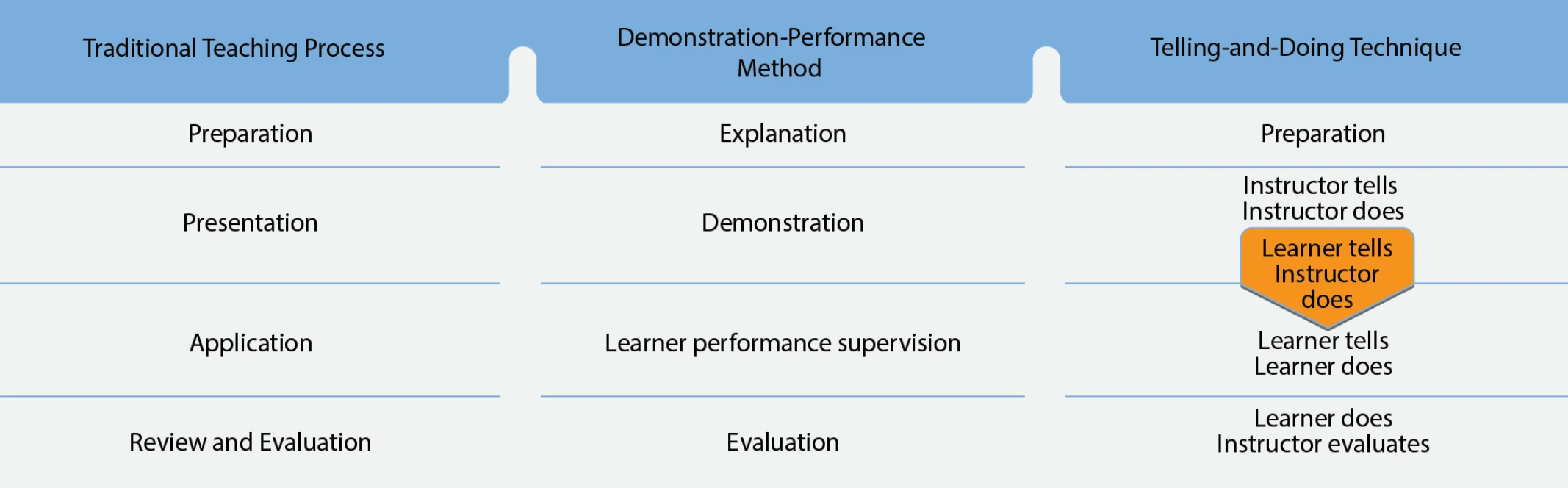
Instructor Tells—Instructor Does
First, the flight instructor gives a carefully planned demonstration of the procedure or maneuver with accompanying verbal explanation. While demonstrating inflight maneuvers, the instructor should explain the required power settings, aircraft attitudes, and describe any other pertinent factors that may apply. This is the only step in which the learner plays a passive role. It is important for the demonstration to conform to the explanation as closely as possible. In addition, it should be demonstrated in the same sequence in which it was explained so as to avoid confusion and provide reinforcement. Since learners generally imitate the instructor’s performance, the instructor needs to demonstrate the skill exactly the way the learners are expected to practice it, including all safety procedures that should be followed. As previously explained, if the demonstration does not closely conform to the explanation, this deviation should be immediately acknowledged and explained.
Most physical skills lend themselves to a sequential pattern where the skill is explained in the same step-by-step order normally used to perform it. When the skill being taught relates to previously learned procedures or maneuvers, the known to unknown strategy may be effective. When teaching more than one skill at the same time, the simple-to-complex strategy works well. By starting with the simplest skill, a learner gains confidence and is less likely to become frustrated when building skills that are more complex.
Another consideration in this phase is the language used. Instructors should attempt to avoid unnecessary jargon and technical terms that their learners do not know. Instructors should also take care to clearly describe the actions learners are expected to perform. Communication is the key. It is neither appropriate nor effective for instructors to try to impress learners with their expertise by using language that is unnecessarily complicated.
As an example, a level turn might be demonstrated and described by the instructor in the following way:
- Use outside visual references and monitor the flight instruments.
- After clearing the airspace around the aircraft, add power slightly, turn the aircraft in the desired direction, and apply a slight amount of back pressure on the yoke to maintain altitude. Maintain coordinated flight by applying rudder in the direction of the turn.
- Remember, the ailerons control the roll rate, as well as the angle of bank. The rate at which the aircraft rolls depends on how much aileron deflection is used. How far the aircraft rolls (steepness of the bank) depends on how long the ailerons are deflected, since the aircraft continues to roll as long as the ailerons are deflected. When the desired angle of bank is reached, neutralize the ailerons, and trim as appropriate.
- Lead the roll-out by approximately one-half the number of degrees of the angle of bank. Use coordinated aileron and rudder control pressures. Simultaneously begin releasing the back pressure so aileron, rudder, and elevator pressures are neutralized when the aircraft reaches the wings-level position.
- Leading the roll-out heading by one-half the bank angle is a good rule of thumb for initial training. However, keep in mind that the required amount of lead really depends on the type of turn, turn rate, and roll-out rate. As a pilot gains experience, he or she will develop a consistent roll-in and roll-out technique for various types of turns. Upon reaching a wings-level attitude, reduce power and trim to remove control pressures.
Learner Tells—Instructor Does
Second, the learner tells as the instructor does. In this step, the learner actually plays the role of instructor, telling the instructor what to do and how to do it. Two benefits accrue from this step: the learner, being freed from the need to concentrate on performance of the maneuver and from concern about its outcome, is able to organize his or her thoughts regarding the steps involved and the techniques to be used. In the process of explaining the maneuver as the instructor performs it, perceptions begin to develop into insights. Mental habits begin to form with repetition of the instructions previously received. Plus, the instructor is able to evaluate the learner’s understanding of the factors involved in performance of the maneuver.