
Chapter 9
Techniques of Flight Instruction
According to the principle of primacy, it is important for the instructor to make sure the learner gets it right the first time. The learner should also understand the correct sequence and be aware of safety precautions for each procedure or maneuver. If a misunderstanding exists, it can be corrected before the learner becomes absorbed in controlling the aircraft.
Learner Tells—Learner Does
Application is the third step in this method. This is where learning takes place and where performance habits are formed. If the learner has been adequately prepared and the procedure or maneuver fully explained and demonstrated, meaningful learning occurs. The instructor should be alert during the learner’s practice to detect any errors in technique and to prevent the formation of faulty
At the same time, the learner should be encouraged to think about what to do during the performance of a maneuver, until it becomes habitual. In this step, the thinking is done verbally. This focuses concentration on the task to be accomplished, so that total involvement in the maneuver is fostered. All of the learner’s physical and mental faculties are brought into play. The instructor should be aware of the learner’s thought processes. It is easy to determine whether an error is induced by a misconception or by a simple lack of motor skills. Therefore, in addition to forcing total concentration on the part of the learner, this method provides a means for keeping the instructor aware of what the learner is thinking. The learner is not only learning to do something, but he or she is also learning a self-teaching process that is highly desirable in development of a skill.
The exact procedures that the instructor should use during learner practice depend on factors such as the learner’s proficiency level, the type of maneuver, and the stage of training. The instructor should exercise good judgment to decide how much control to use. With potentially hazardous or difficult maneuvers, the instructor should be alert and ready to take control at any time. This is especially true during a learner’s first attempt at a particular maneuver. On the other hand, if a learner is progressing normally, the instructor should avoid unnecessary interruptions or too much assistance.
A typical test of how much control is needed often occurs during a learner’s first few attempts to land an aircraft. The instructor must quickly evaluate the learner’s need for help, and not hesitate to take control, if required. At the same time, the learner should be allowed to practice the entire maneuver often enough to achieve the level of proficiency established in the lesson objectives. Since this is a learning phase rather than an evaluation phase of the training, errors or unsafe practices should be identified and corrected in a positive and timely way. In some cases, the learner is not able to meet the proficiency level specified in the lesson objectives within the allotted time. When this occurs, the instructor should be prepared to schedule additional training.
Positive Exchange of Flight Controls
Positive exchange of flight controls is an integral part of flight training. It is especially critical during the demonstration-performance method of flight instruction. Due to the importance of this subject, the following discussion provides guidance on the recommended procedure to use for the positive exchange of flight controls between pilots when operating an aircraft.
Background
Incident/accident statistics indicate a need to place additional emphasis on the exchange of control of an aircraft by pilots. Numerous accidents have occurred due to a lack of communication or misunderstanding regarding who had actual control of the aircraft, particularly between learners and flight instructors. Establishing the following procedure during initial training will ensure the formation of a habit pattern that should stay with learners throughout their flying careers.
Procedure
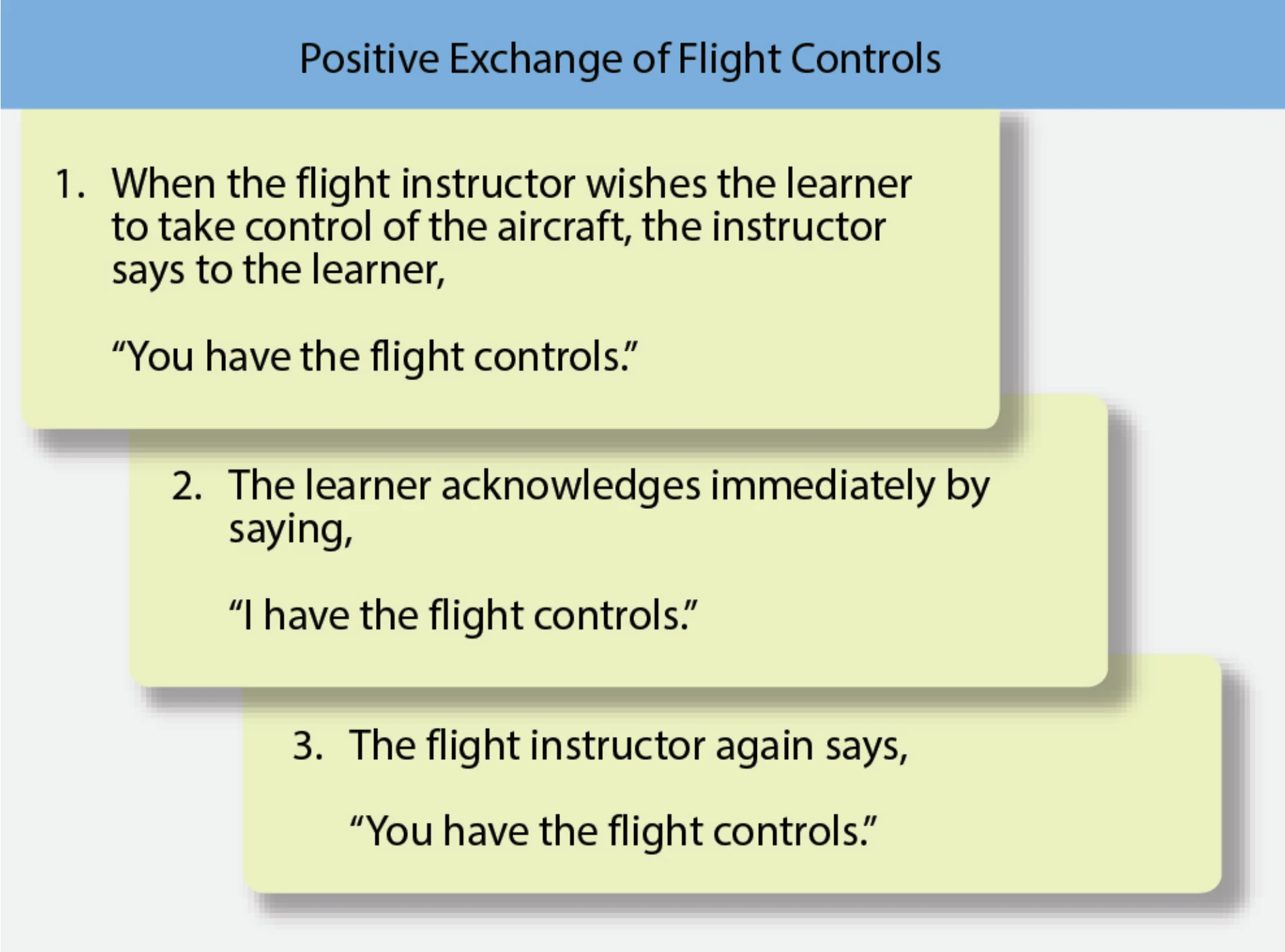
During flight training, there should always be a clear understanding between learners and flight instructors about who has control of the aircraft. The preflight briefing should include procedures for the exchange of flight controls. A positive three-step process in the exchange of flight controls between pilots is a proven procedure and one that is strongly recommended. When an instructor is teaching a maneuver to a learner, the instructor normally demonstrates the maneuver first, then has the learner follow along on the controls during a demonstration and, finally, the learner performs the maneuver with the instructor following along on the controls. [Figure 9-8] Flight instructors should always guard the controls and be prepared to take control of the aircraft. When necessary, the instructor should take the controls and calmly announce, “I have the flight controls.” If an instructor allows a learner to remain on the controls, the instructor may not have full and effective control of the aircraft. Anxious learners can be incredibly strong and usually exhibit reactions inappropriate to the situation. If a recovery is necessary, there is absolutely nothing to be gained by having the learner on the controls and having to fight for control of the aircraft. Learners should never be allowed to exceed the flight instructor’s limits. Flight instructors should not exceed their own ability to perceive a problem, decide upon a course of action, and physically react within their ability to fly the aircraft.
Sterile Flight Deck Rule
Commonly known as the “sterile flight deck rule,” Title 14 of the Code of Federal Regulations (14 CFR) part 121, section 121.542 requires airline flight crewmembers to refrain from nonessential activities during critical phases of flight. As defined in the regulation, critical phases of flight are all ground operations involving taxi, takeoff, and landing, and all other flight operations below 10,000 feet except cruise flight. Nonessential activities include such activities as eating, reading a newspaper, or chatting. A series of aircraft accidents caused by flight crews who were distracted from their flight duties during critical phases of the flight caused the FAA to propose the rule. While the regulation grew out of accidents in the airline industry, it holds true for the entire aviation community. Pilots can improve flight safety significantly by reducing distractions during critical phases of flight. It is important the flight instructor not only teach the concept of a sterile flight deck but also model such behavior during flight instruction.
Use of Distractions
National Transportation Safety Board (NTSB) statistics reveal that most stall/spin accidents occurred when the pilot’s attention was diverted from the primary task of flying the aircraft. Sixty percent of stall/spin accidents occurred during takeoff and landing, and twenty percent were preceded by engine failure. Preoccupation inside or outside the flight deck while changing aircraft configuration or trim, maneuvering to avoid other traffic, or clearing hazardous obstacles during takeoff and climb could create a potential stall/spin situation. The intentional practice of stalls and spins seldom resulted in an accident. The real danger was inadvertent stalls induced by distractions during routine flight situations.
Pilots at all skill levels should be aware of the increased risk of entering into an inadvertent stall or spin or the possibility of an upset while performing tasks that are secondary to controlling the aircraft. The FAA has established a policy for use of certain distractions on practical tests for pilot certification. The purpose is to determine that applicants possess the skills required to cope with distractions while maintaining the degree of aircraft control required for safe flight. The most effective training is the simulation of scenarios that can lead to inadvertent stalls by creating distractions while the learner is practicing certain maneuvers.
Instructor responsibilities include teaching the learner to divide his or her attention between the distracting task and maintaining control of the aircraft. The following are examples of distractions that can be used for this training:
- Drop a pencil. Ask the learner to pick it up.
- Ask the learner to determine a heading to an airport using a chart.
- Ask the learner to reset the clock.
- Ask the learner to get something from the back seat.
- Ask the learner to read the outside air temperature.
- Ask the learner to compute true airspeed with a flight computer.
- Ask the learner to identify terrain or objects on the ground.
- Ask the learner to identify a field suitable for a forced landing.
- Have the learner climb 200 feet and maintain altitude, then descend 200 feet and maintain altitude.
- Have the learner reverse course after a series of S-turns.