
Chapter Appendix C
Certificates, Ratings, and Endorsements
Flight Instructor Endorsements
The authority and responsibility for flight instructors to endorse initial learner certificates, logbooks for solo and solo cross-country, additional aircraft ratings, and flight privileges are outlined in Title 14 of the Code of Federal Regulations (14 CFR) part 61. In addition, Advisory Circular (AC) 61-65, Certification: Pilots and Flight and Ground Instructors, provides guidance for pilots, flight instructors, ground instructors, and examiners on the certification standards, knowledge test procedures, and other requirements of 14 CFR part 61. By utilizing AC 61-65, the flight instructor does not omit any required endorsement for the rating sought, which ensures standardization. It is important for the flight instructor to understand and use AC 61-65 in the certification process.
Instructors should note that evaluations include an English language component. If the instructor doubts that a learner meets the FAA English Language Standard (AELS), the instructor should not endorse the review or check as complete. The instructor may also reach out to their local FSDO for assistance if the learner's continued operation could affect safety of the NAS. For further guidance on this subject refer to FAA AC 60-28, FAA English Language Standard for an FAA Certificate Issued Under 14 CFR parts 61, 63, 65, and 107.
The regulatory requirements for recording and logging time come from several different regulations that should be viewed together.
- 14 CFR part 61, section 61.189 requires flight instructors to sign the logbook of each person to whom that instructor has given flight training or ground training. That section also contains instructor requirements for maintaining a record of endorsements given to the applicant.
- 14 CFR part 61, section 61.193 authorizes instructors to make endorsements applicants need for various certificates or ratings.
- Subparts of 14 CFR part 61 detail the training an applicant needs to log in order to qualify for a rating or privilege. For example, 14 CFR part 61, subpart C, section 61.87(c)(1) requires a student pilot to receive and log flight training in specific maneuvers and procedures.
- 14 CFR part 61, section 61.51 details the information required for logbook entries.
Flight instructors may also provide training and make logbook endorsements for pilots who are already certificated such as sport, recreational, private, commercial, and instrument rated pilots, as well as for other flight instructors. Typical endorsements include but are not limited to flight reviews, instrument proficiency checks, the additional training required for high performance, high altitude, and tail wheel aircraft, and types of glider launches.
Additional rating applicants (e.g., multiengine add-on, seaplane add-on, glider add-on, helicopter add-on) are rated pilots and not considered student pilots nor do they need a student pilot certificate.
- In accordance with 14 CFR part 61, section 61.31(d)(2), applicants without the appropriate rating require an instructor's logbook endorsement prior to solo flight.
- 14 CFR part 61, section 61.63 contains the requirement for an endorsement for an applicant prior to testing for an added rating.
Sample practical test endorsements are listed in AC 61-65. Any requirement for an applicant to receive and log a practical test endorsement is cited in the relevant 14 CFR subpart for each rating. For example, 14 CFR part 61, subpart F, section 61.123(c) requires an endorsement from an authorized instructor for an applicant for a commercial pilot certificate. Note that when giving an endorsement, there is no rule that prevents an instructor from adding a requirement.
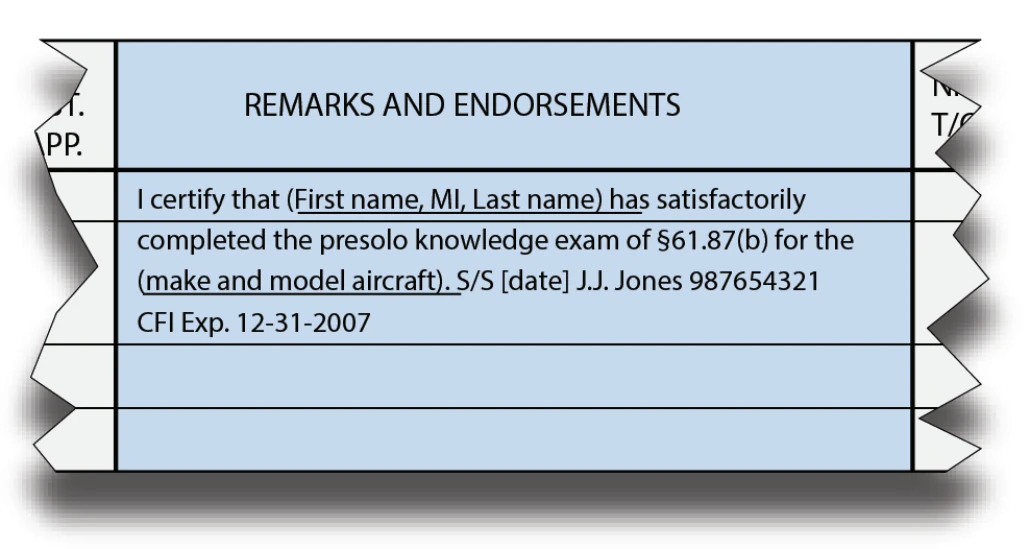
The flight instructor may need to customize the endorsement due to an applicant’s special circumstances or changes in regulatory requirements, but it is recommended all endorsements be worded as closely as possible to those in AC 61-65. At a minimum, the flight instructor needs to cite the appropriate 14 CFR part 61 section that has been completed. [Figure C-1] Federal Aviation Administration (FAA) inspectors and designated pilot examiners (DPEs) rely on flight instructor recommendations for learner or pilot applicant testing. These recommendations are accepted as evidence of qualification for certification and proof that a review of the subject areas found to be deficient on the appropriate knowledge test has been given by the flight instructor. Recommendations also provide assurance the applicant has had a thorough briefing on the Practical Test Standards (PTS), Airman Certification Standards (ACS), and the associated knowledge areas, maneuvers, and procedures. If the flight instructor has trained and prepared the applicant competently, the applicant should have no difficulty in passing the written and practical tests.
Sport Pilot
Many consider the advent of the sport pilot certification to be one of the most significant changes to the airman certification structure to have occurred in over 50 years. Because of the growing cost to acquire the private pilot certification, more and more aviation enthusiasts are considering the sport pilot as an alternative. Many aircraft already meet the light sport aircraft criteria, and many manufacturers are now producing modern light sport aircraft. Flight instructors should review 14 CFR part 61, subparts J and K, for the requirements for, and privileges and limitations of, the sport pilot certifications.
14 CFR part 61, subparts J and K, also describe the process for sport pilots and flight instructors with a sport pilot rating to add additional category/class privileges. Light sport aircraft meet certain criteria, and a well-informed flight instructor should be acquainted with the basic requirements.
FAA Forms 8710-1, 8610-2, and 8710-11
Forms 8710-1, 8610-2, and 8710-11 are versions of the Airman Certificate and/or Rating Application. The instructor should ensure the applicant is prepared for the test and has met all the regulatory requirements, including knowledge, proficiency, required endorsements, and experience requirements before the application process. The applicant then either completes the 8710 or 8610 paper form by hand or uses the Integrated Airman Certification and Rating Application (IACRA) electronic application system available at iacra.faa.gov/IACRA/Default.aspx. ([source link](https://iacra.faa.gov/IACRA/Default.aspx))
Whenever possible, applicants should use the IACRA system to make their application. The system provides internal checking, and reduces the error rate. Any mistake or omission on a paper application form may cause a significant delay in the issuance of an FAA certificate.
Instructor Records
14 CFR part 61, section 61.189 requires the flight instructor to maintain a record that includes information on the type of endorsement, the name of the person receiving the endorsement, and the date of the endorsement. This information may be kept in a logbook or a separate document. For a knowledge or practical test endorsement, the record must include the kind of test, the date, and the results. Records of endorsements must be maintained for at least 3 years.