
Chapter 14
Aircraft Fuel Systems
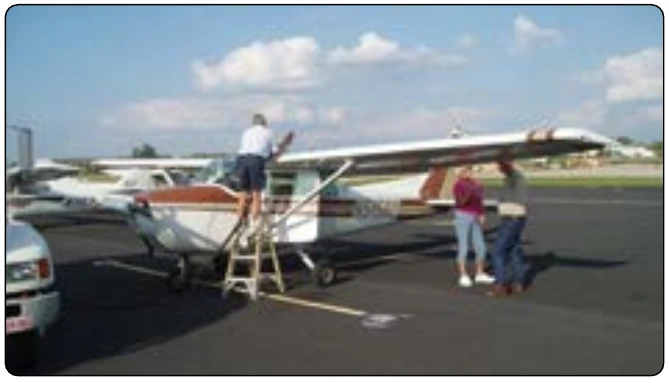
There are other miscellaneous good practices that should be employed when refueling an aircraft. A ladder should be used if the refuel point is not accessible while standing on the ground. Climbing on an expensive aircraft to access the fueling ports is possible but does not give the stability of a ladder and may not be appreciated by the aircraft owner. If it is necessary to walk on the wings of the aircraft, do so only in designated areas, which are safe.
Filler nozzles should be treated as the important tools that they are. They should not be dropped or dragged across the apron. Most have attached dust caps that should be removed only for the actual fueling process and then immediately replaced. Nozzles should be clean to avoid contamination of the fuel. They should not leak and should be repaired at the earliest sign of leak or malfunction. Keep the fueling nozzle in constant contact with the filler neck spout when fueling. Never leave the nozzle in the fill spout unattended. When fueling is complete, always doublecheck the security of all fuel caps and ensure that bonding wires have been removed and stowed.
Defueling
Removing the fuel contained in aircraft fuel tanks is sometimes required. This can occur for maintenance, inspection, or due to contamination. Occasionally, a change in flight plan may require defueling. Safety procedures for defueling are the same as those for fueling. Always defuel outside. Fire extinguishers should be on hand. Bonding cables should be attached to guard against static electricity buildup. Defueling should be performed by experienced personnel, and inexperienced personnel must be checked out before doing so without assistance.
Remember that there may be a sequence in defueling an aircraft’s fuel tanks just as there is when fueling to avoid structural damage. Consult the manufacturer’s maintenance/operations manual(s) if in doubt.
Pressure fueled aircraft normally defuel through the pressure fueling port. The aircraft’s in-tank boost pumps can be used to pump the fuel out. The pump on a fuel truck can also be used to draw fuel out. These tanks can also be drained through the tank sump drains, but the large size of the tanks usually makes this impractical. Aircraft fueled over the wing are normally drained through the tank sump drains. Follow the manufacturer’s procedure for defueling the aircraft.
What to do with the fuel coming out of a tank depends on a few factors. First, if the tank is being drained due to fuel contamination or suspected contamination, it should not be mixed with any other fuel. It should be stored in a separate container from good fuel, treated if possible, or disposed of properly. Take measures to ensure that contaminated fuel is never placed onboard an aircraft or mixed with good fuel. Second, the manufacturer may have requirements for good fuel that has been defueled from an aircraft, specifying whether it can be reused and the type of storage container in which it must be stored. Above all, fuel removed from an aircraft must not be mixed with any other type of fuel.
Good fuel removed from an aircraft must be handled with all precautions used when handling any fuel. It must only be put into clean tanks and efforts must be made to keep it clean. It may be put back in the aircraft or another aircraft if the manufacturer allows. Large aircraft can often transfer fuel from a tank requiring maintenance to another tank to avoid the defueling process.
Fire Hazards When Fueling or Defueling
Due to the combustible nature of AVGAS and turbine engine fuel, the potential for fire while fueling and defueling aircraft must be addressed. Always fuel and defuel outside, not in a hangar that serves as an enclosed area for vapors to build up to a combustible level. Clothing worn by refueling personnel should not promote static electricity buildup. Synthetics, such as nylon, should be avoided. Cotton has proved to be safe for fuel handling attire.
As previously mentioned, the most controllable of the three ingredients required for fire is the source of ignition. It is absolutely necessary to prevent a source of ignition anywhere near the aircraft during fueling or refueling. Any open flame, such as a lit cigarette, must be extinguished. Operation of any electrical devices must be avoided. Radio and radar use is prohibited. It is important to note that fuel vapors proliferate well beyond the actual fuel tank opening and a simple spark, even one caused by static electricity, could be enough for ignition. Any potential for sparks must be nullified.
Spilled fuel poses an additional fire hazard. A thin layer of fuel vaporizes quickly. Small spills should be wiped up immediately. Larger spills can be flooded with water to dissipate the fuel and the potential for ignition. Do not sweep fuel that has spilled onto the ramp.
Class B fire extinguishers need to be charged and accessible nearby during the fueling and defueling processes. Fueling personnel must know exactly where they are and how to use them. In case of an emergency, the fuel truck, if used, may need to be quickly driven away from the area. For this reason alone, it should be positioned correctly on the ramp relative to the aircraft.