
Chapter 16
Cabin Environmental Control Systems
Technician Certification
The EPA requires certification of technicians that work with vapor cycle air conditioning refrigerant and equipment to ensure safe compliance with current regulations. Aircraft technicians can obtain certification or can refer vapor cycle air conditioning work to shops that specialize in this work.
Aircraft Heaters
Bleed Air Systems
Temperatures at high altitudes in which aircraft operate can be well below 0 °F. Combined with seasonally cold temperatures, this makes heating the cabin more than just a luxury. Pressurized aircraft that use air cycle air conditioning systems mix bleed air with cold air produced by the air cycle machine expansion turbine to obtain warm air for the cabin. This is discussed in the section that covers air cycle air conditioning in this chapter. Aircraft not equipped with air cycle air conditioning may be heated by one of a few possible methods.
Some turbine-powered aircraft not equipped with air cycle systems still make use of engine compressor bleed air to heat the cabin. Various arrangements exist. The bleed air is mixed with ambient air, or cabin return air, and distributed throughout the aircraft via ducting. The mixing of air can be done in a variety of ways. Mixing air valves, flow control valves, shutoff valves, and other various control valves are controlled by switches in the flight deck. One STC’d bleed air heat system uses mini-ejectors in helicopter cabins to combine bleed air with cabin air. All of these bleed air heating systems are simple and function well, as long as the valves, ducting, and controls are in operational condition.
Electric Heating Systems
Occasionally, an electric heating device is used to heat the aircraft. Electricity flowing through a heating element makes the element warm. A fan to blow air over the elements and into the cabin is used to transfer the heat. Other floor or sidewall elements simply radiate heat to warm the cabin.
Electric heating element heaters require a significant amount of the aircraft’s generator output, which is better dedicated to the operation of other electrical devices. For this reason, they are not very common. However, their use on the ground when powered by a ground electrical power source preheats the cabin before passengers board and does not tax the electrical system.
Exhaust Shroud Heaters
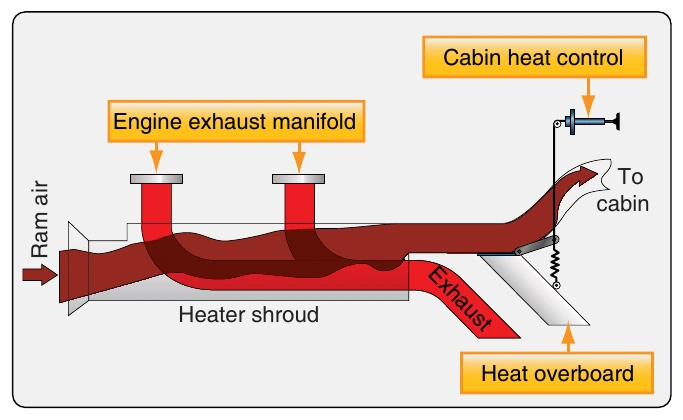
Most single-engine light aircraft use exhaust shroud heating systems to heat the cabin.Ambient air is directed into a metal shroud, or jacket, that encases part of the engine’s exhaust system. The air is warmed by the exhaust and directed through a firewall heater valve into the cabin. This simple solution requires no electrical or engine power and it makes use of heat that would otherwise be wasted. [Figures 16-96 and 16-97]
A major concern of exhaust shroud heat systems is the possibility that exhaust gases could contaminate the cabin air. Even the slightest crack in an exhaust manifold could send enough carbon monoxide into the cabin to be fatal. Strict inspection procedures are in place to minimize this threat. Most involve pressurizing the exhaust system with air, while inspecting for leaks with a soapy solution. Some require the exhaust to be removed and pressurized while submerged under water to detect any leaks. Frequency of exhaust heat leak detection can be every 100 hours.
Occasionally, the exhaust system is slightly modified in a shroud heat configuration. For example, an exhaust muffler may have numerous welded studs attached, which increase heat transfer to the cabin air. Each weld point is a location for a potential leak. [Figure 16-98]
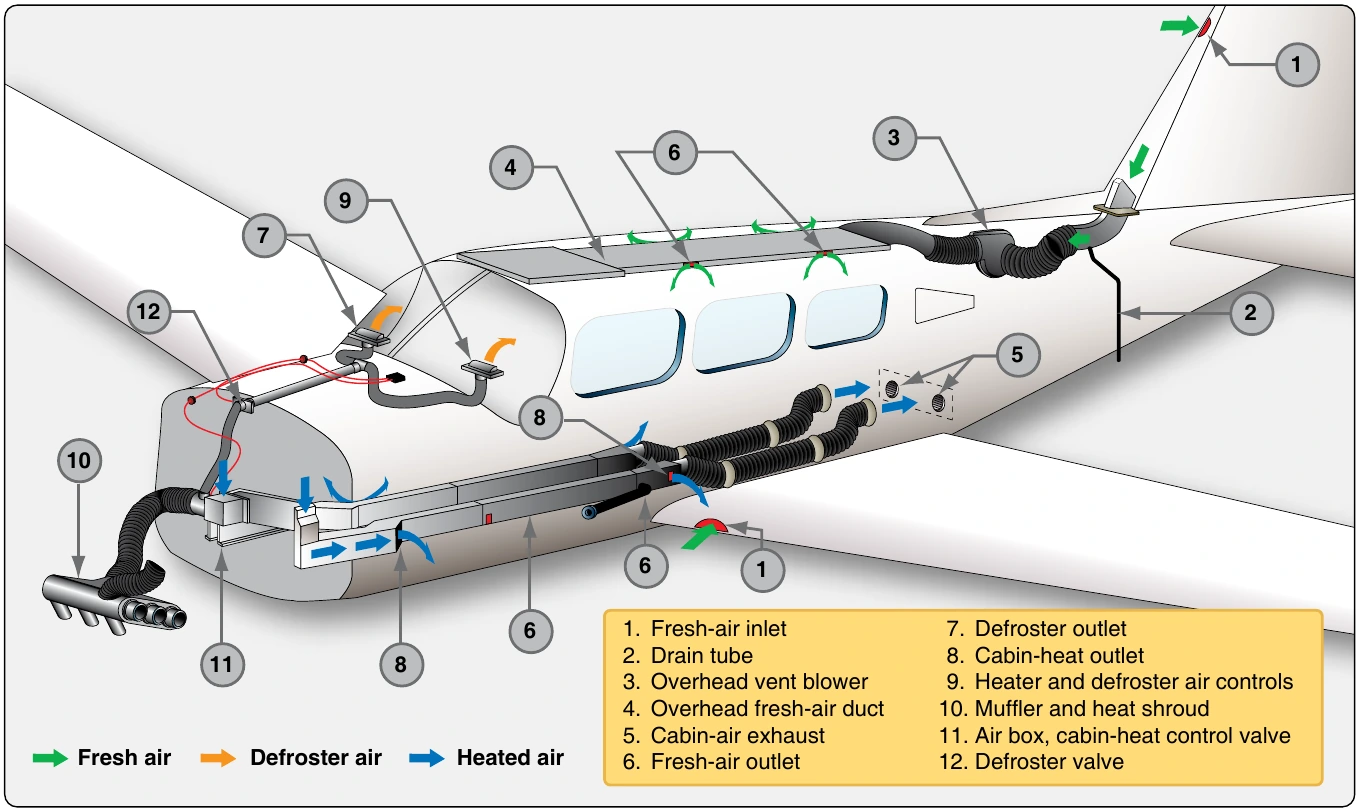
Regardless of age or condition, aircraft with exhaust shroud heating systems should contain a carbon monoxide detection device in the flight deck.
Combustion Heaters
An aircraft combustion heater is used on many small to medium sized aircraft. It is a heat source independent from the aircraft’s engine(s), although it does use fuel from the aircraft’s main fuel system. Combustion heaters are manufactured by a few different companies that supply the aviation industry. Most are similar to the description that follows. The most up to date units have electronic ignition and temperature control switches.
Combustion heaters are similar to exhaust shroud heaters in that ambient air is heated and sent to the cabin. The source of heat in this case is an independent combustion chamber located inside the cylindrical outer shroud of the heater unit. The correct amount of fuel and air are ignited in the air-tight inner chamber. The exhaust from combustion is funneled overboard. Ambient air is directed between the combustion chamber and the outer shroud. It absorbs the combustion heat by convection and is channeled into the cabin. [Figure 16-99] Refer to Figure 16-100 for the following descriptions of the combustion heater subsystems and heater operation.