
Chapter 17
Fire Protection Systems
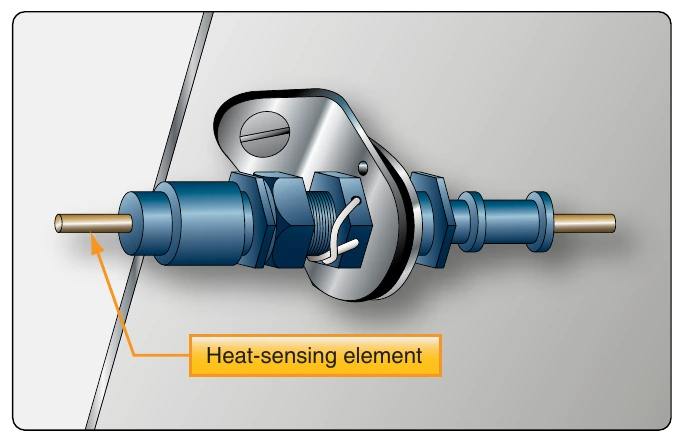
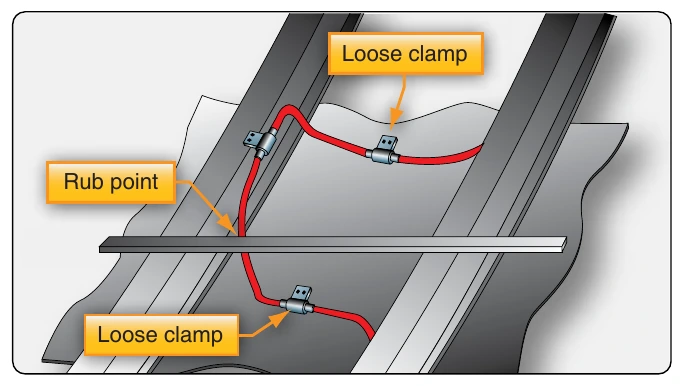
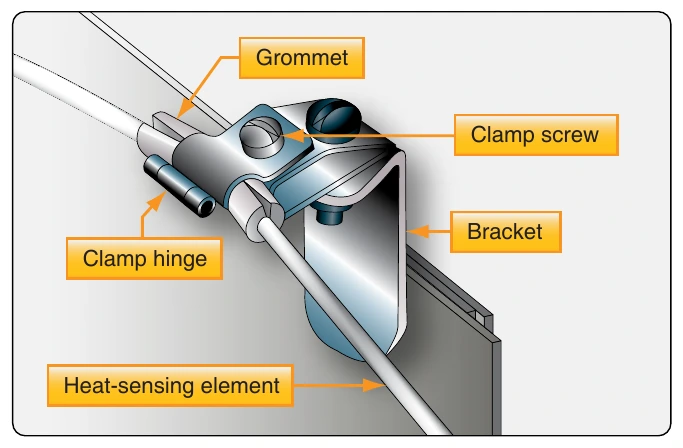
- Fire alarms and warning lights can occur when no engine fire or overheat condition exists. Such false alarms can be most easily located by disconnecting the engine sensing loop connections from the control unit. If the false alarm ceases when the engine sensing loop is disconnected, the fault is in the disconnected sensing loop, which should be examined for areas that have been bent into contact with hot parts of the engine. If no bent element can be found, the shorted section can be located by isolating the connecting elements consecutively around the entire loop.
- Kinks and sharp bends in the sensing element can cause an internal wire to short intermittently to the outer tubing. The fault can be located by checking the sensing element with an ohm meter while tapping the element in the suspected areas to produce the short.
- Moisture in the detection system seldom causes a false fire alarm. If, however, moisture does cause an alarm, the warning persists until the contamination is removed, or boils away, and the resistance of the loop returns to its normal value.
- Failure to obtain an alarm signal when the test switch is actuated may be caused by a defective test switch or control unit, the lack of electrical power, inoperative indicator light, or an opening in the sensing element or connecting wiring. When the test switch fails to provide an alarm, the continuity of a two-wire sensing loop can be determined by opening the loop and measuring the resistance. In a single-wire, continuous-loop system, the center conductor should be grounded.
Fire Extinguisher System Maintenance
Regular maintenance of fire extinguisher systems typically includes such items as the inspection and servicing of fire extinguisher bottles (containers), removal and reinstallation of cartridge and discharge valves, testing of discharge tubing for leakage, and electrical wiring continuity tests. The following paragraphs contain details of some of the most typical maintenance procedures.
Container Pressure Check
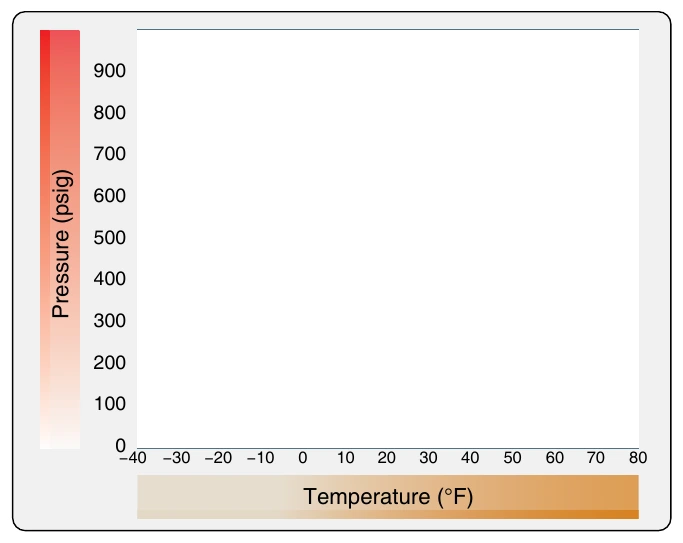
Fire extinguisher containers are checked periodically to determine that the pressure is between the prescribed minimum and maximum limits. Changes of pressure with ambient temperatures must also fall within prescribed limits. The graph shown in Figure 17-29 is typical of the pressure-temperature curve graphs that provide maximum and minimum gauge readings. If the pressure does not fall within the graph limits, the extinguisher container is replaced.
Discharge Cartridges
The service life of fire extinguisher discharge cartridges is determined from the manufacturer’s date stamp, which is usually placed on the face of the cartridge. The cartridge service life recommended by the manufacturer is usually in terms of years. Cartridges are available with a service life of 5 years or more. To determine the unexpired service life of a discharge cartridge, it is usually necessary to remove the electrical leads and discharge line from the plug body, which can then be removed from the extinguisher container.
Agent Containers
Care must be taken in the replacement of cartridge and discharge valves. Most new extinguisher containers are supplied with their cartridge and discharge valve disassembled. Before installation on the aircraft, the cartridge must be assembled properly in the discharge valve and the valve connected to the container, usually by means of a swivel nut that tightens against a packing ring gasket. [Figure 17-30]
If a cartridge is removed from a discharge valve for any reason, it should not be used in another discharge valve assembly, since the distance the contact point protrudes may vary with each unit. Thus, continuity might not exist if a used plug that had been indented with a long contact point were installed in a discharge valve with a shorter contact point.
Fire Prevention
Leaking fuel, hydraulic, deicing, or lubricating fluids can be sources of fire in an aircraft. This condition should be noted, and corrective action taken when inspecting aircraft systems. Minute pressure leaks of these fluids are particularly dangerous for they quickly produce an explosive atmospheric condition. Carefully inspect fuel tank installations for signs of external leaks. With integral fuel tanks, the external evidence may occur at some distance from where the fuel is actually escaping. Many hydraulic fluids are flammable and should not be permitted to accumulate in the structure. Sound-proofing and lagging materials may become highly flammable if soaked with oil of any kind. Any leakage or spillage of flammable fluid in the vicinity of combustion heaters is a serious fire risk, particularly if any vapor is drawn into the heater and passes over the hot combustion chamber.
Oxygen system equipment must be kept absolutely free from traces of oil or grease, since these substances spontaneously ignite when in contact with oxygen under pressure. Oxygen servicing cylinders should be clearly marked so they cannot be mistaken for cylinders containing air or nitrogen, as explosions have resulted from this error during maintenance operations.