
Chapter 2
Aerodynamics, Aircraft Assembly, & Rigging
Introduction
Three topics that are directly related to the manufacture, operation, and repair of aircraft are: aerodynamics, aircraft assembly, and rigging. Each of these subject areas, though studied separately, eventually connect to provide a scientific and physical understanding of how an aircraft is prepared for flight. A logical place to start with these three topics is the study of basic aerodynamics. By studying aerodynamics, a person becomes familiar with the fundamentals of aircraft flight.
Basic Aerodynamics
Aerodynamics is the study of the dynamics of gases, the interaction between a moving object and the atmosphere being of primary interest for this handbook. The movement of an object and its reaction to the air flow around it can be seen when watching water passing the bow of a ship. The major difference between water and air is that air is compressible and water is incompressible. The action of the airflow over a body is a large part of the study of aerodynamics. Some common aircraft terms, such as rudder, hull, water line, and keel beam, were borrowed from nautical terms.
Many textbooks have been written about the aerodynamics of aircraft flight. It is not necessary for an airframe and powerplant (A&P) mechanic to be as knowledgeable as an aeronautical engineer about aerodynamics. The mechanic must be able to understand the relationships between how an aircraft performs in flight and its reaction to the forces acting on its structural parts. Understanding why aircraft are designed with particular types of primary and secondary control systems and why the surfaces must be aerodynamically smooth becomes essential when maintaining today’s complex aircraft.
The theory of flight should be described in terms of the laws of flight because what happens to an aircraft when it flies is not based upon assumptions, but upon a series of facts. Aerodynamics is a study of laws which have been proven to be the physical reasons why an airplane flies. The term aerodynamics is derived from the combination of two Greek words: “aero,” meaning air, and “dyne,” meaning force of power. Thus, when “aero” joins “dynamics” the result is “aerodynamics”—the study of objects in motion through the air and the forces that produce or change such motion.
Aerodynamically, an aircraft can be defined as an object traveling through space that is affected by the changes in atmospheric conditions. To state it another way, aerodynamics covers the relationships between the aircraft, relative wind, and atmosphere.
The Atmosphere
Before examining the fundamental laws of flight, several basic facts must be considered, namely that an aircraft operates in the air. Therefore, those properties of air that affect the control and performance of an aircraft must be understood.
The air in the earth’s atmosphere is composed mostly of nitrogen and oxygen. Air is considered a fluid because it fits the definition of a substance that has the ability to flow or assume the shape of the container in which it is enclosed. If the container is heated, pressure increases; if cooled, the pressure decreases. The weight of air is heaviest at sea level where it has been compressed by all of the air above. This compression of air is called atmospheric pressure.
Pressure
Atmospheric pressure is usually defined as the force exerted against the earth’s surface by the weight of the air above that surface. Weight is force applied to an area that results
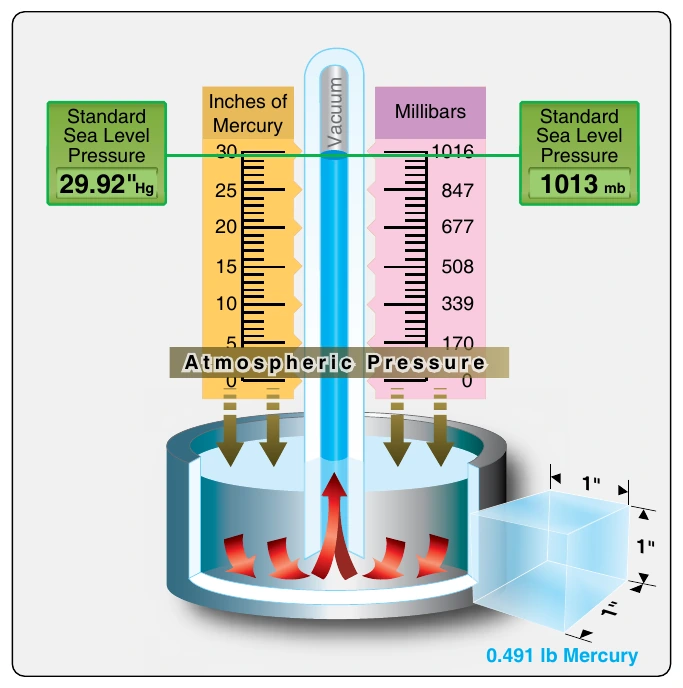
extending from sea level to the top of the atmosphere weighs approximately 14.7 pounds; therefore, atmospheric pressure is stated in pounds per square inch (psi). Thus, atmospheric pressure at sea level is 14.7 psi.
Atmospheric pressure is measured with an instrument called a barometer, composed of mercury in a tube that records atmospheric pressure in inches of mercury ("Hg). [Figure 2-1] The standard measurement in aviation altimeters and U.S. weather reports has been "Hg. However, worldwide weather maps and some non-U.S. manufactured aircraft instruments indicate pressure in millibars (mb), a metric unit. At sea level, when the average atmospheric pressure is 14.7 psi, the barometric pressure is 29.92 "Hg, and the metric measurement is 1013.25 mb.
An important consideration is that atmospheric pressure varies with altitude. As an aircraft ascends, atmospheric pressure drops, oxygen content of the air decreases, and temperature drops. The changes in altitude affect an aircraft’s performance in such areas as lift and engine horsepower. The effects of temperature, altitude, and density of air on aircraft performance are covered in the following paragraphs.
Density
Density is weight per unit of volume. Since air is a mixture of gases, it can be compressed. If the air in one container is under half as much pressure as an equal amount of air in an identical container, the air under the greater pressure weighs twice as much as that in the container under lower pressure. The air under greater pressure is twice as dense as that in the other container. For the equal weight of air, that which is under the greater pressure occupies only half the volume of that under half the pressure.
The density of gases is governed by the following rules: