
Chapter 2
Aerodynamics, Aircraft Assembly, & Rigging
Primary Flight Controls
The primary controls are the ailerons, elevator, and the rudder, which provide the aerodynamic force to make the aircraft follow a desired flightpath. [Figure 2-10] The flight control surfaces are hinged or movable airfoils designed to change the attitude of the aircraft by changing the airflow over the aircraft’s surface during flight. These surfaces are used for moving the aircraft about its three axes.
Typically, the ailerons and elevators are operated from the flight deck by means of a control stick, a wheel, and yoke assembly and on some of the newer design aircraft, a joy-stick. The rudder is normally operated by foot pedals on most aircraft. Lateral control is the banking movement or roll of an aircraft that is controlled by the ailerons. Longitudinal control is the climb and dive movement or pitch of an aircraft that is controlled by the elevator. Directional control is the left and right movement or yaw of an aircraft that is controlled by the rudder.
Trim Controls
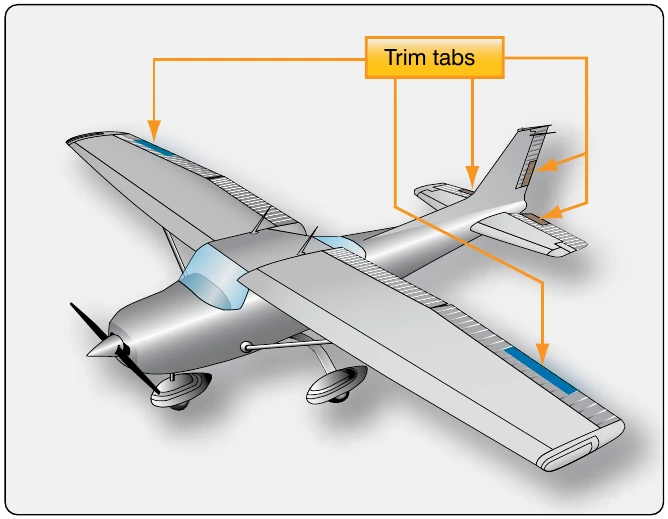
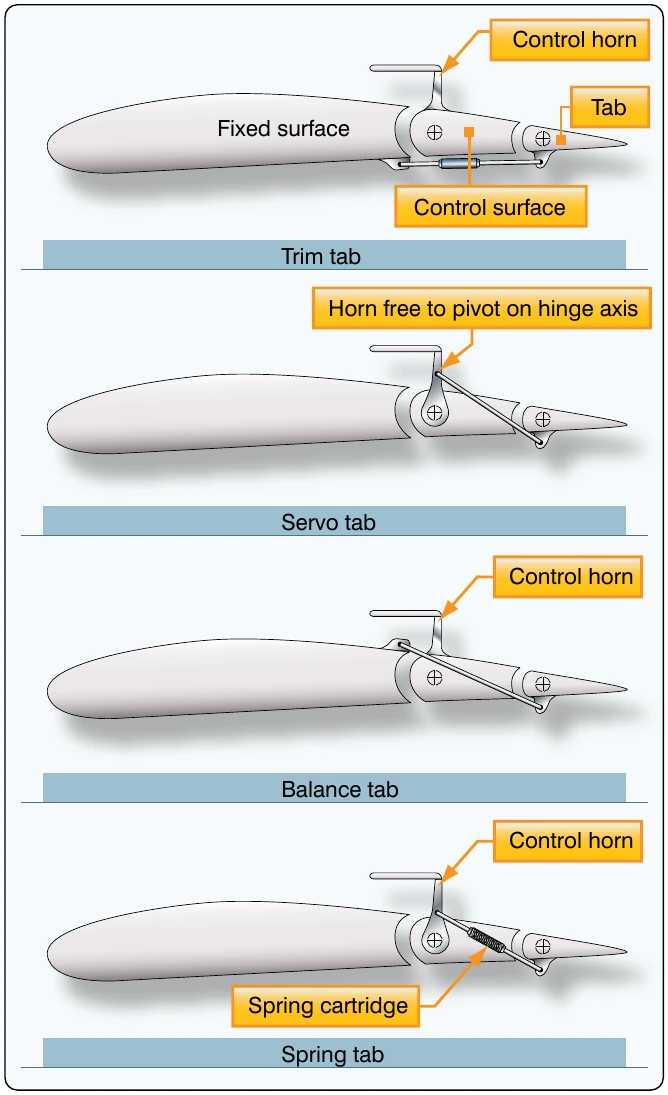
Included in the trim controls are the trim tabs, servo tabs, balance tabs, and spring tabs. Trim tabs are small airfoils recessed into the trailing edges of the primary control surfaces. [Figure 2-12] Trim tabs can be used to correct any tendency of the aircraft to move toward an undesirable flight attitude. Their purpose is to enable the pilot to trim out any unbalanced condition which may exist during flight, without exerting any pressure on the primary controls.
Servo tabs, sometimes referred to as flight tabs, are used primarily on the large main control surfaces. They aid in moving the main control surface and holding it in the desired position. Only the servo tab moves in response to movement by the pilot of the primary flight controls.
Balance tabs are designed to move in the opposite direction of the primary flight control. Thus, aerodynamic forces acting on the tab assist in moving the primary control surface.
Spring tabs are similar in appearance to trim tabs, but serve an entirely different purpose. Spring tabs are used for the same purpose as hydraulic actuators—to aid the pilot in moving the primary control surface.
Figure 2-13 indicates how each trim tab is hinged to its parent primary control surface, but is operated by an independent control.
Auxiliary Lift Devices
Included in the auxiliary lift devices group of flight control surfaces are the wing flaps, spoilers, speed brakes, slats, leading edge flaps, and slots.
The auxiliary groups may be divided into two subgroups: those whose primary purpose is lift augmenting and those whose primary purpose is lift decreasing. In the first group are the flaps, both trailing edge and leading edge (slats), and slots. The lift decreasing devices are speed brakes and spoilers.
Lift Augmenting
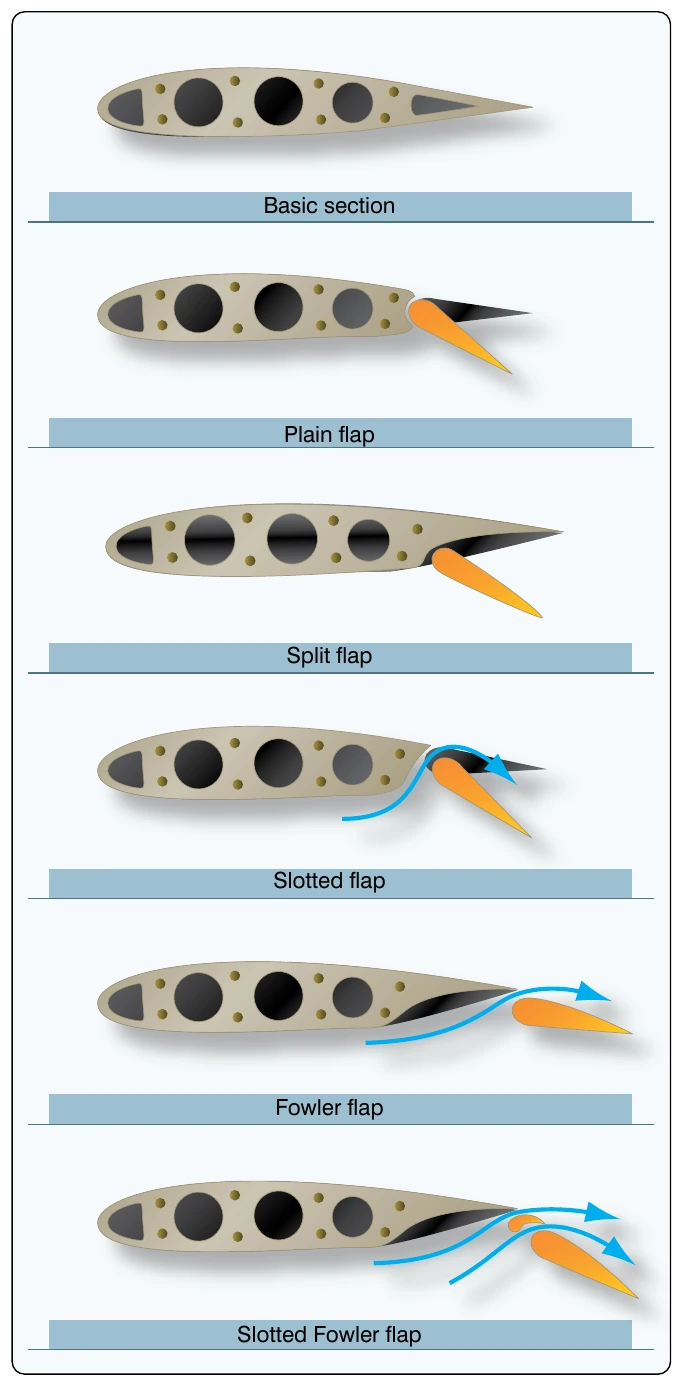
Flaps are located on the trailing edge of the wing and are moveable to increase the wing area, thereby increasing lift on takeoff, and decreasing the speed during landing. These airfoils are retractable and fair into the wing contour. Others are simply a portion of the lower skin which extends into the airstream, thereby slowing the aircraft. Leading edge flaps, also referred to as slats, are airfoils extended from and retracted into the leading edge of the wing. Some installations create a slot (an opening between the extended airfoil and the leading edge). [Figure 2-14] At low airspeeds, this slot increases lift and improves handling characteristics, allowing the aircraft to be controlled at airspeeds below the normal landing speed.
Other installations have permanent slots built in the leading edge of the wing. At cruising speeds, the trailing edge and leading edge flaps (slats) are retracted into the wing proper. Slats are movable control surfaces attached to the leading edges of the wings. When the slat is closed, it forms the leading edge of the wing. When in the open position (extended forward), a slot is created between the slat and the wing leading edge. At low airspeeds, this increases lift and improves handling characteristics, allowing the aircraft to be controlled at airspeeds below the normal landing speed. [Figure 2-15]
Lift Decreasing
Lift decreasing devices are the speed brakes (spoilers). In some installations, there are two types of spoilers. The ground spoiler is extended only after the aircraft is on the ground, thereby assisting in the braking action. The flight spoiler assists in lateral control by being extended whenever the aileron on that wing is rotated up. When actuated as speed brakes, the spoiler panels on both wings raise up. In-flight spoilers may also be located along the sides, underneath the fuselage, or back at the tail. [Figure 2-16] In some aircraft designs, the wing panel on the up aileron side rises more than the wing panel on the down aileron side. This provides speed brake operation and lateral control simultaneously.