
Chapter 5
Aircraft Welding
Introduction
Welding can be traced back to the Bronze Age, but it was not until the 19th century that welding as we know it today was invented. Some of the first successful commercially manufactured aircraft were constructed from welded steel tube frames.
As the technology and manufacturing processes evolved in the aircraft and aerospace industry, lighter metals, such as aluminum, magnesium, and titanium, were used in their construction. New processes and methods of welding these metals were developed. This chapter provides some of the basic information needed to understand and initiate the various welding methods and processes.
Traditionally, welding is defined as a process that joins metal by melting or hammering the work pieces until they are united together. With the right equipment and instruction, almost anyone with some basic mechanical skill, dexterity, and practice can learn to weld.
There are three general types of welding: gas, electric arc, and electric resistance. Each type of welding has several variations, some of which are used in the construction of aircraft. Additionally, there are some new welding processes that have been developed in recent years that are highlighted for the purpose of information.
This chapter addresses the welding equipment, methods, and various techniques used during the repair of aircraft and fabrication of component parts, including the processes of brazing and soldering of various metals.
Types of Welding
Gas Welding
Gas welding is accomplished by heating the ends or edges of metal parts to a molten state with a high temperature flame. The oxy-acetylene flame, with a temperature of approximately 6,300 °Fahrenheit (F), is produced with a torch burning acetylene and mixing it with pure oxygen. Hydrogen may be used in place of acetylene for aluminum welding, but the heat output is reduced to about 4,800 °F. Gas welding was the method most commonly used in production on aircraft materials under 3⁄16-inch in thickness until the mid 1950s, when it was replaced by electric welding for economic (not engineering) reasons. Gas welding continues to be a very popular and proven method for repair operations.
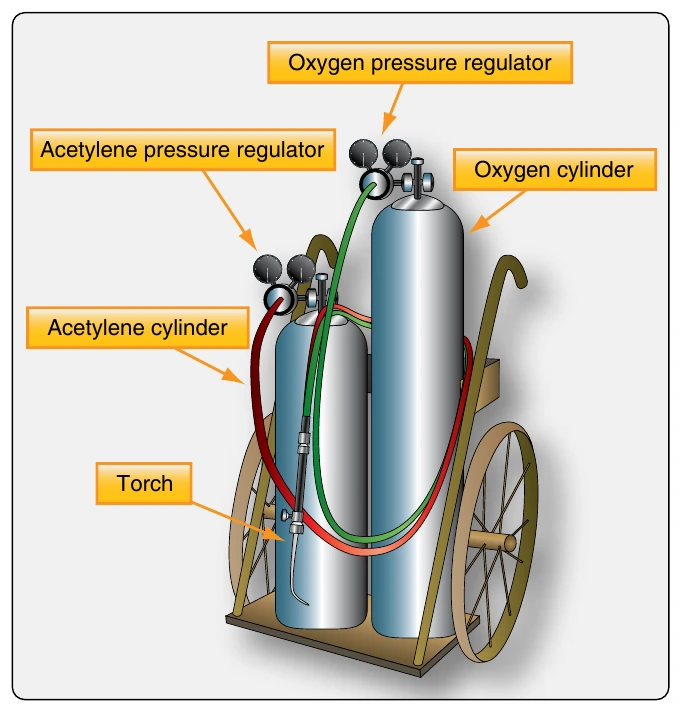
Nearly all gas welding in aircraft fabrication is performed with oxy-acetylene welding equipment consisting of:
- Two cylinders, acetylene and oxygen.
- Acetylene and oxygen pressure regulators and cylinder pressure gauges.
- Two lengths of colored hose (red for acetylene and green for oxygen) with adapter connections for the regulators and torch.
- A welding torch with an internal mixing head, various size tips, and hose connections.
- Welding goggles fitted with appropriate colored lenses.
- A flint or spark lighter.
- Special wrench for acetylene tank valve if needed.
- An appropriately-rated fire extinguisher.
The equipment may be permanently installed in a shop, but most welding outfits are of the portable type. [Figure 5-1]
Electric Arc Welding
Electric arc welding is used extensively by the aircraft industry in both the manufacture and repair of aircraft. It can be used satisfactorily to join all weldable metals, provided that the proper processes and materials are used. The four types of electric arc welding are addressed in the following paragraphs.
Shielded Metal Arc Welding (SMAW)
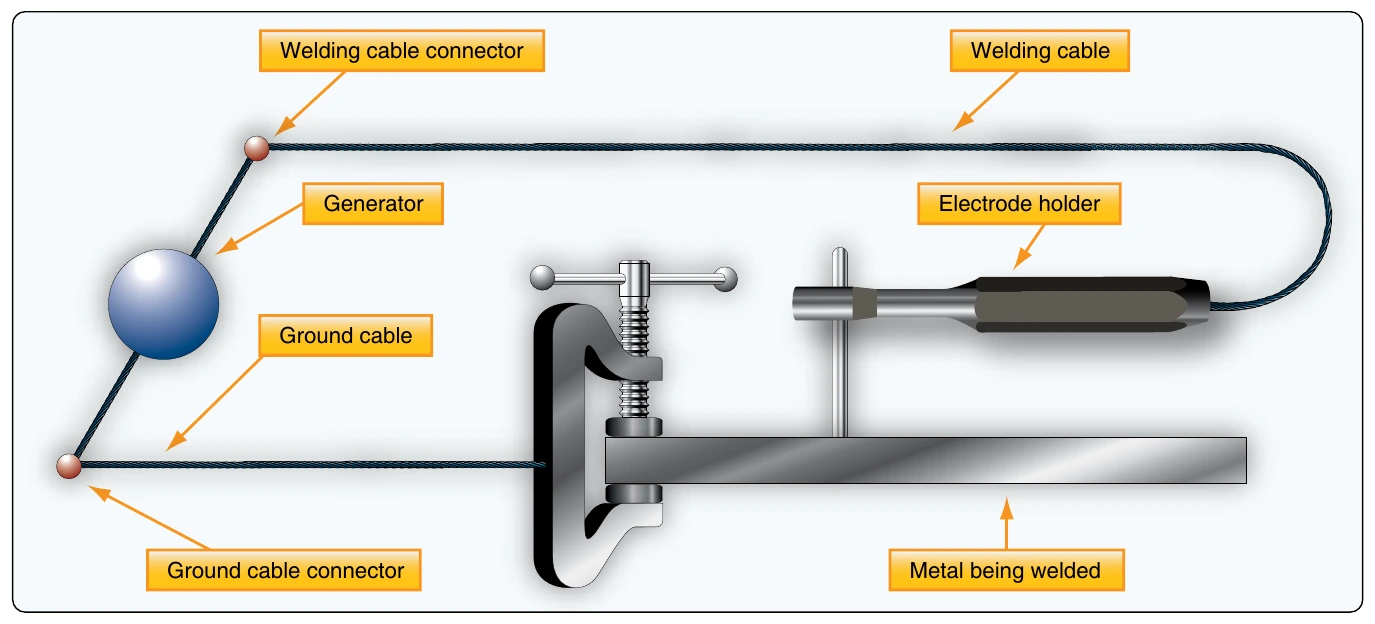
Shielded metal arc welding (SMAW) is the most common type of welding and is usually referred to as “stick” welding. The equipment consists of a metal wire rod coated with a welding flux that is clamped in an electrode holder that is connected by a heavy electrical cable to a low voltage and high current in either alternating current (AC) or direct current (DC), depending on the type of welding being done. An arc is struck between the rod and the work and produces heat in excess of 10,000 °F, which melts both the material and the rod. The welding circuit consists of a welding machine, two leads, an electrode holder, an electrode, and the work to be welded. [Figure 5-2]
When the electrode is touched to the metal to be welded, the circuit is complete and the current flows. The electrode is then withdrawn from the metal approximately 1⁄4-inch to form an air gap between the metal and the electrode. If the correct gap is maintained, the current bridges the gap to form a sustained electric spark called the arc. This action melts the electrode and the coating of flux.
As the flux melts, it releases an inert gas that shields the molten puddle from oxygen in the air to prevent oxidation. The molten flux covers the weld and hardens to an airtight slag that protects the weld bead as it cools. Some aircraft manufacturers, such as Stinson, used this process for the welding of 4130 steel fuselage structures. This was followed by heat treatment in an oven to stress relieve and normalize the structure. Shown in Figure 5-3 is a typical arc welding machine with cables, ground clamp, and electrode holder.