
Chapter 5
Aircraft Welding
Since it is impractical to cite every possible variation occasioned by different welding conditions, only the information necessary for the commonly used positions and welds is discussed here.
Flat Position Welding
There are four types of welds commonly used in flat position welding: bead, groove, fillet, and lap joint. Each type is discussed separately in the following paragraphs.
Bead Weld
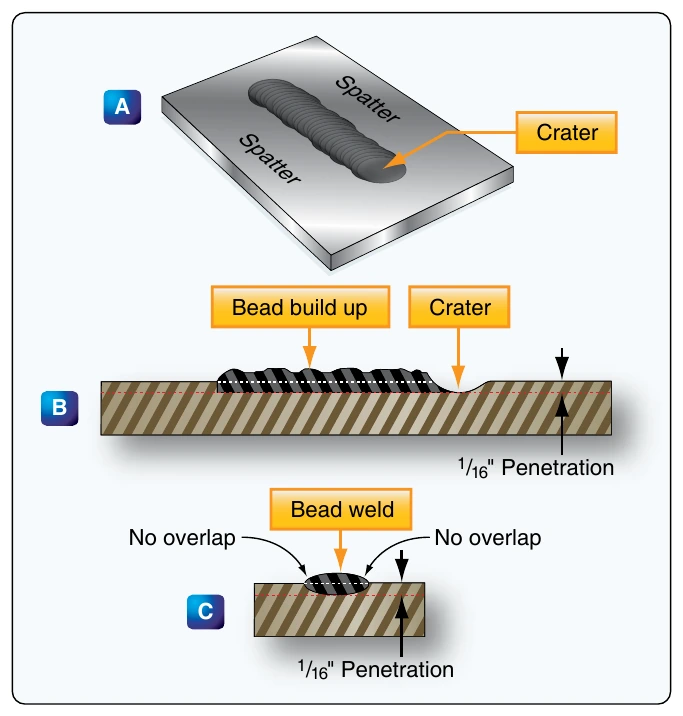
The bead weld utilizes the same technique that is used when depositing a bead on a flat metal surface. [Figure 5-35] The only difference is that the deposited bead is at the butt joint of two steel plates, fusing them together. Square butt joints may be welded in one or multiple passes. If the thickness of the metal is such that complete fusion cannot be obtained by welding from one side, the joint must be welded from both sides. Most joints should first be tack-welded to ensure alignment and reduce warping.
Groove Weld
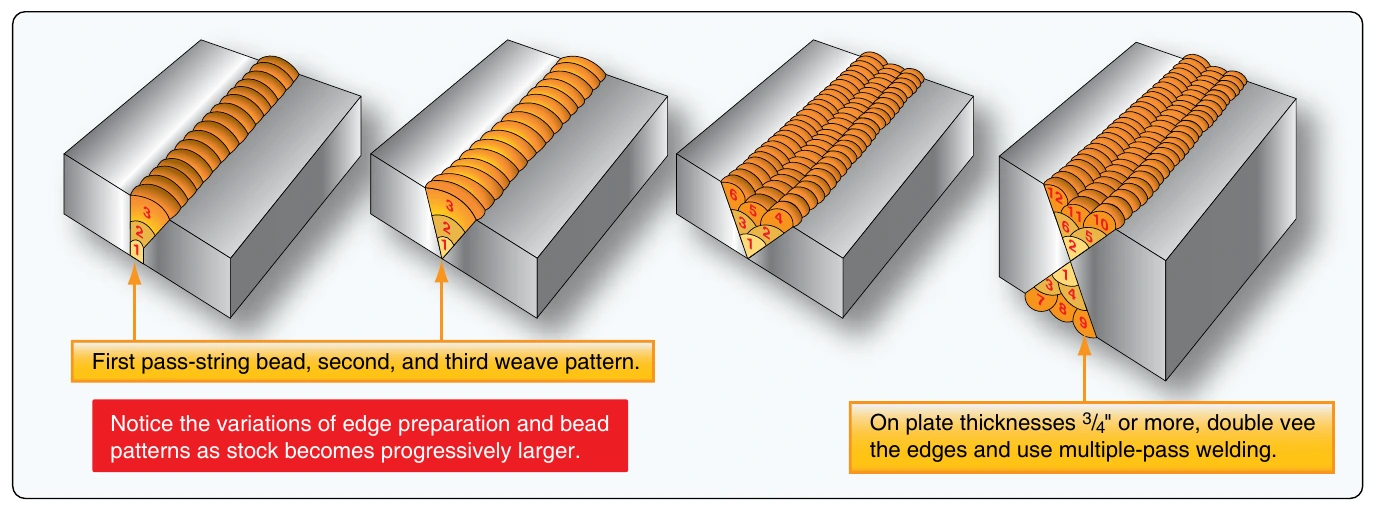
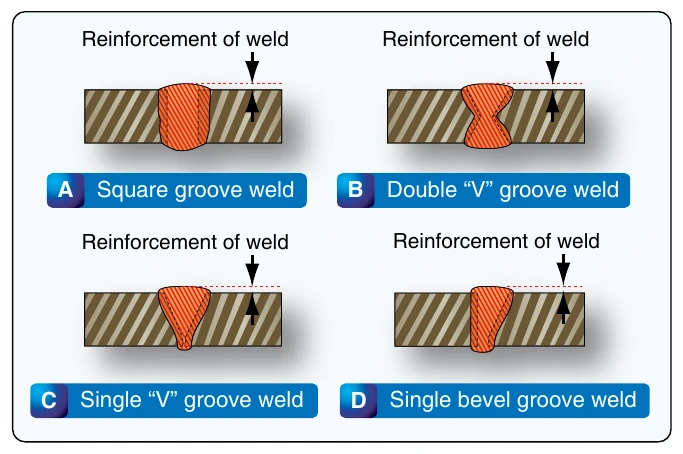
Groove welding may be performed on a butt joint or an outside corner joint. Groove welds are made on butt joints where the metal to be welded is ¼-inch or more in thickness. The butt joint can be prepared using either a single or double groove depending on the thickness of the plate. The number of passes required to complete a weld is determined by the thickness of the metal being welded and the size of the electrode being used.
Any groove weld made in more than one pass must have the slag, spatter, and oxide carefully removed from all previous weld deposits before welding over them. Some of the common types of groove welds performed on butt joints in the flat position are shown in Figure 5-36.
Fillet Weld
Fillet welds are used to make tee and lap joints. The electrode should be held at an angle of 45° to the plate surface. The electrode should be tilted at an angle of about 15° in the direction of welding. Thin plates should be welded with little or no weaving motion of the electrode and the weld is made in one pass. Fillet welding of thicker plates may require two or more passes using a semicircular weaving motion of the electrode. [Figure 5-37]
Lap Joint Weld
The procedure for making fillet weld in a lap joint is similar to that used in the tee joint. The electrode is held at about a 30° angle to the vertical and tilted to an angle of about 15° in the direction of welding when joining plates of the same thickness. [Figure 5-38]
Vertical Position Welding
Vertical positing welding includes any weld applied to a surface inclined more than 45° from the horizontal. Welding in the vertical position is more difficult than welding in the flat position because of the force of gravity. The molten metal has the tendency to run down. To control the flow of molten metal, the voltage and current adjustments of the welding machine must be correct.
The current setting, or amperage, is less for welding in the vertical position than for welding in the flat position for similar size electrodes. Additionally, the current used for welding upward should be set slightly higher than the current used for welding downward on the same work piece. When welding up, hold the electrode 90° to the vertical, and weld moving the bead upward. Focus on welding the sides of the joint and the middle takes care of itself. In welding downward, with the hand below the arc and the electrode tilted about 15° upward, the weld should move downward.
Overhead Position Welding
Overhead position welding is one of the most difficult in welding since a very short arc must be constantly maintained to control the molten metal. The force of gravity tends to cause the molten metal to drop down or sag from the plate, so it is important that protective clothing and head gear be worn at all times when performing overhead welding.