
Chapter 6
Aircraft Wood & Structural Repair
External & Internal Inspection
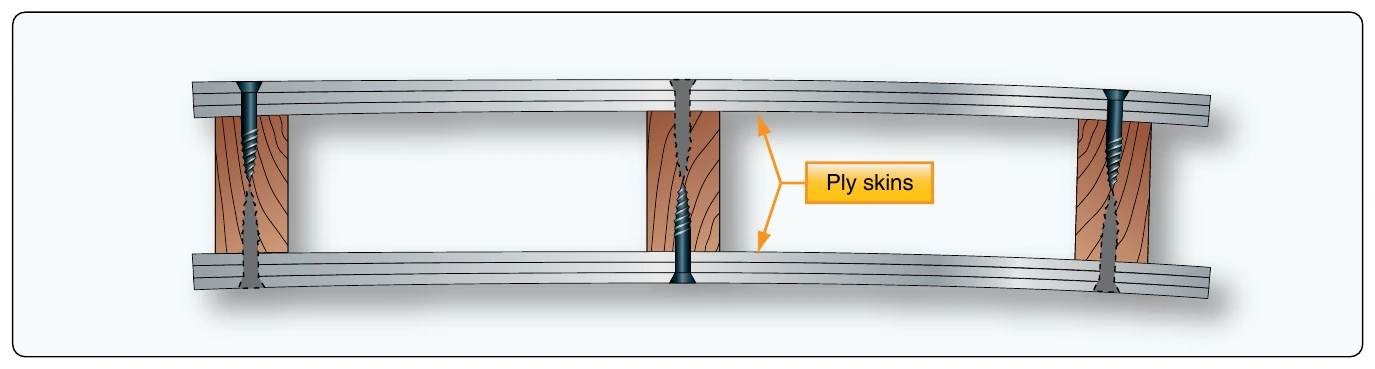
The inspection should begin with an examination of the external surface of the aircraft. This provides a general assessment of the overall condition of the wood and structure. The wings, fuselage, and empennage should be inspected for undulation, warping, or any other disparity from the original shape. Where the wings, fuselage, or empennage structure and skins form stressed structures, no departure from the original contour or shape is permissible. [Figure 6-3]
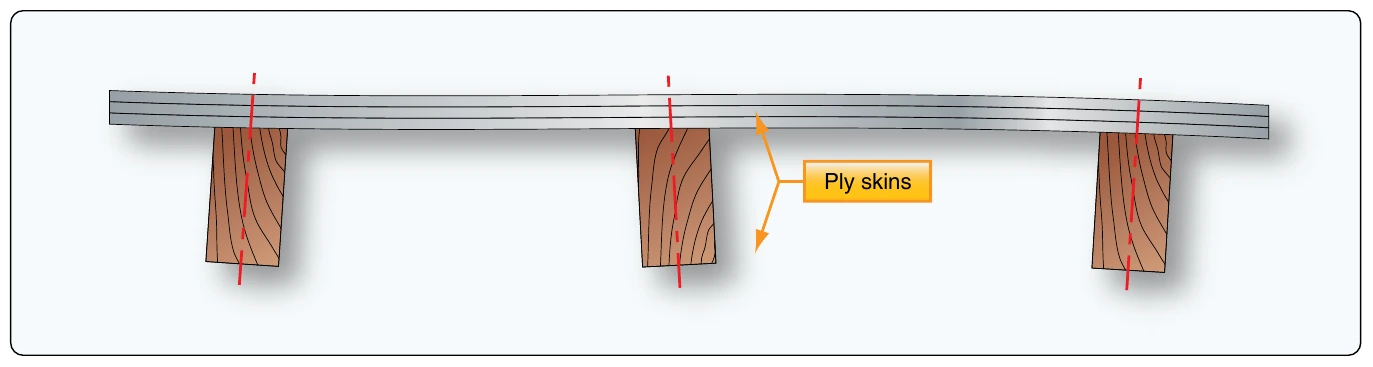
Where light structures using single plywood covering are concerned, some slight sectional undulation or bulging between panels may be permissible if the wood and glue are sound. However, where such conditions exist, a careful check must be made of the attachment of the plywood to its supporting structure. A typical example of a distorted single plywood structure is illustrated in Figure 6-4.
The contours and alignment of leading and trailing edges are of particular importance. A careful check should be made for any deviation from the original shape. Any distortion of these light plywood and spruce structures is indicative of deterioration, and a detailed internal inspection has to be made for security of these parts to the main wing structure. If deterioration is found in these components, the main wing structure may also be affected.
Splits in the fabric covering on plywood surfaces must be investigated to ascertain whether the plywood skin beneath is serviceable. In all cases, remove the fabric and inspect the plywood, since it is common for a split in the plywood skin to initiate a similar defect in the protective fabric covering.
Although a preliminary inspection of the external structure can be useful in assessing the general condition of the aircraft,
Glue failure and wood deterioration are often closely related, and the inspection of glued joints must include an examination of the adjacent wood structure. Note: Water need not be present for glue deterioration to take place.
The inspection of a complete aircraft for glue or wood deterioration requires scrutiny of parts of the structure that may be known, or suspected, trouble spots. In many instances, these areas are boxed in or otherwise inaccessible. Considerable dismantling may be required. It may be necessary to cut access holes in some of the structures to facilitate the inspection. Do such work only in accordance with approved drawings or instructions in the maintenance manual for the aircraft concerned. If drawings and manuals are not available, engineering review may be required before cutting access holes.
Glued Joint Inspection
The inspection of glued joints in wooden aircraft structures presents considerable difficulties. Even where access to the joint exists, it is still difficult to positively assess the integrity of the joint. Keep this in mind when inspecting any glue joint.
Some common factors in premature glue deterioration include:
- Chemical reactions of the glue caused by aging or moisture, extreme temperatures, or a combination of these factors.
- Mechanical forces caused mainly by wood shrinkage.
- Development of fungal growths.
An aircraft painted in darker colors experiences higher skin temperatures and heat buildup within its structure. Perform a more detailed inspection on a wooden aircraft structure immediately beneath the upper surfaces for signs of deteriorating adhesives.
Aircraft that are exposed to large cyclic changes of temperature and humidity are especially prone to wood shrinkage that may lead to glue joint deterioration. The amount of movement of a wooden member due to these changes varies with the size of each member, the rate of growth of the tree from which it was cut, and the way the wood was converted in relation to the grain.
This means that two major structural members joined to each other by glue are not likely to have identical characteristics. Over a period of time, differential loads are transmitted across the glue joint because the two members do not react identically. This imposes stresses in the glue joint that can normally be accommodated when the aircraft is new and for some years afterwards. However, glue tends to deteriorate with age, and stresses at the glued joints may cause failure of the joints. This is a fact even when the aircraft is maintained under ideal conditions.
The various cuts of lumber from a tree have tendency to shrink and warp in the direction(s) indicated in the yellow area around each cut in Figure 6-5.
When checking a glue line (the edge of the glued joint) for condition, all protective coatings of paint should be removed by careful scraping. It is important to ensure that the wood is not damaged during the scraping operation. Scraping should cease immediately when the wood is revealed in its natural state and the glue line is clearly discernible. At this point in the inspection, it is important that the surrounding wood is dry; otherwise, you will get a false indication of the integrity of the glue line due to swelling of the wood and subsequent closing of the joint.