
Chapter 6
Aircraft Wood & Structural Repair
The front and rear spars should be checked for longitudinal cracks at the ends of the plywood reinforcement plates where the lift struts attach. [Figure 6-8] Check the ribs on either side of the strut attach points for cracks where the cap strips pass over and under the spars, and for missing or loose rib-to-spar attach nails. All spars, those in the wing(s) and empennage, should be inspected on the face and top surface for compression cracks. A borescope can be utilized by accessing existing inspection holes.
Various mechanical methods can be employed to enhance the visual inspection of wood structures. Tapping the subject area with a light plastic hammer or screwdriver handle should produce a sharp solid sound. If the suspected area sounds hollow and dull, further inspection is warranted. Use a sharp metal awl or thin-bladed screwdriver to probe the area. The wood structure should be solid and firm. If the area is soft and mushy, the wood is rotted and disassembly and repair of the structure is necessary.
Repair of Wood Aircraft Structures
The standard for any repair is that it should return the aircraft or component to its original condition in strength, function, and aerodynamic shape. It should also be accomplished in accordance with the manufacturer’s specifications and/or instructions, or other approved data.
The purpose of repairing all wood structural components is to obtain a structure as strong as the original. Major damage probably requires replacement of the entire damaged assembly, but minor damage can be repaired by removing or cutting away the damaged members and replacing them with new sections. This replacement may be accomplished by gluing, glue and nails, or glue and screw-reinforced splicing.
Materials
Several forms of wood are commonly used in aircraft.
- Solid wood or the adjective “solid” used with such nouns as “beam” or “spar” refers to a member consisting of one piece of wood.
- Laminated wood is an assembly of two or more layers of wood that have been glued together with the grain of all layers or laminations approximately parallel.
- Plywood is an assembled product of wood and glue that is usually made of an odd number of thin plies, or veneers, with the grain of each layer placed 90° with the adjacent ply or plies.
- High-density material includes compreg, impreg, or similar commercially made products, heat-stabilized wood, or any of the hardwood plywoods commonly used as bearing or reinforcement plates.
Suitable Wood
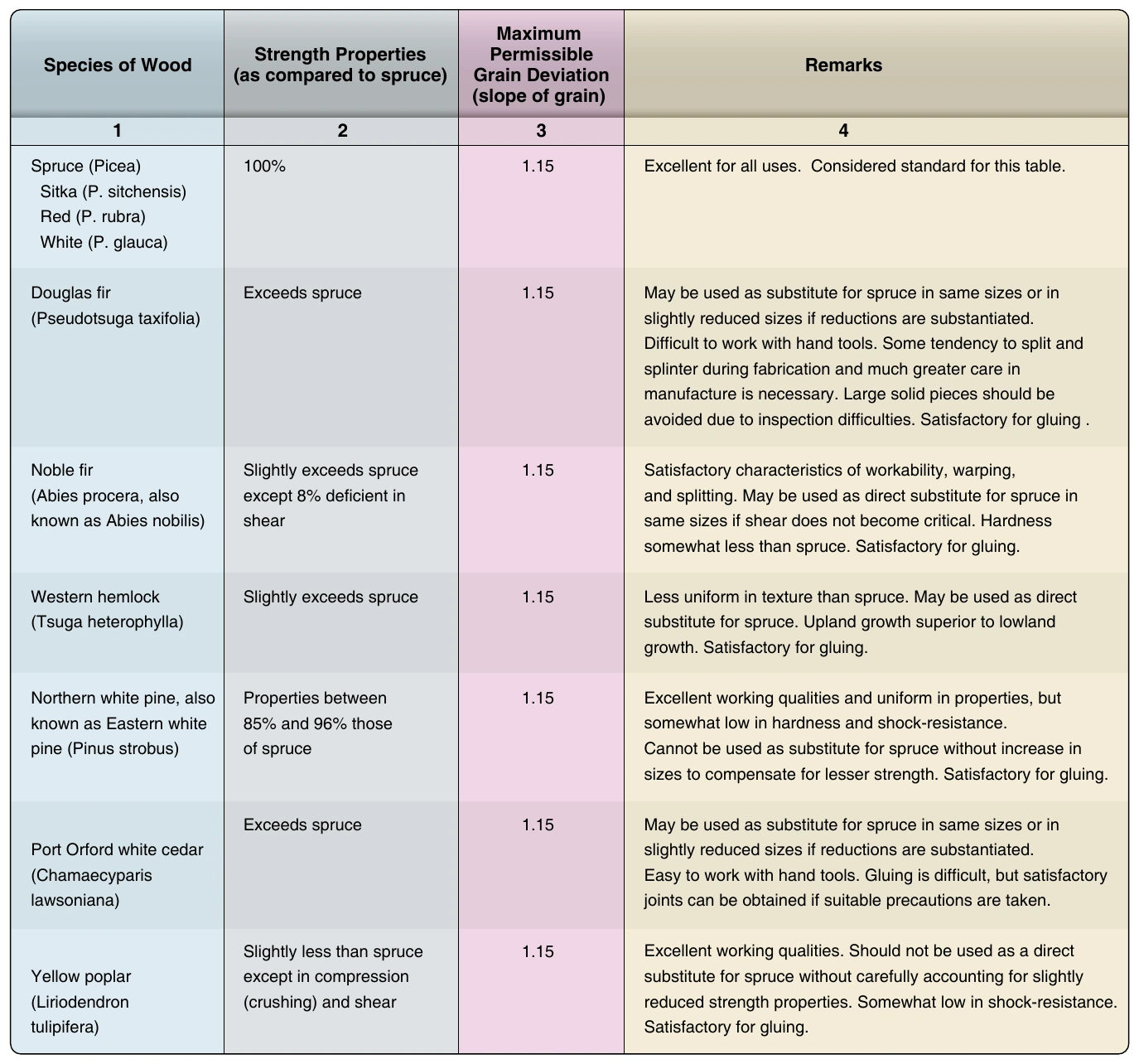
The various species of wood listed in Figure 6-10 are acceptable for structural purposes when used for the repair of aircraft. Spruce is the preferred choice and the standard by which the other wood is measured. Figure 6-10 provides a comparison of other wood that may be suitable for aircraft repair. It lists the strength and characteristics of the wood in comparison to spruce. The one item common to all the species is that the slope of the grain cannot be steeper than 1:15.
All solid wood and plywood used for the construction and repair of aircraft should be of the highest quality and grade. For certificated aircraft, the wood should have traceability to a source that can provide certification to a military specification (MIL-SPEC). The term “aircraft quality” or “aircraft grade” is referred to and specified in some repair documents, but that grade wood cannot be purchased from a local lumber company. To purchase the material, contact one of the specialty aircraft supply companies and request a certification document with the order. The MIL-SPEC for solid spruce is MIL-S-6073 and for plywood it is MIL-P-6070B.
When possible, fabricated wood components should be purchased from the aircraft manufacturer, or someone who may have a Parts Manufacturer Approval (PMA) to produce replacement parts for the aircraft. With either of these sources supplying the wood components, the mechanic can be assured of installing approved material. At the completion of the repair, as always, it is the responsibility of the person returning the aircraft to service to determine the quality of the replacement wood and the airworthiness of the subsequent repair.
To help determine the suitability of the wood, inspect it for defects that would make it unsuitable material to repair or construct an aircraft. The type, location, and amount or size of the defects grade the wood for possible use. All woods used for structural repair of aircraft are classified as softwood. Softwood is typically used for construction and is graded based on strength, load carrying ability, and safety. Hardwoods, on the other hand, are typically appearance woods and are graded based on the number and size of clear cuttings from the tree.
Defects Permitted
The following defects are permitted in the wood species used for aircraft repair that are identified in Figure 6-10:
- Cross grain—Spiral grain, diagonal grain, or a combination of the two is acceptable if the grain does not diverge from the longitudinal axis of the material more than specified in Figure 6-10 column
- A check of all four faces of the board is necessary to determine the amount of divergence. The direction of free-flowing ink frequently assists in determining grain direction.
- Wavy, curly, and interlocked grain—Acceptable, if local irregularities do not exceed limitations specified for spiral and diagonal grain.
- Hard knots—Sound, hard knots up to 3⁄8-inch in diameter are acceptable if: (1) they are not projecting portions of I-beams, along the edges of rectangular or beveled unrouted beams, or along the edges of flanges of box beams (except in portions of low stress); (2) they do not cause grain divergence at the edges of the board or in the flanges of a beam more than specified in Figure 6-10 column 3; and (3) they are in the center third of the beam and not closer than 20-inches to another knot or other defect (pertains to 3⁄8-inch knots; smaller knots may be proportionately closer). Knots greater than ¼-inch must be used with caution.
- Pin knot clusters—Small clusters are acceptable if they produce only a small effect on grain direction.
- Pitch pockets—Acceptable in center portion of a beam if they are at least 14-inches apart when they lie in the same growth ring and do not exceed 1½-inches in length by 1⁄8-inch width by 1⁄8-inch depth, and if they are not along the projecting portions of I-beams, along the edges of rectangular or beveled unrouted beams, or along the edges of the flanges of box beams.
- Mineral streaks—Acceptable if careful inspection fails to reveal any decay.
Defects Not Permitted
The following defects are not permitted in wood used for aircraft repair. If a defect is listed as unacceptable, please refer to the previous section, Defects Permitted, for acceptable conditions.
- Cross grain—unacceptable.
- Wavy, curly, and interlocked grain – unacceptable.
- Hard knots—unacceptable.
- Pin knot clusters—unacceptable, if they produce large effect on grain direction.
- Spike knots—knots running completely through the depth of a beam perpendicular to the annual rings and appear most frequently in quarter-sawed lumber. Reject wood containing this defect.
- Pitch pockets—unacceptable.
- Mineral streaks—unacceptable, if accompanied by decay.