
Chapter 9
Aircraft Electrical System
NiCd cells installed in an aircraft battery are typical of the vented cell type. The vented cells have a vent or low pressure release valve that releases any generated oxygen and hydrogen gases when overcharged or discharged rapidly. This also means the battery is not normally damaged by excessive rates of overcharge, discharge, or even negative charge. The cells are rechargeable and deliver a voltage of 1.2 volts during discharge.
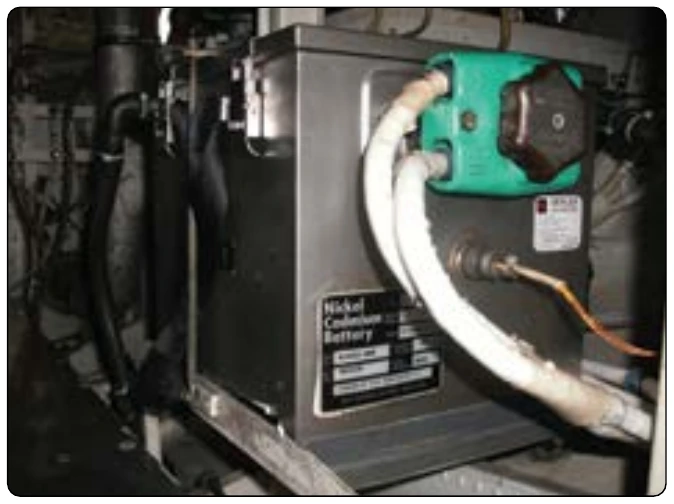
Aircraft that are outfitted with NiCd batteries typically have a fault protection system that monitors the condition of the battery. The battery charger is the unit that monitors the condition of the battery and the following conditions are monitored:
- Overheat condition,
- Low temperature condition (below –40 °F),
- Cell imbalance,
- Open circuit, and
- Shorted circuit.
If the battery charger finds a fault, it turns off and sends a fault signal to the Electrical Load Management System (ELMS).
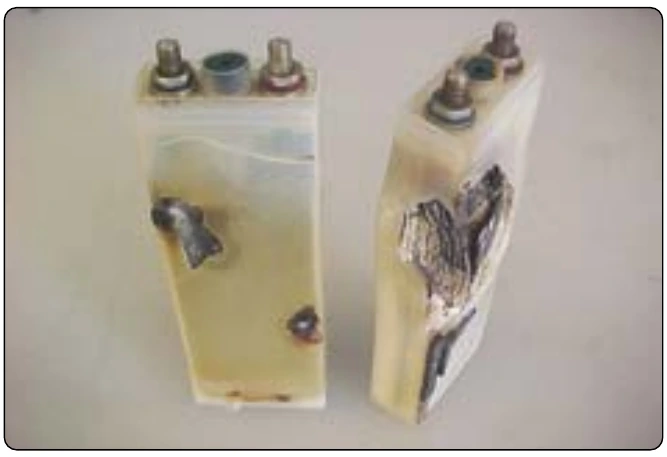
NiCd batteries are capable of performing to their rated capacity when the ambient temperature of the battery is in the range of approximately 60–90 °F. An increase or decrease in temperature from this range results in reduced capacity. NiCd batteries have a ventilation system to control the temperature of the battery. A combination of high battery temperature (in excess of 160 °F) and overcharging can lead to a condition called thermal runaway. [Figure 9-35] The temperature of the battery has to be constantly monitored to ensure safe operation. Thermal runaway can result in a NiCd chemical fire and/or explosion of the NiCd battery under recharge by a constant-voltage source and is due to cyclical, ever-increasing temperature and charging current. One or more shorted cells or an existing high temperature and low charge can produce the following cyclical sequence of events:
- Excessive current,
- Increased temperature,
- Decreased cell(s) resistance,
- Further increased current, and
- Further increased temperature.
This does not become a self-sustaining thermal-chemical action if the constant-voltage charging source is removed before the battery temperature is in excess of 160 °F.
Capacity
Capacity is measured quantitatively in ampere-hours delivered at a specified discharge rate to a specified cut-off voltage at room temperature. The cut-off voltage is 1.0 volt per cell. Battery available capacity depends upon several factors including such items as:
- Cell design (cell geometry, plate thickness, hardware, and terminal design govern performance under specific usage conditions of temperature, discharge rate, etc.).
- Discharge rate (high current rates yield less capacity than low rates).
- Temperature (capacity and voltage levels decrease as battery temperature moves away from the 60 °F (16 °C) to 90 °F (32 °C) range toward the high and low extremes).
- Charge rate (higher charge rates generally yield greater capacity).
Aircraft Battery Ratings by Specification
The one-hour rate is the rate of discharge a battery can endure for 1 hour with the battery voltage at or above 1.67 volts per cell, or 20 volts for a 24-volt lead-acid battery, or 10 volts for a 12-volt lead-acid battery. The one-hour capacity, measured in ampere hours (Ah), is the product of the discharge rate and time (in hours) to the specified end voltage.
The emergency rate is the total essential load, measured in amperes, required to support the essential bus for 30 minutes. This is the rate of discharge a battery can endure for 30 minutes with the battery voltage at or above 1.67 volts per cell, or 20 volts for a 24 volt lead-acid battery, or 10 volts for a 12 volt lead-acid battery.
Storing & Servicing Facilities
Separate facilities for storing and/or servicing flooded electrolyte lead-acid and NiCd batteries must be maintained. Introduction of acid electrolyte into alkaline electrolyte causes permanent damage to vented (flooded electrolyte) NiCd batteries and vice versa. However, batteries that are sealed can be charged and capacity checked in the same area. Because the electrolyte in a valve-regulated lead-acid battery is absorbed in the separators and porous plates, it cannot contaminate a NiCd battery even when they are serviced in the same area.
Warning: It is extremely dangerous to store or service lead-acid and NiCd batteries in the same area. Introduction of acid electrolytes into alkaline electrolyte destroys the NiCd, and vice versa.