
Chapter 1
Safety, Ground Operations, & Servicing

Operating at pressures of 3,000 psi or more, extreme caution must be used when operating hydraulic power units. At 3,000 psi, a small stream from a leak can cut like a sharp knife. Therefore, inspect lines used with the system for cuts, frays, or any other damage, and keep them free of kinks and twists. When not in use, hydraulic power unit lines are to be stored (preferably wound on a reel) and kept clean, dry, and free of contaminants.
Ground Support Air Units
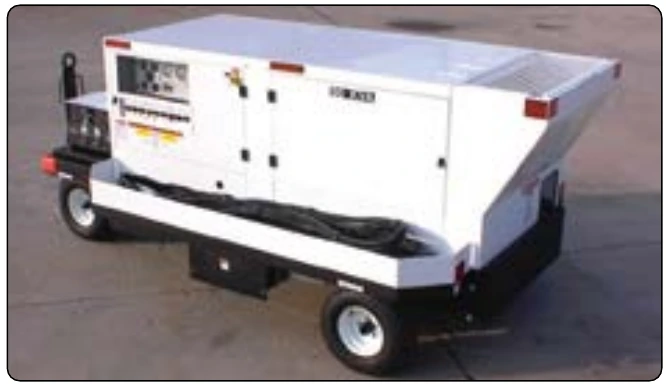
Air carts are used to provide low-pressure (up to 50 psi high volume flow) air that can be used for starting the engines and heating and cooling the aircraft on the ground (using the onboard aircraft systems). It generally consists of an APU [Figure 1-30]

Ground Air Heating and Air Conditioning
Most airport gates have facilities that can provide heated or cooled air. The units that cool or heat the air are permanent installations that connect to the aircraft’s ventilation system by use of a large hose. Portable heating and air conditioning units can also be moved close to the aircraft and connected by a duct that provides air to keep the cabin temperature comfortable.
Oxygen Servicing Equipment
Before servicing any aircraft, consult the specific aircraft maintenance manual to determine the proper types of servicing equipment to be used. Two personnel are required to service an aircraft with gaseous oxygen. One person is stationed at the control valves of the servicing equipment, and one person is stationed where they can observe the pressure in the aircraft system. Communication between the two people is required in the event of an emergency.
Do not service aircraft with oxygen during fueling, defueling, or other maintenance work that could provide a source of ignition. Oxygen servicing of aircraft is to be accomplished outside hangars.
Oxygen used on aircraft is available in two types: gaseous and liquid. The type to use on any specific aircraft depends on the type of equipment in the aircraft. Gaseous oxygen is stored in large steel cylinders, while liquid oxygen (commonly referred to as LOX) is stored and converted into a usable gas in a liquid oxygen converter.
Oxygen is commercially available in three general types: aviator’s breathing, industrial, and medical. Only oxygen marked “Aviator’s Breathing Oxygen” that meets Federal Specification BB-0-925A, Grade A, or its equivalent is to be used in aircraft breathing oxygen systems. Industrial oxygen may contain impurities that could cause the pilot, crew, and/or passengers to become sick. Medical oxygen, although pure, contains water that can freeze in the cold temperatures found at the altitudes where oxygen is necessary.
Oxygen Hazards
Gaseous oxygen is chemically stable and is nonflammable. However, combustible materials ignite more rapidly and burn with greater intensity in an oxygen-rich atmosphere. In addition, oxygen combines with oil, grease, or bituminous material to form a highly-explosive mixture that is sensitive to compression or impact. Physical damage to, or failure of, oxygen containers, valves, or plumbing can result in an explosive rupture with extreme danger to life and property. It is imperative that the highest standard of cleanliness be observed in handling oxygen and that only qualified and authorized persons be permitted to service aircraft gaseous oxygen systems. In addition to aggravating the fire hazard and because of its low temperature (it boils at −297 °F), liquid oxygen causes severe “burns” (frostbite) if it comes in contact with the skin.
Fuel Servicing of Aircraft
Types of Fuel and Identification
Two types of aviation fuel in general use are aviation gasoline, also known as AVGAS, and turbine fuel, also known as JET A fuel.
Aviation gasoline (AVGAS) is used in reciprocating engine aircraft. Currently, there are three grades of fuel in general use: 80/87, 100/130, and 100LL (low lead). A fourth grade, 115/145, is in limited use in the large reciprocating-engine aircraft. The two numbers indicate the lean mixture and rich mixture octane rating numbers of the specific fuel. In other words, with 80/87 AVGAS, the 80 is the lean mixture rating and 87 is the rich mixture rating number. To avoid confusing the types of AVGAS, it is generally identified as grade 80, 100, 100LL, or 115. AVGAS can also be identified by a color code. The color of the fuel needs to match the color band on piping and fueling equipment. [Figure 1-31]