
Chapter 1
Safety, Ground Operations, & Servicing
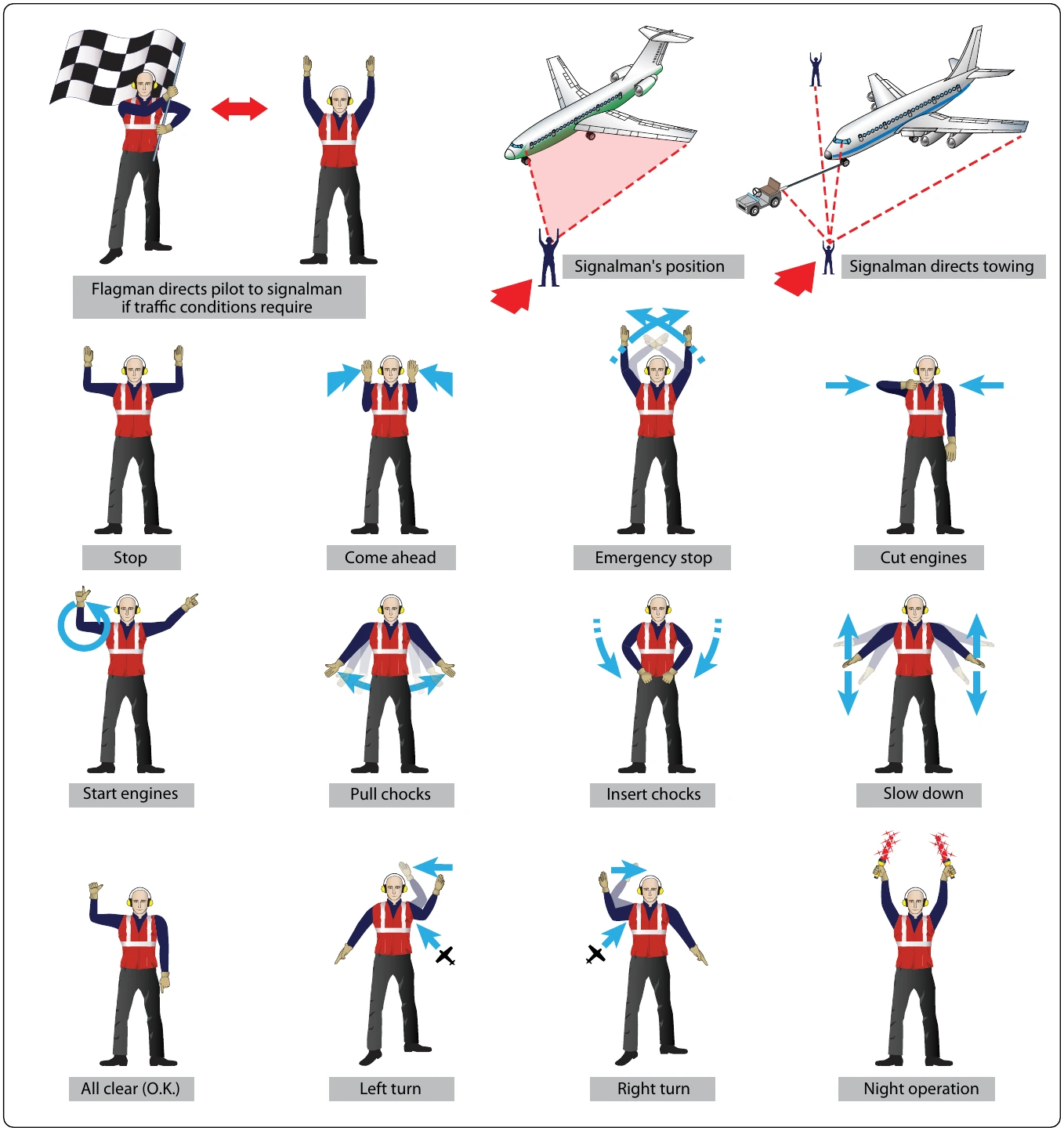
The taxi signals to be used must be studied until the taxi signalman can execute them clearly and precisely. The signals are to be given in such a way that the pilot cannot confuse their meaning. Remember that the pilot receiving the signals is always some distance away and often look out and down from a difficult angle. Thus, the signalman’s hands must be kept well separated, and signals are to be over-exaggerated rather than risk making indistinct signals. If there is any doubt about a signal, or if the pilot does not appear to be following the signals, use the “stop” sign and begin the series of signals again.
The signalman is to always try to give the pilot an indication of the approximate area that the aircraft is to be parked. The signalman must glance behind himself or herself often when walking backward to prevent backing into a propeller or tripping over a chock, fire bottle, tie-down line, or other obstruction.
Taxi signals are usually given at night with the aid of illuminated wands attached to flashlights. [Figure 1-26] Night signals are made in the same manner as day signals with the exception of the stop signal. The stop signal used at night is the “emergence stop” signal. This signal is made by crossing the wands to form a lighted “X” above and in front of the head.
Servicing Aircraft
Servicing Aircraft Air/Nitrogen Oil & Fluids
Checking or servicing aircraft fluids is an important maintenance function. Before servicing any aircraft, consult the specific aircraft maintenance manual to determine the proper type of servicing equipment and procedures. In general, aircraft engine oil is checked with a dipstick or a sight gauge. There are markings on the stick or around the sight gauge to determine the correct level. Reciprocating engines are to be checked after the engine has been inactive, while the turbine engine must be checked just after shutdown. Dry sump oil systems tend to hide oil that has seeped from the oil tank into the gearcase of the engine. This oil does not show up on the dipstick until the engine has been started or motored. If serviced before this oil is pumped back into the tank, the engine overfills. Never overfill the oil tank. Oil foams as it is circulated through the engine. The expansion space in the oil tank allows for this foaming (oil mixing with air). Also the correct type of oil must be used for the appropriate engine being serviced. Hydraulic fluid, fuel, and oil, if spilled on clothes or skin, must be removed as soon as possible because of fire danger and health reasons.
When servicing a hydraulic reservoir, the correct fluid must be used. Normally, this can be determined by the container or by color. Some reservoirs are pressurized by air that must be bled off before servicing. Efforts must be made to prevent any type of contamination during servicing. Also, if changing hydraulic filters, assure that the pressure is off the system before removing the filters. After servicing the filters (if large amounts of fluids were lost) or system quantity, air must be purged and the system checked for leaks. While servicing tires or struts with high-pressure nitrogen, the technician must use caution while performing maintenance. Clean areas before connecting filling hose and do not overinflate.
Ground Support Equipment
Electric Ground Power Units
Ground support electrical APUs vary widely in size and type. However, they can be generally classified by towed, stationary, or self-propelled items of equipment. Some units are mainly for in-hangar use during maintenance. Others are designed for use on the flight line, either at a stationary gate area or towed from aircraft to aircraft. The stationary type can be powered from the electrical service of the facility. The movable type ground power unit (GPU) generally has an onboard engine that turns a generator to produce power. Some smaller units use a series of batteries. The towed power units vary in size and range of available power.
The smallest units are simply high-capacity batteries used to start light aircraft. These units are normally mounted on wheels or skids and are equipped with an extra-long electrical line terminated in a suitable plug-in adapter.
Larger units are equipped with generators. Providing a wider range of output power, these power units are normally designed to supply constant-current, variable voltage DC electrical power for starting turbine aircraft engines and constant-voltage DC for starting reciprocating aircraft engines. Normally somewhat top-heavy, large towed power units are towed at restricted speeds, and sharp turns are avoided. An example of a large power unit is shown in Self-propelled power units are normally more expensive than the towed units and, in most instances, supply a wider range of output voltages and frequencies. The stationary power unit, shown in Figure 1-28, is capable of supplying DC power in varying amounts, as well as 115/200-volt, 3-phase, 400-cycle AC power continuously for 5 minutes.
When using ground electrical power units, it is important to position the unit to prevent collision with the aircraft being serviced, or others nearby, in the event the brakes on the unit fail. It must be parked so that the service cable is extended to near its full length away from the aircraft being serviced, but not so far that the cable is stretched or undue stress is placed on the aircraft electrical receptacle.
Observe all electrical safety precautions when servicing an aircraft. Additionally, never move a power unit when service cables are attached to an aircraft or when the generator system is engaged.
and cost ranges. [Figure 1-29] Some have a limited range of operation, while others can be used to perform all the system tests that fixed-shop test stands are designed to perform. Hydraulic power units, sometimes called a hydraulic mule, provide hydraulic pressure to operate the aircraft systems during maintenance. They can be used to:
- Drain the aircraft hydraulic systems.
- Filter the aircraft hydraulic system fluid.
- Refill the aircraft hydraulic system with clean fluid.
- Check the aircraft hydraulic systems for operation and leaks.
This type of portable hydraulic test unit is usually an electrically-powered unit. It uses a hydraulic system up to 3,000 psi.