
Chapter 11
Hand Tools & Measuring Devices
Knife File
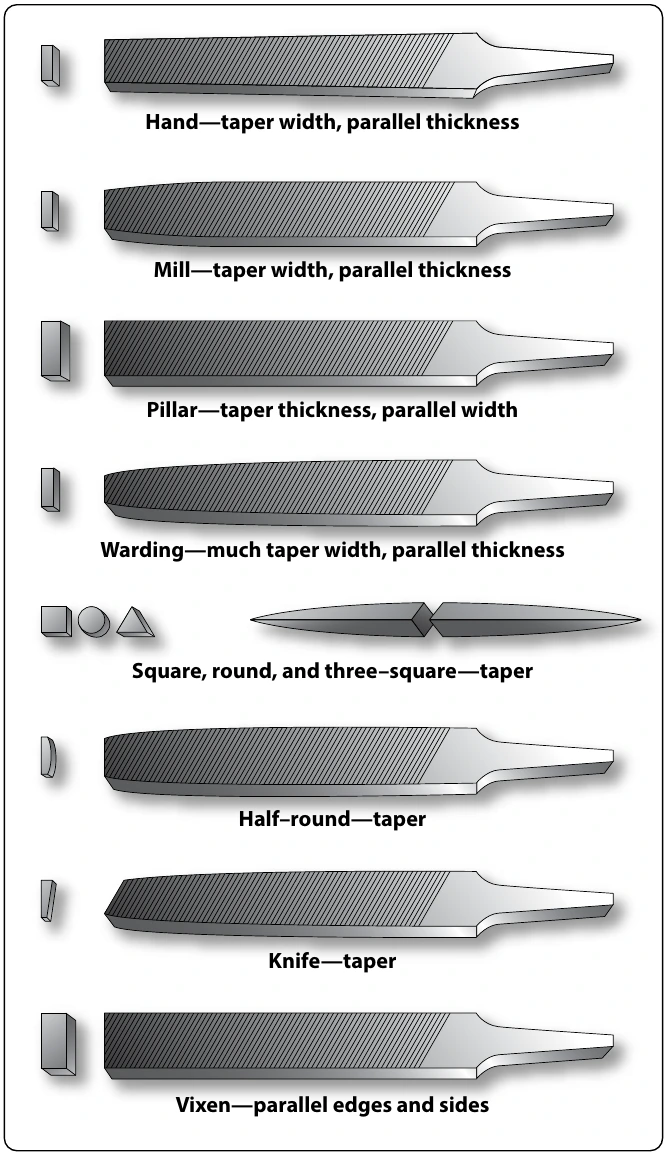
Knife blade section. This file is used by tool and die makers on work having acute angles. [Figure 11-17]
Wood File
Same section as flat and half-round files. This file has coarser teeth and is especially adaptable for use on wood. [Figure 11-17]
Vixen (Curved-Tooth Files)
Curved-tooth files are especially designed for rapid filing and smooth finish on soft metals and wood. The regular cut is adapted for tough work on cast iron, soft steel, copper, brass, aluminum, wood, slate, marble, fiber, rubber, and so forth. The fine cut gives excellent results on steel, cast iron, phosphor bronze, white brass, and all hard metals. The smooth cut is used where the amount of material to be removed is very slight, but where a superior finish is desired. [Figure 11-17]
The following methods are recommended for using files:
- Crossfiling. Before attempting to use a file, place a handle on the tang of the file. This is essential for proper guiding and safe use. In moving the file endwise across the work (commonly known as crossfiling), grasp the handle so that its end fits into and against the fleshy part of the palm with the thumb lying along the top of the handle in a lengthwise direction. Grasp the end of the file between the thumb and first two fingers. To prevent undue wear of the file, relieve the pressure during the return stroke.
- Drawfiling. A file is sometimes used by grasping it at each end, crosswise to the work, then moving it lengthwise with the work. When done properly, work may be finished somewhat finer than when cross filing with the same file. In draw filing, the teeth of the file produce a shearing effect. To accomplish this shearing effect, the angle at which the file is held with respect to its line of movement varies with different files, depending on the angle at which the teeth are cut.
surface depends upon its width and the radius of the rounded surface. If the surface is narrow or only a portion of a surface is to be rounded, start the forward stroke of the file with the point of the file inclined downward at approximately a 45° angle. Using a rocking chair motion, finish the stroke with the heel of the file near the curved surface. This method allows use of the full length of the file.
- Removing burred or slivered edges. Practically every cutting operation on sheet metal produces burrs or slivers. These must be removed to avoid personal injury and to prevent scratching and marring of parts to be assembled. Burrs and slivers prevent parts from fitting properly and should always be removed from the work as a matter of habit.
Lathe filing requires that the file be held against the work revolving in the lathe. The file should not be held rigid or stationary but should be stroked constantly with a slight gliding or lateral motion along the work. A standard mill file may be used for this operation, but the long angle lathe file provides a much cleaner shearing and self-clearing action. Use a file with “safe” edges to protect work with shoulders from being marred.
Care of Files
There are several precautions that any good craftsman takes in caring for files.
- Choose the right file for the material and work to be performed.
- Keep all files racked and separated so they do not bear against each other.
- Keep the files in a dry place—rust corrodes the teeth points, dulling the file.
- Keep files clean. Tap the end of the file against the bench after every few strokes to loosen and clear the filings. Use the file card to keep files clean—a dirty file is a dull file. A dirty file can also contaminate different metals when the same file is used on multiple metal surfaces.
Particles of metal collect between the teeth of a file and may make deep scratches in the material being filed. When these particles of metal are lodged too firmly between the teeth and cannot be removed by tapping the edge of the file, remove them with a file card or wire brush. Draw the brush across the file so that the bristles pass down the gullet between the teeth. [Figure 11-18]
Drills
The four types of portable drills used in aviation for holding and turning twist drills are the hand drill, breast drill, electric power drill, and pneumatic power drill. Holes 1⁄4 inch in diameter and under can be drilled using a hand drill. This drill is commonly called an “egg beater.” The breast drill is designed to hold larger size twist drills than the hand drill. Also, a breastplate is affixed at the upper end of the drill to permit the use of body weight to increase the cutting power of the drill. Electric and pneumatic power drills are available in various shapes and sizes to satisfy almost any requirement. Pneumatic drills are preferred for use around flammable materials, since sparks from an electric drill are a fire or explosion hazard.
Twist Drills
A twist drill is a pointed tool that is rotated to cut holes in material. It is made of a cylindrical hardened steel bar having spiral flutes, or grooves, running the length of the body and a conical point with cutting edges formed by the ends of the flutes.