
Chapter 11
Hand Tools & Measuring Devices
A countersink is a tool that cuts a cone-shaped depression around the hole to allow a rivet or screw to set flush with the surface of the material. Countersinks are made with various angles to correspond to the various angles of the countersunk rivet and screw heads. The angle of the standard countersink shown in Figure 11-24 is 100°.
Special stop countersinks are available. Stop countersinks are adjustable to any desired depth, and the cutters are interchangeable so that holes of various countersunk angles may be made. Some stop countersinks have a micrometer set arrangement (in increments of 0.001 inch) for adjusting the cutting depths. [Figure 11-24]
When using a countersink, care must be taken not to remove an excessive amount of material, since this reduces the strength of flush joints.
Taps and Dies
A tap is used to cut threads on the inside of a hole, while a die is for cutting external threads on round stock. They are made of hard tempered steel and ground to an exact size. There are four types of threads that can be cut with standard taps and dies: National Coarse, National Fine, National Extra Fine, and National Pipe.
Hand taps are usually provided in sets of three taps for each diameter and thread series. Each set contains a taper tap, a plug tap, and a bottoming tap. The taps in a set are identical in diameter and cross section and the only difference is the amount of taper. [Figure 11-25]
The taper tap is used to begin the tapping process, because it is tapered back for 6 to 7 threads. This tap cuts a complete thread when it is cutting above the taper. It is the only tap needed when tapping holes that extend through thin sections. The plug tap supplements the taper tap for tapping holes in thick stock.
The bottoming tap is not tapered. It is used to cut full threads to the bottom of a blind hole.
Dies may be classified as adjustable round split die and plain round split die. The adjustable split die has an adjusting screw that can be tightened so that the die is spread slightly. By adjusting the die, the diameter and fit of the thread can be controlled. [Figure 11-26]
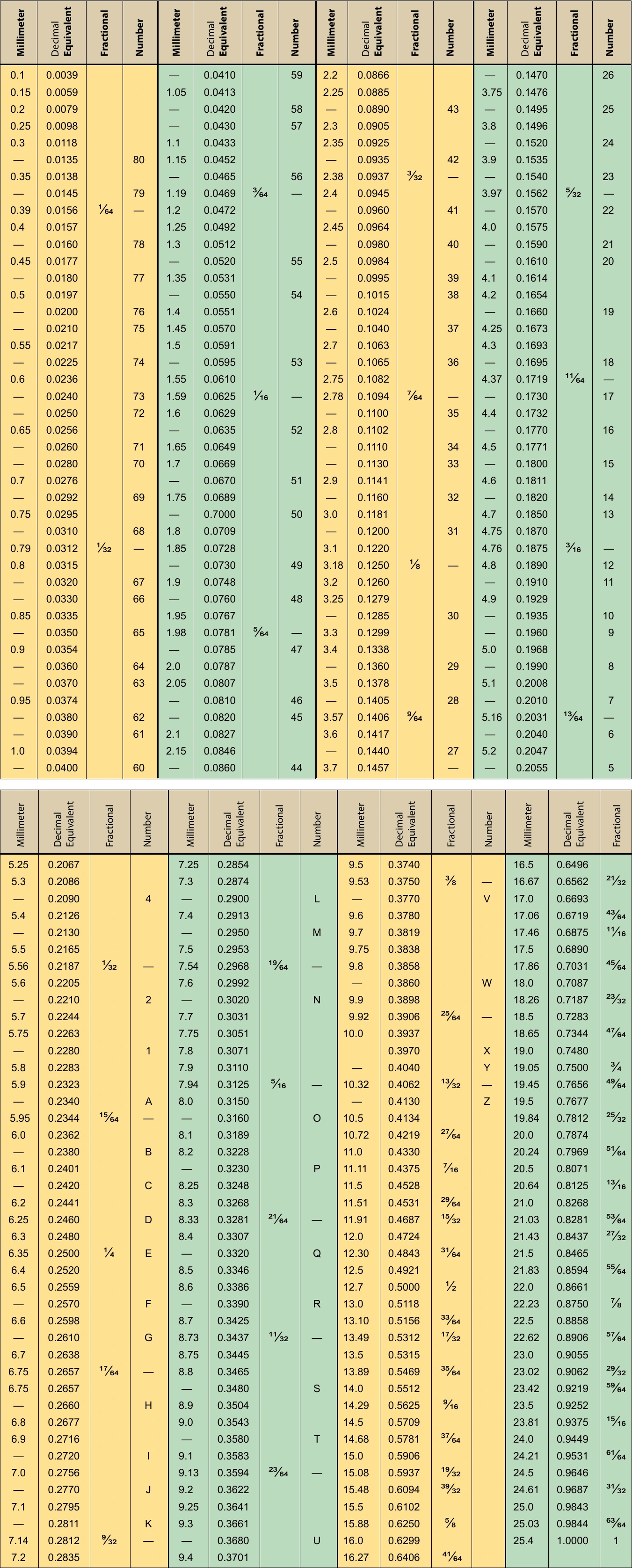
Solid dies are not adjustable. Therefore, a variety of thread fits cannot be obtained with this type. There are many types of wrenches for turning taps, as well as turning dies. The T-handle, the adjustable tap wrench, and the diestock for round split dies shown in Figure 11-27 are a few of the more common types. Information on thread sizes, fits, types, and drill speeds are shown in shown in Figure 11-28 through 11-30.
Layout and Measuring Tools
Layout and measuring devices are precision tools. They are carefully machined, accurately marked and, in many cases, are made up of very delicate parts. When using these tools, be careful not to drop, bend, or scratch them. The finished product is no more accurate than the measurements or the layout; therefore, it is very important to understand how to read, use, and care for these tools.
Rules
Rules are made of steel and are either rigid or flexible. The flexible steel rule bends, but it should not be bent intentionally as it may be broken rather easily. In aircraft work, the unit of measure most commonly used is the inch. The inch may be divided into smaller parts by means of either common or decimal fraction divisions.
The fractional divisions for an inch are found by dividing the inch into equal parts: halves (1⁄2), quarters (1⁄4), eighths (1⁄8), sixteenths (1⁄16), thirty-secondths (1⁄32), and sixty-fourths (1⁄64). The fractions of an inch may be expressed in decimals, called decimal equivalents of an inch. For example, 1⁄8 inch is expressed as 0.0125 (one hundred twenty-five ten-thousandths of an inch).
decimals or divisions of one one-hundredth of an inch. A rule may be used either as a measuring tool or as a straightedge. [Figure 11-31]