
Chapter 12
Fundamentals of Electricity & Electronics
the cross-sectional area in square meters must be determined
convenient unit of wire length is the foot. Using these standards, the unit of size is the mil-foot. Thus, a wire has unit size if it has a diameter of 1 mil and length of 1 foot.
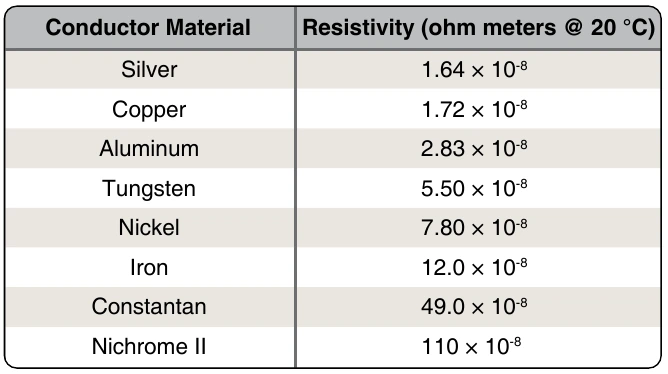
In the case of using copper conductors, we are spared the task of tedious calculations by using a table as shown in
the table are such that each decrease of one gauge number equals a 25 percent increase in the cross-sectional area. Because of this, a decrease of three gauge numbers represents an increase in cross-sectional area of approximately 2:1. Likewise, change of ten wire gauge numbers represents a 10:1 change in cross-sectional area—also, by doubling the cross-sectional area of the conductor, the resistance is cut in half. A decrease of three wire gauge numbers cuts the resistance of the conductor of a given length in half.
Rectangular Conductors (Bus Bars)
To compute the cross-sectional area of a conductor in square mils, the length in mils of one side is squared. In the case of a rectangular conductor, the length of one side is multiplied by the length of the other. For example, a common rectangular bus bar (large, special conductor) is 3⁄8 inch thick and 4 inches
Power and Energy
Power in an Electrical Circuit
This section covers power in the DC circuit and energy consumption. Whether referring to mechanical or electrical systems, power is defined as the rate of energy consumption or conversion within that system—that is, the amount of energy used or converted in a given amount of time.
From the scientific discipline of physics, the fundamental expression for power is:
The unit measurement for power is the watt (W), which refers to a rate of energy conversion of 1 joule (J)/second. Therefore, the number of joules consumed in 1 second is equal to the number of watts. A simple example is given below.
Suppose 300 joules of energy is consumed in 10 seconds. What would be the power in watts?
The watt is named for James Watt, the inventor of the steam engine. Watt devised an experiment to measure the power of a horse in order to find a means of measuring the mechanical power of his steam engine. One horsepower is required to move 33,000 pounds 1 foot in 1 minute. Since power is the rate of doing work, it is equivalent to the work divided by time. Stated as a formula, this is:
Electrical power can be rated in a similar manner. For example, an electric motor rated as a 1 horsepower motor requires 746 watts of electrical energy.