Aviation Training Experts™

handbook

Aviation Maintenance Technician Handbook–General

FAA-H-8083-30B Version 2023

Chapter 12

Fundamentals of Electricity & Electronics

Power Formulas Used in the Study of Electricity

When current flows through a resistive circuit, energy is dissipated in the form of heat. Recall that voltage can be expressed in the terms of energy and charge as given in the expression:

Formula: E = ; Q

Where

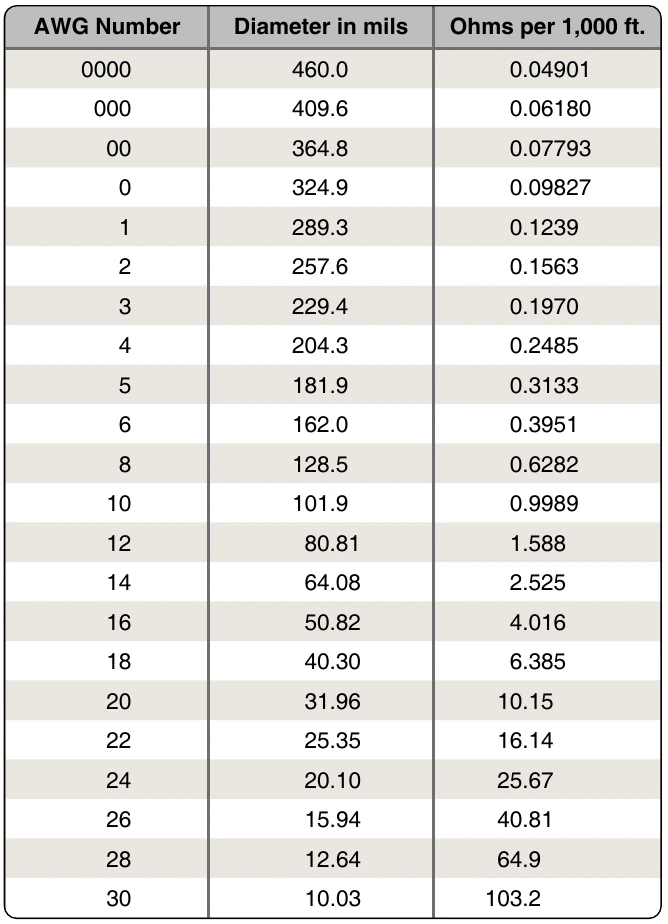
Figure 12-43. Conversion table when using copper conductors.
Formula: Q = charge measured in coulombs

Current I, can also be expressed in terms of charge and time as given by the expression:

Formula: Charge ; Current = ; Time

or

Formula: Q ; I = ; T ; Where: ; I = current in amperes (A) ; Q = charge in coulombs (C) ; T = time

When voltage ⁄Q and current Q⁄t are multiplied, the charge Q is divided out leaving the basic expression from physics:

Formula: E × I = × = = power ; Q t t

For a simple DC electrical system, power dissipation can then be given by the equation:

Formula: General Power Formula P = I (E) ; Where ; P = Power ; I = Current ; E = Volts

If a circuit has a known voltage of 24 volts and a current of 2 amps, then the power in the circuit is:

Formula: P = I (E) ; P = 2A (24V) ; P = 48W ; Now recall Ohm’s Laws that state E = I(R). If we now

substitute IR for E in the general formula, we get a formula that uses only current I and resistance R to determine the power in a circuit.

Formula: P = I (IR)

Second Form of Power Equation

Formula: P = I2R ; If a circuit has a known current of 2 amps and a resistance ; of 100 Ω, then the power in the circuit is: ; P = I2R ; P = (2A)2 100 Ω ; P = 400 W ; Using Ohm’s Law, which can be stated as I = E/R, we can again