Chapter 12
Fundamentals of Electricity & Electronics
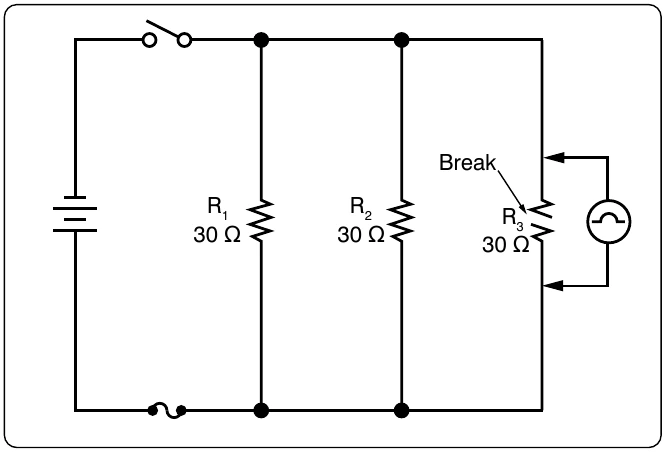
- In the circuit shown in Figure 12-187, an open has occurred in the series portion of the circuit. When the open occurs anywhere in the series portion of a series-parallel circuit, current flow in the entire circuit stops. In this case, the circuit does not function, and the lamp, L1, is not lit.
- If the open occurs in the parallel portion of a series-parallel circuit, as shown in Figure 12-188, part of the circuit continues to function. In this case, the lamp continues to burn, but its brightness diminishes, since the total resistance of the circuit has increased and the total current has decreased.
- If the open occurs in the branch containing the lamp, as shown in Figure 12-189, the circuit continues to function with increased resistance and decreased current, but the lamp does not light.
Tracing Opens with the Voltmeter
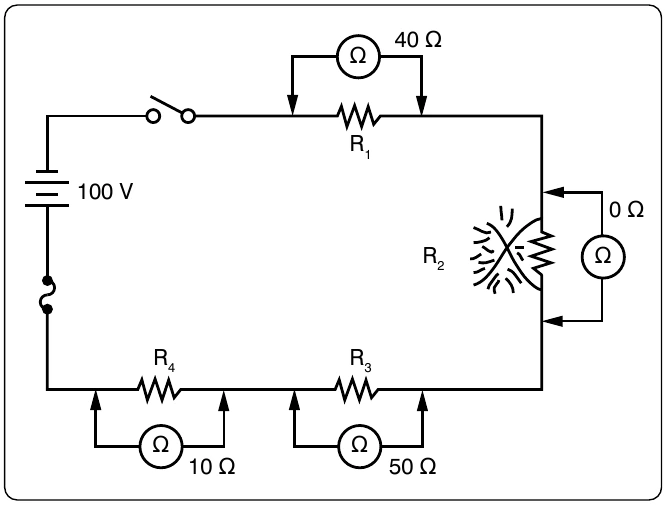
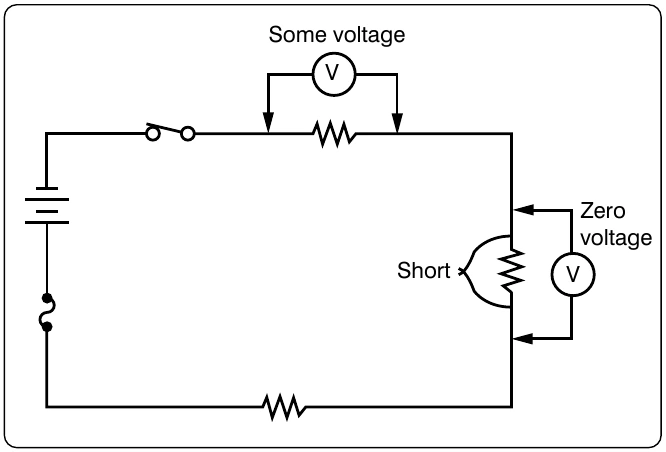
To explain how the voltmeter and ohmmeter can be used to troubleshoot series-parallel circuits, the circuit shown in Figure 12-190 has been labeled at various points. A point-to-point description is listed below with expected results:
- By connecting a voltmeter between points A and D, the battery and switch can be checked for opens.
- By connecting the voltmeter between points A and B, the voltage drop across R1 can be checked. This voltage drop is a portion of the applied voltage.
- If R1 is open, the reading between B and D is zero.
- By connecting a voltmeter between A and E, the continuity of the conductor between the positive terminal of the battery and point E, as well as the fuse,
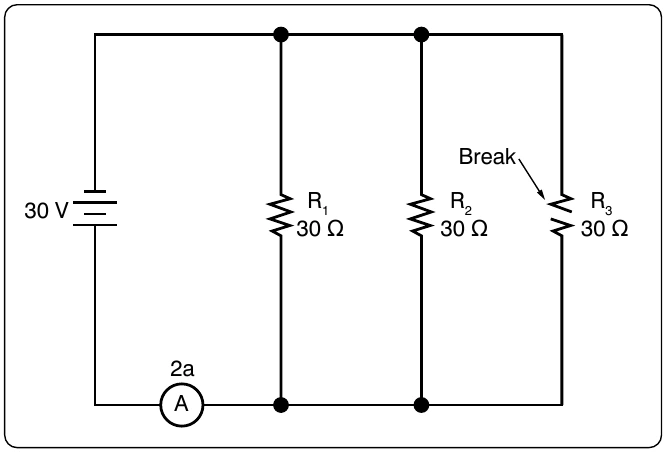
- If the lamp is burning, it is obvious that no open exists in the branch containing the lamp, and the voltmeter could be used to detect an open in the branch containing R2 by removing lamp, L1, from the circuit.
Troubleshooting the series portion of a series-parallel circuit presents no difficulties, but in the parallel portion of the circuit, misleading readings can be obtained.
Batteries
Primary Cell
The dry cell is the most common type of primary-cell battery and is similar in its characteristics to that of an electrolytic cell. This type of a battery is basically designed with a metal electrode or graphite rod acting as the cathode (+) terminal, immersed in an electrolytic paste. This electrode⁄electrolytic build-up is then encased in a metal container, usually made of zinc, which itself acts as the anode (−) terminal. When the battery is in a discharge condition an electrochemical reaction takes place resulting in one of the metals being consumed. Because of this consumption, the charging process is not reversible. Attempting to reverse the chemical reaction in a primary cell by way of recharging is usually dangerous and can lead to a battery explosion.
These batteries are commonly used to power items such as flashlights. The most common primary cells today are found in alkaline batteries, silver-oxide, and lithium batteries. The earlier carbon-zinc cells, with a carbon post as cathode and a zinc shell as anode were once prevalent but are not as common.
Secondary Cell
A secondary cell is any kind of electrolytic cell in which the electrochemical reaction that releases energy is reversible. The lead-acid car battery is a secondary-cell battery. The electrolyte is sulfuric acid (battery acid), the positive electrode is lead peroxide, and the negative electrode is lead. A typical lead-acid battery consists of six lead-acid cells in a case. Each cell produces 2 volts, so the whole battery produces a total of 12 volts.
Other commonly used secondary cell chemistry types are nickel-cadmium (Ni-Cad), nickel-metal hydride (NiMH), lithium-ion (Li-ion), and Lithium-ion polymer (Li-ion polymer).
Lead-acid batteries used in aircraft are similar to automobile batteries. The lead acid battery is made up of a series of identical cells each containing sets of positive and negative plates. Figure 12-191 illustrates each cell contains positive plates of lead dioxide (PbO2), negative plates of spongy lead, and electrolyte (sulfuric acid and water). A practical cell is constructed with many more plates than just two in order to get the required current output. All positive plates are connected together as well as all the negatives. Because each positive plate is always positioned between two negative plates, there are always one or more negative plates than positive plates.
Between the plates are porous separators that keep the positive and negative plates from touching each other and shorting out the cell. The separators have vertical ribs on the side facing the positive plate. This construction permits the electrolyte to circulate freely around the plates. In addition, it provides a path for sediment to settle to the bottom of the cell.
Each cell is seated in a hard rubber casing through the top of which are terminal posts and a hole into which a nonspill vent cap is screwed. The hole provides access for testing the strength of the electrolyte and adding water. The vent plug permits gases to escape from the cell with a minimum of leakage of electrolyte, regardless of the position the airplane might assume. [Figure 12-192] In level flight, the lead weight The individual cells of the battery are connected in series by means of cell straps. [Figure 12-193] The complete assembly is enclosed in an acid resisting metal container (battery box), which serves as electrical shielding and mechanical protection. The battery box has a removable top. It also has a vent tube nipple at each end. When the battery is installed in an airplane, a vent tube is attached to each nipple. One tube is the intake tube and is exposed to the slipstream. The other is the exhaust vent tube and is attached to the battery drain sump, which is a glass jar containing a felt pad moistened with a concentrated solution of sodium bicarbonate (baking soda). With this arrangement, the airstream is directed through the battery case where battery gases are picked up, neutralized in the sump, and then expelled overboard without damage to the airplane.