
Chapter 12
Fundamentals of Electricity & Electronics
To facilitate installation and removal of the battery in some aircraft, a quick disconnect assembly is used to connect the power leads to the battery. This assembly attaches the battery leads in the aircraft to a receptacle mounted on the side of the battery. [Figure 12-194] The receptacle covers the battery terminal posts and prevents accidental shorting during the Another advantage of this assembly is that the plug can be installed in only one position, eliminating the possibility of reversing the battery leads.
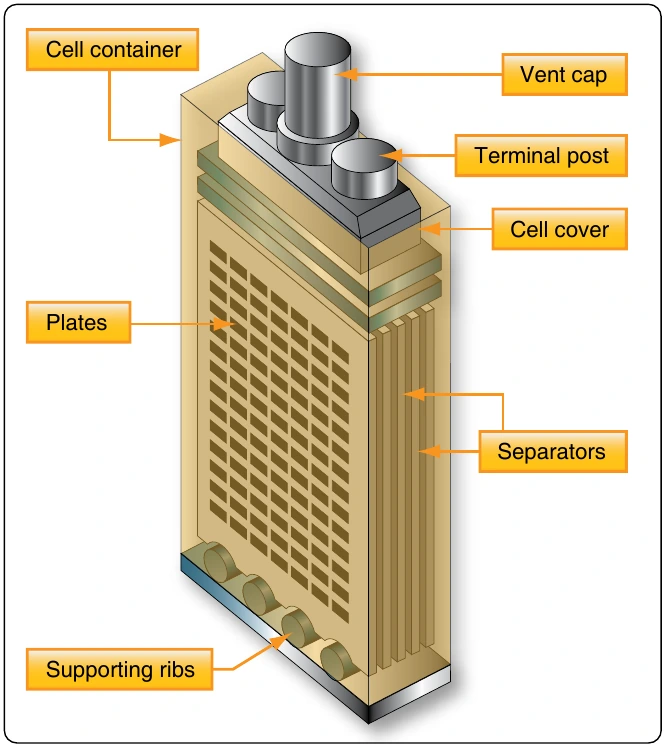
The voltage of lead acid cell is approximately two volts in order to attain the voltage required for the application. Each cell is then connected in series with heavy gauge metal straps to form a battery. In a typical battery, such as that used in an aircraft for starting, the voltage required is 12 or 24 volts. This voltage is achieved by connecting six cells or twelve cells respectively together in series and enclosing them in one plastic box.
Each cell containing the plates are filled with an electrolyte composed of sulfuric acid and distilled water with a specific gravity of 1.270 at 60 °F. This solution contains positive hydrogen ions and negative sulfate (SO4) ions that are free to combine with other ions and form a new chemical compound. When the cell is discharged, electrons leave the negative plate and flow to the positive plates where they cause the lead dioxide (PbO2) to break down into negative oxygen ions and positive lead ions. The negative oxygen ions join with positive hydrogen ions from the sulfuric acid and form water (H2O). The negative sulfate ions join with the lead ions in both plates and form lead sulfate (PbSO4). After the discharge, the specific gravity changes to about 1.150.
Battery Ratings
The voltage of a battery is determined by the number of cells connected in series to form the battery. Although the voltage of one lead-acid cell just removed from a charger is approximately 2.2 volts, a lead-acid cell is normally rated at approximately 2 volts. A battery rated at 12 volts consists of 6 lead-acid cells connected in series, and a battery rated at 24 volts is composed of 12 cells.
The most common battery rating is the ampere-hour rating. This is a unit of measurement for battery capacity. It is determined by multiplying a current flow in amperes by the time in hours that the battery is being discharged.
A battery with a capacity of 1 ampere-hour should be able to continuously supply a current of 1 amp to a load for exactly 1 hour, or 2 amps for 1⁄2 hour, or 1⁄3 amp for 3 hours, etc., before becoming completely discharged. Actually, the ampere-hour output of a particular battery depends on the rate at which it is discharged. Heavy discharge current heats the battery and decreases its efficiency and total ampere-hour output. For airplane batteries, a period of 5 hours has been established as the discharge time in rating battery capacity. However, this time of 5 hours is only a basis for rating and does not necessarily mean the length of time during which the battery is expected to furnish current. Under actual service conditions, the battery can be completely discharged within a few minutes, or it may never be discharged if the generator provides sufficient charge.
The ampere-hour capacity of a battery depends upon its total effective plate area. Connecting batteries in parallel increases ampere-hour capacity. Connecting batteries in series increases the total voltage but not the ampere-hour capacity.
Life Cycle of a Battery
Battery life cycle is defined as the number of complete charge/discharge cycles a battery can perform before its normal charge capacity falls below 80 percent of its initial rated capacity. Battery life can vary anywhere from 500 to 1,300 cycles. Various factors can cause deterioration of a battery and shorten its service life. The first is over-discharging, which causes excess sulfation; second, too-rapid charging or discharging that results in overheating of the plates and shedding of active material. The accumulation of shed material, in turn, causes shorting of the plates and results in internal discharge. A battery that remains in a low or discharged condition for a long period of time may be permanently damaged. The deterioration can continue to a point where cell capacity can drop to 80 percent after 1,000 cycles. In many cases, the cell can continue working to nearly 2,000 cycles but with a diminished capacity of 60 percent of its original state.
Lead-Acid Battery Testing Methods
The state of charge of a storage battery depends upon the condition of its active materials, primarily the plates. However, the state of charge of a battery is indicated by the density of the electrolyte and is checked by a hydrometer, an instrument that measures the specific gravity (weight as compared with water) of liquids.
The most commonly used hydrometer consists of a small sealed glass tube weighted at its lower end so it floats upright. [Figure 12-195] Within the narrow stem of the tube is a paper scale with a range of 1.100 to 1.300. When a hydrometer is used, a quantity of electrolyte sufficient to float the hydrometer is drawn up into the syringe. The depth to which the hydrometer sinks into the electrolyte is determined by the density of the electrolyte, and the scale value indicated at the level of the electrolyte is its specific gravity. The more dense the electrolyte, the higher the hydrometer floats; therefore, the highest number on the scale (1.300) is at the lower end of the hydrometer scale.