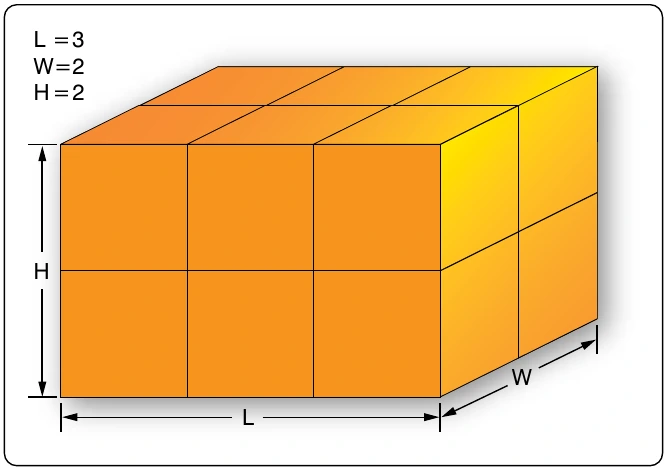
Since each of the smaller boxes has a volume of 1 cubic foot, the large carton holds 27 boxes.
Cylinder
A solid having the shape of a can, a length of pipe, or a barrel is called a cylinder. [Figure 3-26] The ends of a cylinder are identical circles. The formula for the volume of a cylinder is:
Formula: volume = π × radius2 × height of the cylinder = π r2 × h
One of the most important applications of the volume of a cylinder is finding the piston displacement of a cylinder in a reciprocating engine. Piston displacement is the total volume (in cubic inches, cubic centimeters, or liters) swept by all of the pistons of a reciprocating engine as they move in one revolution of the crankshaft. The formula for piston displacement is given as:
The bore of an engine is the inside diameter of the cylinder. The stroke of the engine is the length the piston travels inside the cylinder. [Figure 3-27] Example: Find the piston displacement of one cylinder in a multi-cylinder aircraft engine. The engine has a cylinder bore of 5.5 inches and a stroke of 5.4 inches. First, substitute the known values in the formula.
Formula: v = π × r2 × h = (3.1416) × (5.5 ÷ 2)2 × (5.4) ; v = 23.758 × 5.4 = 128.29 cubic inches
The piston displacement of one cylinder is 128.29 cubic
inches. For an eight-cylinder engine, then the total engine displacement would be:
Formula: Total displacement for 8 cylinders = 8 × 128.29 = ; 1026.32 cubic inches of displacement
Sphere
A solid having the shape of a ball is called a sphere. [Figure 3-28] A sphere has a constant diameter. The radius (r) of a sphere is one-half of the diameter (d). The formula for the volume of a sphere is given as:
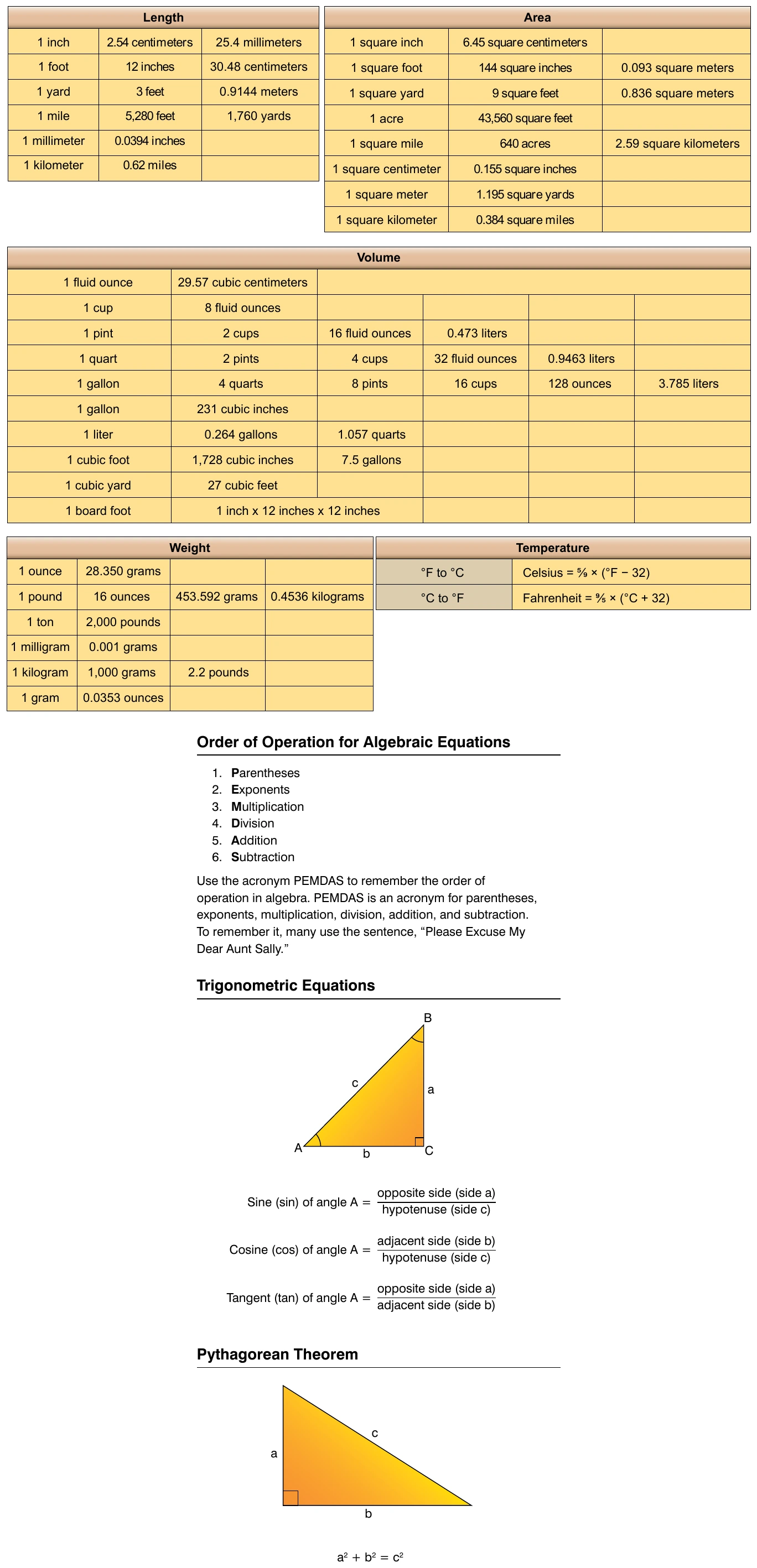
Figure 3-23. Applied mathematics formula sheet.
Formula: Figure 3-23 formula reference: Trigonometric equations: sin(A) = opposite / hypotenuse; cos(A) = adjacent / hypotenuse; tan(A) = opposite / adjacent. Pythagorean theorem: a² + b² = c². The companion visual also contains searchable length, area, volume, weight, and temperature conversions. Source text: Order of Operation for Algebraic Equations ; 1. Parentheses ; 2. Exponents ; 3. Multiplication ; 4. Division ; 5. Addition ; 6. Subtraction ; Use the acronym PEMDAS to remember the order of ; operation in algebra. PEMDAS is an acronym for parentheses, ; exponents, multiplication, division, addition, and subtraction. ; To remember it, many use the sentence, “Please Excuse My ; Dear Aunt Sally.” ; Trigonometric Equations ; B ; c a ; A b C ; opposite side (side a) ; Sine (sin) of angle A = hypotenuse (side c) ; adjacent side (side b) ; Cosine (cos) of angle A = hypotenuse (side c) ; opposite side (side a) ; Tangent (tan) of angle A = adjacent side (side b) ; Pythagorean Theorem ; c ; a ; b ; a2 + b2 = c2
Example: A pressure tank inside the fuselage of a cargo aircraft is in the shape of a sphere with a diameter of 34 inches. What is the volume of the pressure tank?
Figure 3-24. Rectangular solid.
Cookie Preferences
We use cookies to operate this website, improve performance, understand site traffic, and personalize your experience. Essential cookies are always active because they are required for the website to function.
Required for basic site functionality and security.
Help us understand how visitors use the website so we can improve it.
May be used for advertising, remarketing, or social media features.
You can update your choices anytime using Cookie Settings. View Privacy Policy