Chapter 3
Mathematics in Aviation Maintenance
Cone
A solid with a circle as a base and with sides that gradually taper to a point is called a cone. [Figure 3-29] The formula for the volume of a cone is given as:
Units of Volume
Since all volumes are not measured in the same units, it is necessary to know all the common units of volume and how they are related to each other. For example, the mechanic may know the volume of a tank in cubic feet or cubic inches, but when the tank is full of gasoline, they are interested in how many gallons it contains. Refer to Figure 3-23, Applied Mathematics Formula Sheet, for a comparison of different units of volume.
Computing Surface Area of Three-Dimensional Solids
The surface area of a three-dimensional solid is the sum of the areas of the faces of the solid. Surface area is a different concept from that of volume. For example, surface area is the amount of sheet metal needed to build a rectangular fuel tank while volume is the amount of fuel that the tank can contain.
Rectangular Solid
The formula for the surface area of a rectangular solid [Figure 3-24] is given as:
Cube
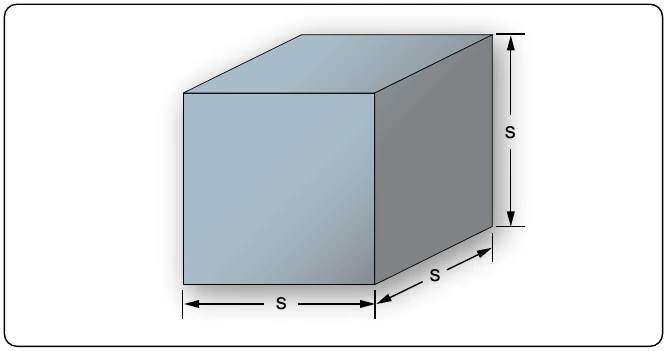
The formula for the surface area of a cube [Figure 3-25] is given as:
Example: What is the surface area of a cube with a side measure of 8 inches?
Cylinder
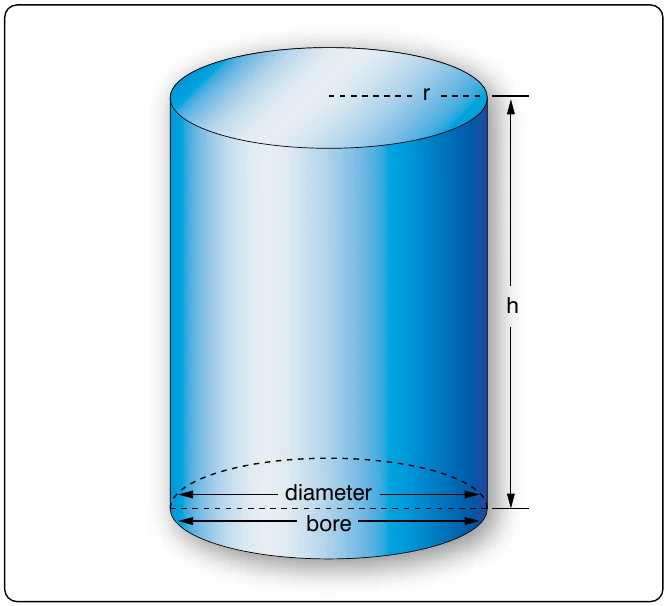
The formula for the surface area of a cylinder [Figure 3-26] is given as: