
Chapter 5
Physics for Aviation
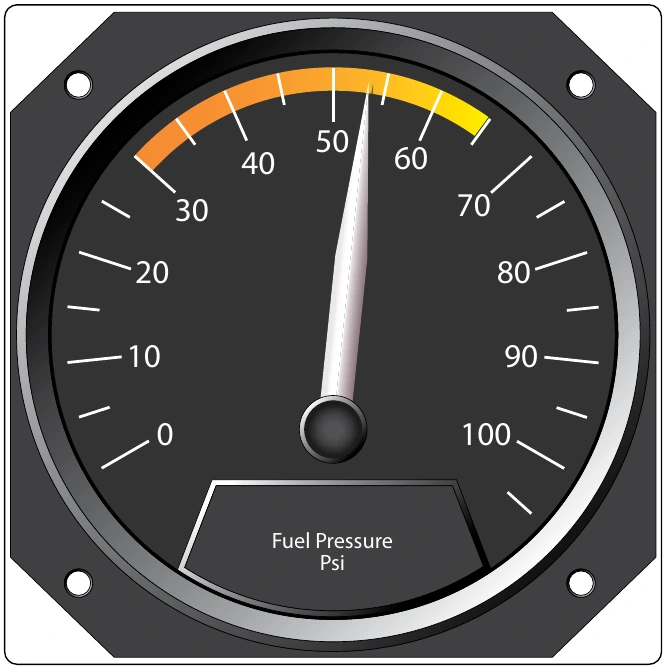
Gauge Pressure
A gauge pressure (psig) is a reading that refers to when an instrument, such as an oil pressure gauge, fuel pressure gauge, or hydraulic system pressure gauge, displays pressure which is over and above ambient. This can be seen on the fuel pressure gauge shown in Figure 5-34. When the oil, fuel, or hydraulic pump is not turning, and there is no pressure being created, the gauge will read zero.
Absolute Pressure
A gauge that includes atmospheric pressure in its reading is measuring what is known as absolute pressure, or psia. Absolute pressure is equal to gauge pressure plus atmospheric pressure. If someone hooked up a psia indicating instrument to an engine’s oil system, the gauge would read atmospheric pressure when the engine was not running. Since this would not make good sense to the typical operator, psia gauges are not used in this type of application. For the manifold pressure on a piston engine, a psia gauge does make good sense. Manifold pressure on a piston engine can read anywhere from less than atmospheric pressure if the engine is not supercharged, to more than atmospheric if it is supercharged. The only gauge that has the flexibility to show this variety of readings is the absolute pressure gauge. Figure 5-35 shows a manifold pressure gauge, with a readout that ranges from 10 "Hg to 35 "Hg. Remember that 29.92 "Hg is standard day atmospheric.
Differential Pressure
Differential pressure, or psid, is the difference between pressures being read at two different locations within a system. For example, in a turbine engine oil system the pressure is read as it enters the oil filter, and as it leaves the filter. These two readings are sent to a transmitter which powers a light located on the flight deck. Across anything that poses a resistance to flow, like an oil filter, there will be a drop in pressure. If the filter starts to clog, the pressure drop will become greater, eventually causing the advisory light on the flight deck to come on.
Figure 5-36 shows a differential pressure gauge for the pressurization system on a Boeing 737. In this case, the difference in pressure is between the inside and the outside of the airplane. If the pressure difference becomes too great, the structure of the airplane could become overstressed.
Gas Laws
The simple structure of gases makes them readily adaptable to mathematical analysis from which has evolved a detailed theory of the behavior of gases. This is called the kinetic theory of gases. The theory assumes that a body of gas is composed of identical molecules which behave like minute elastic spheres, spaced relatively far apart and continuously in motion.
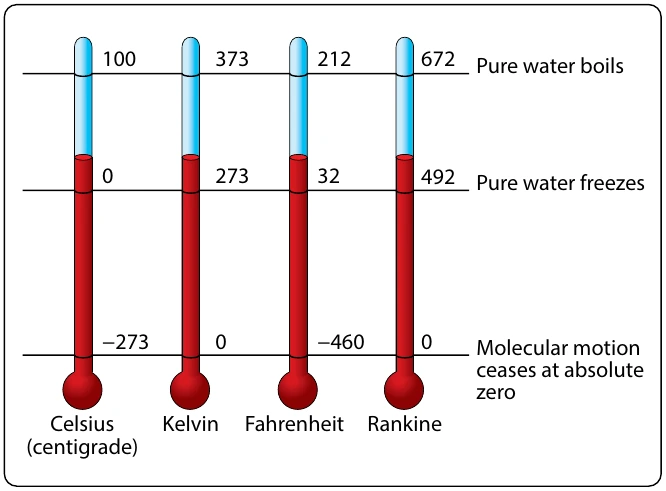
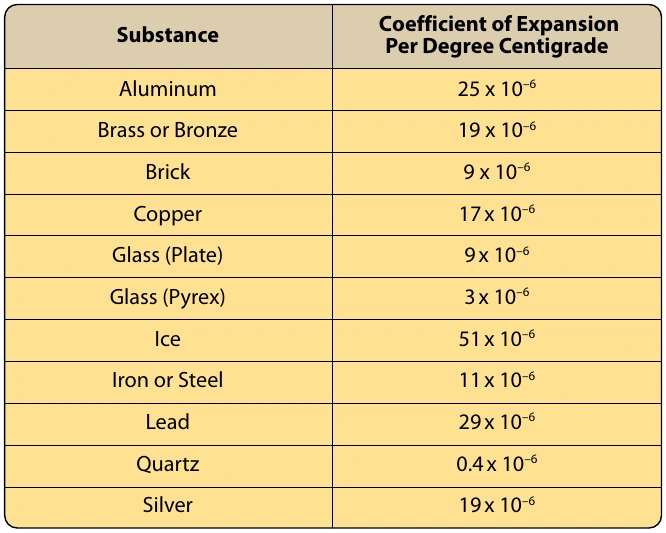
The degree of molecular motion is dependent upon the temperature of the gas. Since the molecules are continuously striking against each other and against the walls of the container, an increase in temperature with the resulting increase in molecular motion causes a corresponding increase in the number of collisions between the molecules. The increased number of collisions results in an increase in pressure because a greater number of molecules strike against the walls of the container in a given unit of time.
If the container were an open vessel, the gas would expand and overflow from the container. However, if the container is sealed and possesses elasticity, such as a rubber balloon, the increased pressure causes the container to expand. For instance, when making a long drive on a hot day, the pressure in the tires of an automobile increases, and a tire which appeared to be somewhat “soft” in cool morning temperature may appear normal at a higher midday temperature.
Such phenomena as these have been explained and set forth in the form of laws pertaining to gases and tend to support
Boyle’s Law
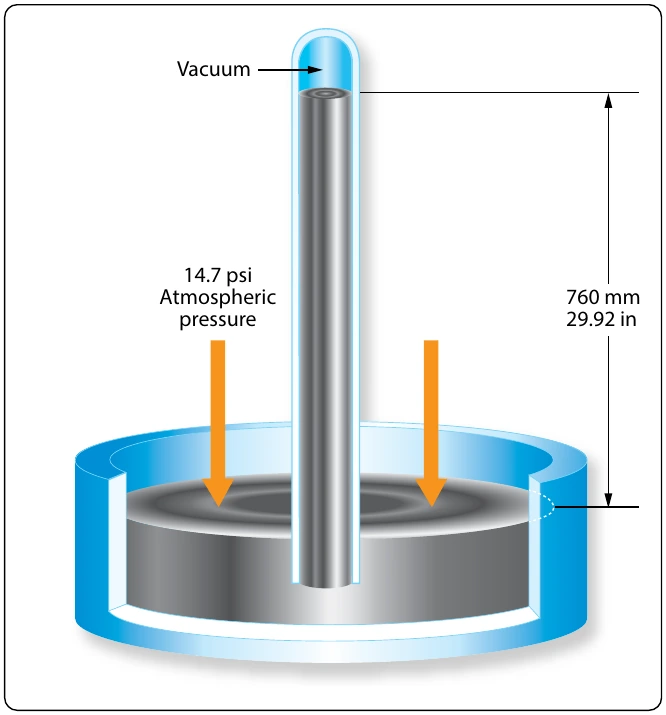
As previously stated, compressibility is an outstanding characteristic of gases. The English scientist, Robert Boyle, was among the first to study this characteristic that he called the “springiness of air.” By direct measurement he discovered that when the temperature of a combined sample of gas was kept constant and the absolute pressure doubled, the volume was reduced to half the former value. As the applied absolute pressure was decreased, the resulting volume increased. From these observations, he concluded that for a constant temperature the product of the volume and absolute pressure of an enclosed gas remains constant. Boyle’s law is normally stated: “The volume of an enclosed dry gas varies inversely with its absolute pressure, provided the temperature remains constant.” The following formula is used for Boyle’s law calculations. Remember, pressure needs to be in the absolute.
Example: 10 ft3 of nitrogen is under a pressure of 500 psia. If the volume is reduced to 7 ft3, what will the new pressure be? [Figure 5-37]