Chapter 5
Physics for Aviation
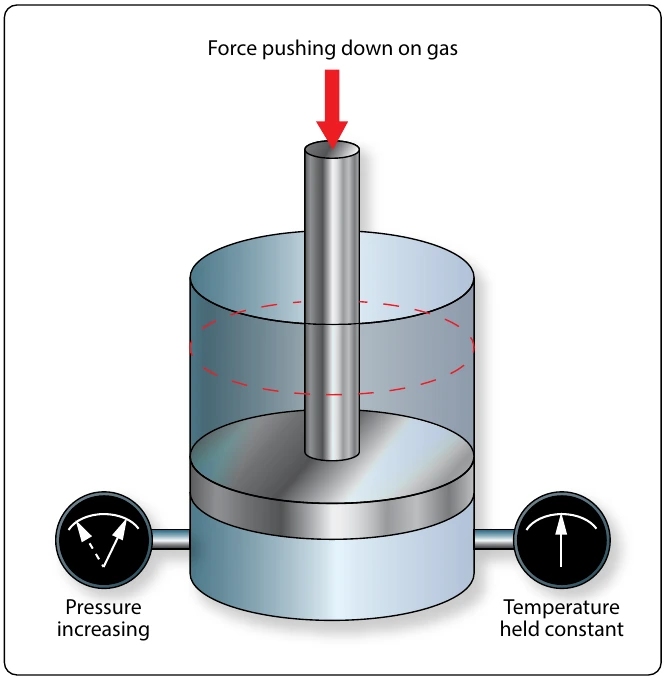
The useful applications of Boyle’s law are many and varied. Some applications more common to aviation are: (1) the carbon dioxide (CO2) bottle used to inflate life rafts and life vests; (2) the compressed oxygen and the acetylene tanks used in welding; (3) the compressed air brakes and shock absorbers; and (4) the use of oxygen tanks for high altitude flying and emergency use.
that all gases expand and contract in direct proportion to the change in the absolute temperature, provided the pressure is held constant. As a formula, this law is shown as follows:
Charles’ law also works if the volume is held constant, and pressure and temperature are the variables. In this case, the formula would be as follows:
For this second formula, pressure and temperature must be in the absolute.
Example: A 15-ft3 cylinder of oxygen is at a temperature of 70 °F and a pressure of 750 psig. The cylinder is placed in the sun and the temperature of the oxygen increases to 140 °F. What would be the new pressure in psig?
General Gas Law
By combining Boyle’s and Charles’ laws, a single expression can be derived which states all the information contained in both. The formula which is used to express the general gas law is as follows:
When using the general gas law formula, temperature and pressure must be in the absolute.
Example: 20 ft3 of the gas argon is compressed to 15 ft3. The gas starts out at a temperature of 60 °F and a pressure of 1,000 psig. After being compressed, its temperature is 90 °F. What would its new pressure be in psig?
Dalton’s Law
If a mixture of two or more gases that do not combine chemically is placed in a container, each gas expands throughout the total space and the absolute pressure of each gas is reduced to a lower value, called its partial pressure. This reduction is in accordance with Boyle’s law. The pressure of the mixed gases is equal to the sum of the partial pressures. This fact was discovered by Dalton, an English physicist, and is set forth in Dalton’s law: “A mixture of several gases which do not react chemically exerts a pressure equal to the sum of the pressures which the several gases would exert separately if each were allowed to occupy the entire space alone at the given temperature.”