
Chapter 5
Physics for Aviation
Since atmospheric pressure at any altitude is due to the weight of air above it, pressure decreases with increased altitude. Obviously, the total weight of air above an area at 15,000 ft would be less than the total weight of the air above an area at 10,000 ft.
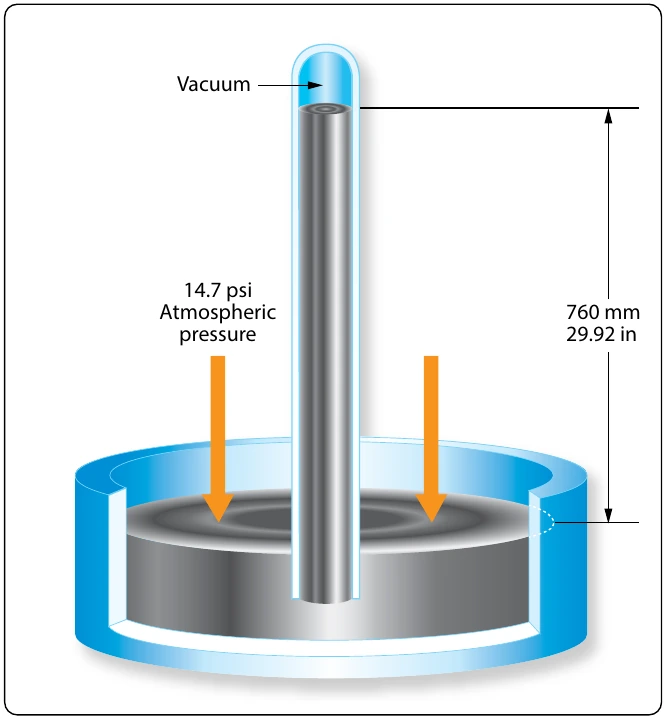
Atmospheric pressure is often measured by a mercury barometer. A glass tube somewhat over 30 inches in length is sealed at one end and then filled with mercury. It is then inverted and the open end placed in a dish of mercury. Immediately, the mercury level in the inverted tube will drop a short distance, leaving a small volume of mercury vapor at nearly zero absolute pressure in the tube just above the top of the liquid mercury column. Gravity acting on the mercury in the tube will try to make the mercury run out. Atmospheric pressure pushing down on the mercury in the open container tries to make the mercury stay in the tube. At some point these two forces (gravity and atmospheric pressure) will equilibrate out and the mercury will stabilize at a certain height in the tube. Under standard day atmospheric conditions, the air in a 1 square inch column extending to the top of the atmosphere would weigh 14.7 lb. A 1-in2 column of mercury, 29.92 inches tall, would also weigh 14.7 lb. That is why 14.7 psi is equal to 29.92 "Hg. Figure 5-50 demonstrates this point.
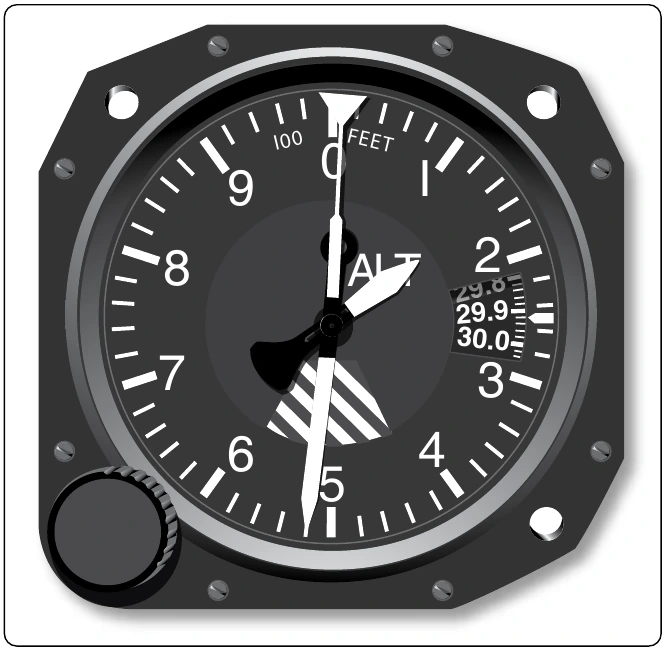
A second means of measuring atmospheric pressure is with an aneroid barometer. This mechanical instrument is a much better choice than a mercury barometer for use on airplanes. Aneroid barometers, or altimeters, are used to indicate altitude in flight. The calibrations are made in thousands of feet rather than in psi or inches of mercury. For example, the standard pressure at sea level is 29.92 "Hg, or 14.7 psi. At 10,000 feet above sea level, standard pressure is 20.58 "Hg, or 10.10 psi. Altimeters are calibrated so that if the pressure exerted by the atmosphere is 10.10 psi, the altimeter will point to 10,000 ft. [Figure 5-51]
Atmospheric Density
Since both temperature and pressure decrease with altitude, it might appear that the density of the atmosphere would remain fairly constant with increased altitude. This is not true, however, because pressure drops more rapidly with increased altitude than does the temperature. The result is that density decreases with increased altitude.
By use of the general gas law, studied earlier, it can be shown that for a particular gas, pressure and temperature determine the density. Since standard pressure and temperatures have been associated with each altitude, the density of the air at these standard temperatures and pressures must also be considered standard. Thus, a particular atmospheric density is associated with each altitude. This gives rise to the expression “density altitude,” symbolized “Hd.” A density altitude of 15,000 ft is the altitude at which the density is the same as that considered standard for 15,000 ft. Remember, however, that density altitude is not necessarily true altitude. For example, on a day when the atmospheric pressure is higher than standard and the temperature is lower than standard, the density which is standard at 10,000 ft might occur at 12,000 ft. In this case, at an actual altitude of 12,000 ft, we have air that has the same density as standard air at 10,000 ft. Density altitude is a calculated altitude obtained by correcting pressure altitude for temperature.
Water Content of the Atmosphere
In the troposphere, the air is rarely completely dry. It contains water vapor in one of two forms: (1) fog or (2) water vapor. Fog consists of minute droplets of water held in suspension by the air. Clouds are composed of fog. The height to which some clouds extend is a good indication of the presence of water in the atmosphere almost up to the stratosphere. The presence of water vapor in the air is quite evident in Figure 5-52, with a military F-18 doing a high-speed fly-by at nearly Mach 1. The temperature and pressure changes that occur as the airplane approaches supersonic flight cause the water vapor in the air to condense and form the vapor cloud that is visible.
As a result of evaporation, the atmosphere always contains some moisture in the form of water vapor. The moisture in the air is called the humidity of the air. Moisture does not consist of tiny particles of liquid held in suspension in the air as in the case of fog, but is an invisible vapor truly as gaseous as the air with which it mixes. Fog and humidity both affect the performance of an aircraft. In flight, at cruising power, the effects are small and receive no consideration. During takeoff, however, humidity has important effects. Two things are done to compensate for the effects of humidity on takeoff performance. Since humid air is less dense than dry air, the allowable takeoff gross weight of an aircraft is generally reduced for operation in areas that are consistently humid.
Second, because the power output of reciprocating engines is decreased by humidity, the manifold pressure may need to be increased above that recommended for takeoff in dry air in order to obtain the same power output.
Engine power output is calculated on dry air. Since water vapor is incombustible, its pressure in the atmosphere is a total loss as far as contributing to power output. The mixture of water vapor and air is drawn through the carburetor, and fuel is metered into it as though it were all air. This mixture of water vapor, air, and fuel enters the combustion chamber where it is ignited. Since the water vapor will not burn, the effective air-fuel ratio is enriched and the engine operates as though it were on an excessively rich mixture. The resulting horsepower loss under humid conditions can therefore be attributed to the loss in volumetric efficiency due to displaced air, and the incomplete combustion due to an excessively rich fuel and air mixture.
The reduction in power that can be expected from humidity is usually given in charts in the flight manual. There are several types of charts in use. Some merely show the expected reduction in power due to humidity; others show the boost in manifold pressure necessary to restore full takeoff power.
The effect of fog on the performance of an engine is very noticeable, particularly on engines with high compression ratios. Normally, some detonation will occur during acceleration, due to the high BMEP, which stands for brake mean effective pressures, developed. However, on a foggy that have not vaporized. When these particles enter the cylinders, they absorb a tremendous amount of heat energy in the process of vaporizing. The temperature is thus lowered, and the decrease is sufficient to prevent detonation.
Fog will generally cause a decrease in horsepower output. However, with a supercharged engine, it will be possible to use higher manifold pressures without danger of detonation.
Absolute Humidity
Absolute humidity is the actual amount of the water vapor in a mixture of air and water. It is expressed either in grams per cubic meter or pounds per cubic foot. The amount of water vapor that can be present in the air is dependent upon the temperature and pressure. The higher the temperatures, the more water vapor the air is capable of holding, assuming constant pressure. When air has all the water vapor it can hold at the prevailing temperature and pressure, it is said to be saturated.
Relative Humidity
Relative humidity is the ratio of the amount of water vapor actually present in the atmosphere to the amount that would be present if the air were saturated at the prevailing temperature and pressure. This ratio is usually multiplied by 100 and expressed as a percentage. Suppose, for example, that a weather report includes the information that the temperature is 75 °F and the relative humidity is 56 percent. This indicates that the air holds 56 percent of the water vapor required to This is because less water vapor is required to saturate the air at the lower temperature.