
Chapter 5
Physics for Aviation
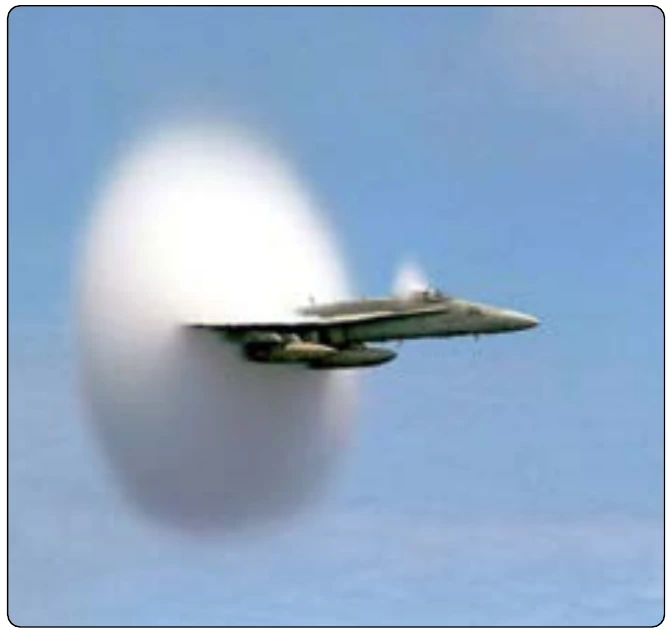
Dew Point
The dew point is the temperature to which humid air must be cooled at constant pressure to become saturated. If the temperature drops below the dew point, condensation occurs. People who wear eyeglasses have experience going from cold outside air into a warm room and having moisture collect quickly on their glasses. This happens because the glasses were below the dew point temperature of the air in the room. The air immediately in contact with the glasses was cooled below its dew point temperature, and some of the water vapor was condensed out. This principle is applied in determining the dew point. A vessel is cooled until water vapor begins to condense on its surface. The temperature at which this occurs is the dew point.
Vapor Pressure
Vapor pressure is the portion of atmospheric pressure that is exerted by the moisture in the air, which is expressed in tenths of an inch of mercury. The dew point for a given condition depends on the amount of water pressure present; thus, a direct relationship exists between the vapor pressure and the dew point.
Standard Atmosphere
If the performance of an aircraft is computed, either through flight tests or wind tunnel tests, some standard reference condition must be determined first in order to compare results with those of similar tests. The conditions in the atmosphere vary continuously, and it is generally not possible to obtain exactly the same set of conditions on two different days or even on two successive flights. For this reason, a set group of standards must be used as a point of reference. The set of standard conditions presently used in the United States is known as the U.S. Standard Atmosphere.
The standard atmosphere approximates the average conditions existing at 40° latitude, and is determined on the basis of the following assumptions. The standard sea level conditions are:
The U.S. Standard Atmosphere is in agreement with the International Civil Aviation Organization (ICAO) Standard Atmosphere over their common altitude range. The ICAO Standard Atmosphere has been adopted as standard by most of the principal nations of the world.
Aircraft Theory of Flight
Before a technician can consider performing maintenance on an aircraft, it is necessary to understand the pieces that make up the aircraft. Names like fuselage, empennage, wing, and so many others, come into play when describing what an airplane is and how it operates. For helicopters, names like main rotor, anti-torque rotor, and autorotation come to mind as a small portion of what needs to be understood about rotorcraft. The study of physics, which includes basic aerodynamics, is a necessary part of understanding why aircraft operate the way they do.
Four Forces of Flight
During flight, there are four forces acting on an airplane. These forces are lift, weight, thrust, and drag. [Figure 5-53] Lift is the upward force created by the wing, weight is the pull of gravity on the mass, thrust is the force created by the airplane’s propeller or turbine engine, and drag is the friction caused by the air flowing around the airplane.
All four of these forces are measured in pounds. Any time the forces are not in balance, something about the airplane’s condition is changing. The possibilities are as follows:
- When an airplane is accelerating, it has more thrust than drag.
- When an airplane is decelerating, it has less thrust than drag.
- When an airplane is at a constant velocity, thrust and drag are equal.
- When an airplane is climbing, it has more lift than weight.
- When an airplane is descending, it has more weight than lift.
- When an airplane is at a constant altitude, lift and weight are equal.
Bernoulli’s Principle and Subsonic Flow
The basic concept of subsonic airflow and the resulting pressure differentials was discovered by Daniel Bernoulli, a Swiss physicist. Bernoulli’s principle, as we refer to it today, states that “as the velocity of a fluid increases, the static pressure of that fluid will decrease, provided there is no energy added or energy taken away.” A direct application of Bernoulli’s principle is the study of air as it flows through either a converging or a diverging passage, and to relate the findings to some aviation concepts.
A converging shape is one whose cross-sectional area gets progressively smaller from entry to exit. A diverging shape is just the opposite, with the cross-sectional area getting larger from entry to exit. Figure 5-54 shows a converging shaped duct, with the air entering on the left at subsonic velocity and exiting on the right. Notice that the air exits at an increased velocity and a decreased static pressure when looking at the pressure and velocity gauges, and the indicated velocity and pressure. The unit leaving must increase its velocity as it flows into a smaller space, because a unit of air must exit the duct when another unit enters.