
Chapter 5
Physics for Aviation
The ailerons move as a result of the pilot rotating the control wheel to the left or to the right, much the same as turning the steering wheel on an automobile. [Figure 5-68] When a pilot turns the control wheel to the left, the airplane is being asked to turn or bank to the left. Turning the control wheel to the left causes the trailing edge of the aileron on the left wing to lowers down into the airstream. This increases the lift on the right wing and decreases the lift on the left wing, causing the right wing to move up and the airplane to bank to the left.
In Figure 5-69, an aircraft can be seen doing an aileron roll. Notice that the left aileron is up and the right aileron is down, which would cause the airplane to roll around the longitudinal axis in a counterclockwise direction.
Flight Controls and the Vertical Axis
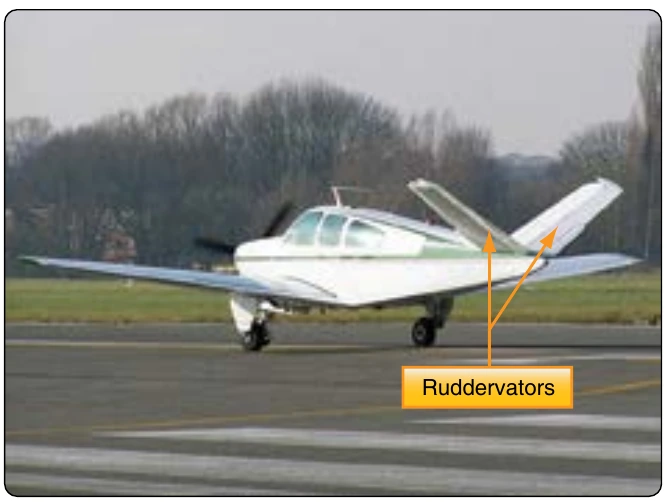
The vertical axis of an airplane runs from top to bottom through the middle of the airplane, passing through the center of gravity. Movement around this axis is known as yaw, and control around this axis is called directional control. Movement around this axis is controlled by the rudder, or in the case of the Beechcraft Bonanza in Figure 5-67, by the ruddervators.
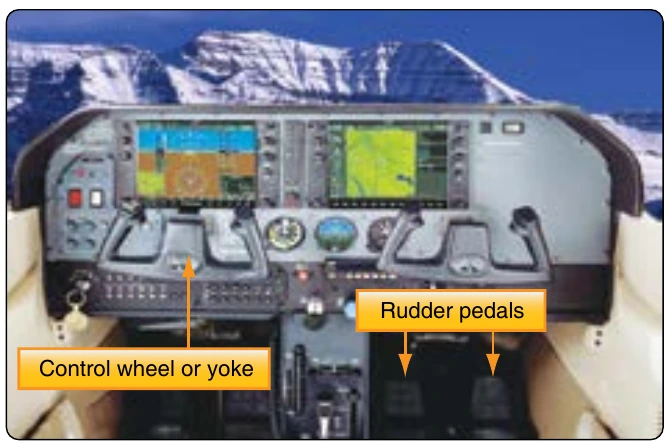
The feet of the pilot are on the rudder pedals, and pushing on the left or right rudder pedal makes the rudder move left or right. The trailing edge of the rudder moves to the right, and the nose of the airplane yaws to the right, when the right rudder pedal is pushed. The rudder pedals of a Cessna 182 can be seen in Figure 5-68.
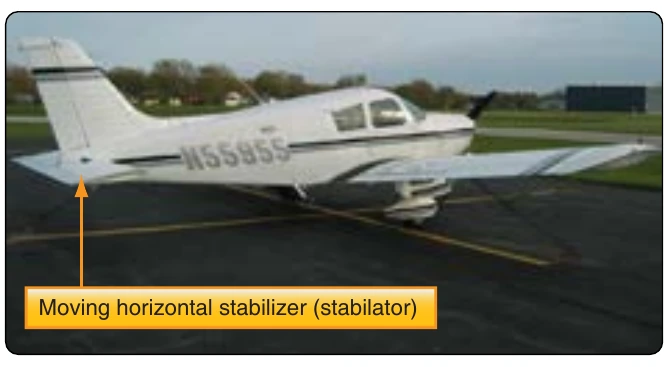
Even though the rudder of the airplane will make the nose the ailerons and rudder come into play. Let’s say we want to turn the airplane to the right. We start by turning the control wheel to the right, which raises the right aileron and lowers the left aileron and initiates the banking turn. The increased lift on the left wing also increases the induced drag on the left wing, which tries to make the nose of the airplane yaw to the left. To counteract this, when the control wheel is moved to the right, a small amount of right rudder is used to keep the nose of the airplane from yawing to the left. Once the nose of the airplane is pointing in the right direction, pressure on the rudder is no longer needed. The rudder of a Piper Cherokee Arrow can be seen in Figure 5-70.
Tabs
Trim Tabs
Trim tabs are small movable surfaces that attach to the trailing edge of flight controls. These tabs can be controlled from the flight deck, and their purpose is to create an aerodynamic force that keeps the flight control in a deflected position. Trim is the elevator. In order to be stable in flight, most airplanes have the center of gravity located forward of the center of lift on the wing. This causes a nose heavy condition, which needs to be balanced out by having the elevator deflect upwards and create a downward force. To relieve the pilot of the need to hold back pressure on the control wheel, a trim tab on the elevator can be adjusted to hold the elevator in a slightly deflected position. An elevator trim tab for a Cessna 182 is shown in Figure 5-71.
Anti-servo Tab
Some airplanes, like a Piper Cherokee Arrow, do not have a fixed horizontal stabilizer and movable elevator. The Cherokee uses a moving horizontal surface known as a stabilator. Because of the location of the pivot point for this movable surface, it has a tendency to be extremely sensitive to pilot input. To reduce the sensitivity, a full length anti-servo tab is installed on the trailing edge of the stabilator. As the trailing edge of the stabilator moves down, the anti-servo tab moves down and creates a force trying to raise the trailing edge. With this force acting against the movement of the stabilator, it reduces the sensitivity to pilot input. The anti-servo tab on a Piper Cherokee Arrow is shown in Figure 5-70.
Balance Tab
On some airplanes, the force needed to move the flight controls can be excessive. In these cases, a balance tab can be used to generate a force that assists in the movement of the flight control. Just the opposite of anti-servo tabs, balance tabs move in the opposite direction of the flight control’s trailing edge, providing a force that helps the flight control move.