
Chapter 5
Physics for Aviation
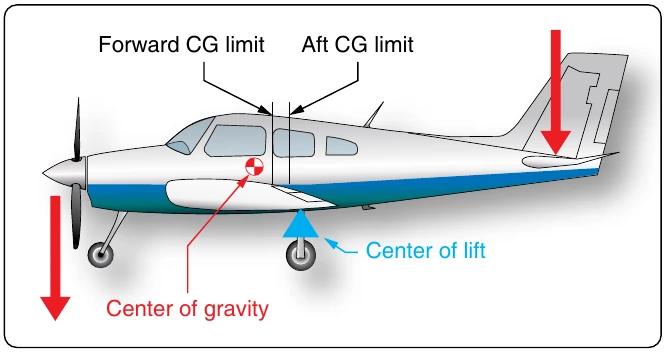
In Figure 5-62, the center of lift, center of gravity, and center of gravity limits are shown. It can be seen that the center of gravity is not only forward of the center of lift, it is also forward of the center of gravity limit. At the back of the airplane, the elevator trailing edge is deflected upward to create a downward force on the tail, to try and keep the nose vity. The flight control that produces motion around the indicated of the airplane up. This airplane would be highly unstable longitudinally, especially at low speed when trying to land. It is especially dangerous if the center of gravity is behind the aft limit. The airplane will now have a tendency to pitch noseup, which can lead to the wing stalling and possible loss of control of the airplane.
Lateral Stability
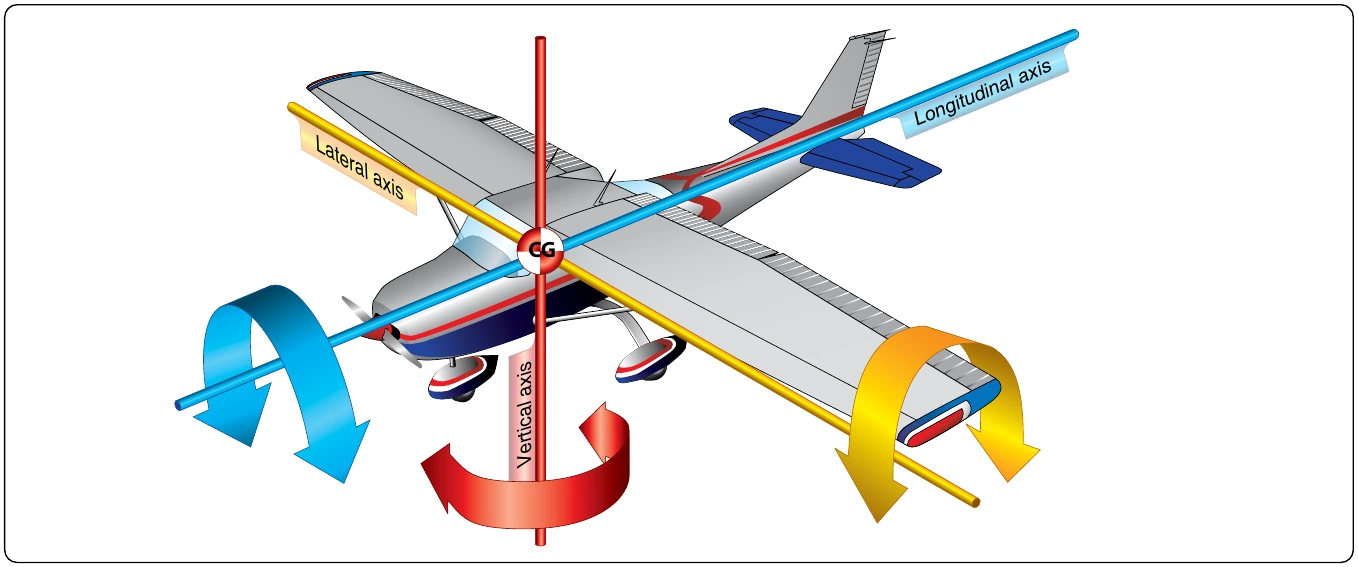
Lateral stability of an airplane takes place around the longitudinal axis, which is from the airplane’s nose to its tail. If one wing is lower than the other, good lateral stability will tend to bring the wings back to a level flight attitude. One design characteristic that tends to give an airplane good lateral stability is called dihedral. Dihedral is an upward wing angle, with respect to the horizontal, and it is usually just a few degrees.
Imagine a low wing airplane with a few degrees of dihedral experiencing a disruption of its flightpath such that the left wing drops. When the left wing drops, this will cause the airplane to experience a sideslip toward the low wing. The sideslip causes the low wing to experience a higher angle of attack, which increases its lift and raises it back to a level flight attitude. The dihedral on a wing is shown in Figure 5-63.
Directional Stability
Movement of the airplane around its vertical axis, and the airplane’s ability to not be adversely affected by a force creating a yaw type of motion, is called directional stability. The vertical fin gives the airplane this stability, causing the airplane to align with the relative wind. In flight, the airplane acts like the weather vane we use around our home to show the direction the wind is blowing. The distance from the pivot point on a weather vane to its tail is greater than the distance from its pivot point to the nose. So, when the wind blows, it creates a greater torque force on the tail and forces it to align with the wind. On an airplane, the same is true. With the CG being the pivot point, it is a greater distance from the CG to the vertical stabilizer than it is from the CG to the nose. [Figure 5-64]
Dutch Roll
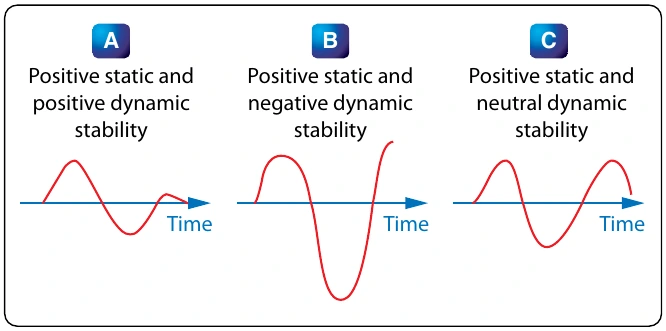
The dihedral of the wing tries to roll the airplane in the opposite direction of how it is slipping, and the vertical fin will try to yaw the airplane in the direction of the slip. These two events combine in a way that affects lateral and directional stability. If the wing dihedral has the greatest effect, the airplane will have a tendency to experience a Dutch roll. A Dutch roll is a small amount of oscillation around both the longitudinal and vertical axes. Although this condition is not considered dangerous, it can produce an uncomfortable feeling for passengers. Commercial airliners typically have yaw dampers that sense a Dutch roll condition and cancel it out.
Flight Control Surfaces
The purpose of flight controls is to allow the pilot to maneuver the airplane, and to control it from the time it starts the takeoff roll until it lands and safely comes to a halt. Flight controls are typically associated with the wing and the vertical and horizontal stabilizers, because these are the parts of the airplane that flight controls most often attach to. In flight, and to some extent on the ground, flight controls provide the airplane with the ability to move around one or more of the three axes. Flight controls function by changing the shape or aerodynamic characteristics of the surface they are attached to.
Flight Controls & the Lateral Axis
The lateral axis of an airplane is a line that runs below the wing, from wingtip to wingtip, passing through the airplane’s center of gravity. Movement around this axis is called pitch, and control around this axis is called longitudinal control. The flight control that handles this job is the elevator attached to the horizontal stabilizer, a fully moving horizontal stabilizer, or on a v-tail configured airplane, it is called ruddervators. An elevator on a Cessna 182 can be seen in Figure 5-65. In Figure 5-66, a fully moving horizontal stabilizer, known as a stabilator, can be seen on a Piper Cherokee Cruiser PA-28-140, and Figure 5-67 shows a ruddervator on a Beechcraft Bonanza. Depending on the airplane being discussed, movement around the lateral axis happens as a result of the pilot moving the control wheel or yoke, the control stick, or on some airplanes, a side stick. On the airplanes shown in Figures 5-70 and 5-71, a control wheel or yoke is used.
On the Cessna 182 shown in Figure 5-65, pulling back on the control wheel causes the trailing edge of the elevator to deflect upward, causing an increased downward force that raises the nose of the airplane. Movement of the elevator causes the nose of the airplane to pitch up or pitch down by rotating around the lateral axis. The Cessna 182 control wheel can be seen in Figure 5-68.
On the Piper Cherokee Cruiser PA-28-140 shown in Figure 5-66, pulling back on the control wheel causes the entire horizontal surface, or stabilator, to move, with the trailing edge deflecting upward. The anti-servo tab seen on the Cherokee provides a control feel similar to what would be experienced by moving an elevator. Without this tab, the stabilator might be too easy to move and a pilot could overcontrol the airplane.
The ruddervators shown on the Beechcraft Bonanza in Figure 5-67 are also moved by the control wheel, with their trailing edges deflecting upward when the control wheel is pulled back. As the name implies, these surfaces also act as the rudder for this airplane.
Flight Controls and the Longitudinal Axis
The longitudinal axis of the airplane runs through the middle of the airplane, from nose to tail, passing through the center of gravity. Movement around this axis is known as roll, and control around this axis is called lateral control. Movement around this axis is controlled by the ailerons, and on jet transport airplanes, it is aided by surfaces on the wing known as spoilers.