
Chapter 5
Physics for Aviation
Wingtip vortices are caused by the air beneath the wing, which is at the higher pressure, flowing over the wingtip and up toward the top of the wing. The end result is a spiral or vortex that trails behind the wingtip anytime lift is being produced. This vortex is also referred to as wake turbulence, and is a significant factor in determining how closely one airplane can follow behind another on approach to land. The wake turbulence of a large airplane can cause a smaller airplane, if it is following too closely, to be thrown out of control. Vortices from the wing and from the horizontal stabilizer are quite visible on the MD-11 shown in Figure 5-59.
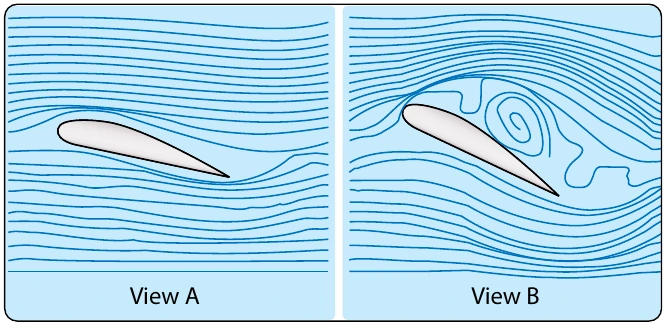
Upwash and downwash refer to the effect an airfoil has on the free airstream. Upwash is the deflection of the oncoming airstream, causing it to flow up and over the wing. Downwash is the downward deflection of the airstream after it has passed over the wing and is leaving the trailing edge. This downward deflection is what creates the action and reaction described under lift and Newton’s third law.
Axes of an Aircraft
An airplane in flight is controlled around one or more of three axes of rotation. These axes of rotation are the longitudinal, lateral, and vertical. On the airplane, all three axes intersect at the center of gravity. As the airplane pivots on one of these axes, it is in essence pivoting around the center of gravity (CG).
The center of gravity is also referred to as the center of rotation.
On the brightly colored airplane shown in Figure 5-60, the three axes are shown in the colors red (vertical axis), blue (longitudinal axis), and orange (lateral axis). The flight control that makes the airplane move around the axis is shown in a matching color.
The rudder, in red, causes the airplane to move around the vertical axis and this movement is described as being a yaw. The elevator, in orange, causes the airplane to move around the lateral axis and this movement is described as being a pitch. The ailerons, in blue, cause the airplane to move around the longitudinal axis and this movement is described as being a roll.
Aircraft Stability
When an airplane is in straight-and-level flight at a constant velocity, all the forces acting on the airplane are in equilibrium. If that straight-and-level flight is disrupted by a disturbance in the air, such as wake turbulence, the airplane might pitch up or down, yaw left or right, or go into a roll. If the airplane has what is characterized as stability, once the disturbance goes away, the airplane will return to a state of equilibrium.
Static Stability
The initial response that an airplane displays after its equilibrium is disrupted is referred to as its static stability. If the static stability is positive, the airplane will tend to return to its original position after the disruptive force is removed. If the static stability is negative, the airplane will continue to move away from its original position after the disruptive force is removed. If an airplane with negative static stability has the nose pitch up because of wake turbulence, the tendency will be for the nose to continue to pitch up even after the turbulence goes away. If an airplane tends to remain in a displaced position after the force is removed, but does not continue to move toward even greater displacement, its static stability is described as being neutral.
Dynamic Stability
The dynamic stability of an airplane involves the amount of time it takes for it to react to its static stability after it has been displaced from a condition of equilibrium. Dynamic stability involves the oscillations that typically occur as the airplane tries to return to its original position or attitude. Even though an airplane may have positive static stability, it may have dynamic stability which is positive, neutral, or negative.
Imagine that an airplane in straight-and-level flight is disturbed and pitches noseup. If the airplane has positive static stability, the nose will pitch back down after the disturbance is removed. If it immediately returns to straight-process by pitching back up. This pitching up and then down is known as an oscillation. If the oscillations lessen over time, the airplane is still classified as having positive dynamic stability. If the oscillations increase over time, the airplane is classified as having negative dynamic stability. If the oscillations remain the same over time, the airplane is classified as having neutral dynamic stability.
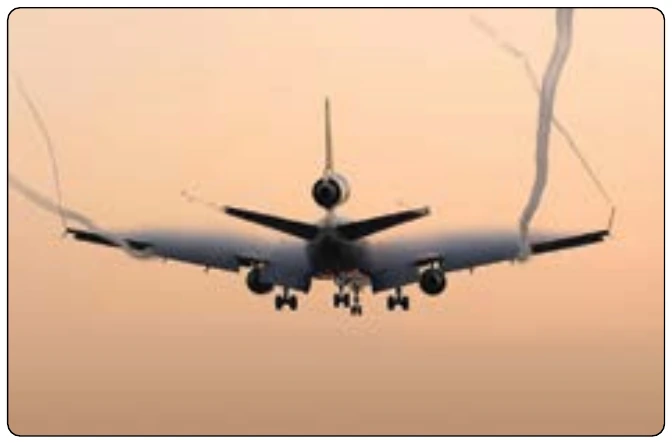
Figure 5-61 shows the concept of dynamic stability. In view A, the displacement from equilibrium goes through three oscillations and then returns to equilibrium. In view B, the displacement from equilibrium is increasing after two oscillations, and will not return to equilibrium. In view C, the displacement from equilibrium is staying the same with each oscillation.
Longitudinal Stability
Longitudinal stability for an airplane involves the tendency for the nose to pitch up or pitch down, rotating around the lateral axis, which is measured from wingtip to wingtip. If an airplane is longitudinally stable, it will return to a properly trimmed angle of attack after the force that upset its flightpath is removed.
The weight and balance of an airplane, which is based on both the design characteristics of the airplane and the way it is loaded, is a major factor in determining longitudinal stability. There is a point on the wing of an airplane, called the center of pressure or center of lift, where all the lifting forces concentrate. In flight, the airplane acts like it is being lifted from or supported by this point. This center of lift runs from wingtip to wingtip. There is also a point on the airplane, called the center of gravity, where the mass or weight of the airplane is concentrated. For an airplane to have good longitudinal stability, the center of gravity is typically located forward of the center of lift. This gives the airplane a nosedown pitching tendency, which is balanced out by the force generated at the horizontal stabilizer and elevator. The center of gravity has limits within which it must fall. If it is too far forward, the forces at the tail might not be able to compensate and it may not be possible to keep the nose of the airplane from pitching down.